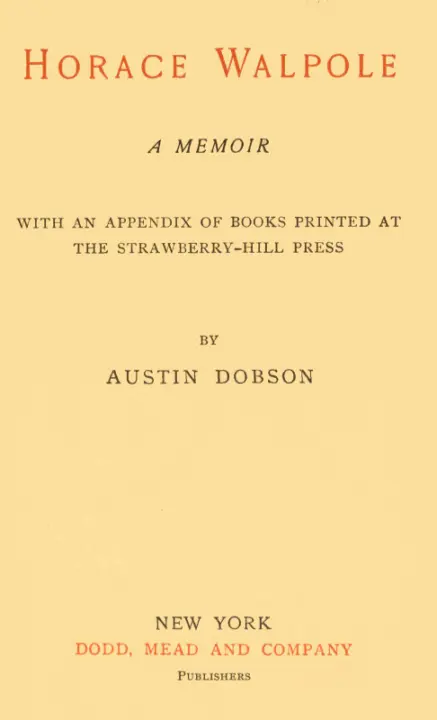
Horace Walpole: A memoir With an appendix of books printed at the Strawberry Hill Press
Austin Dobson
THE CLASSIC COLLECTION · 1895
"Collected Poems in Two Volumes, Vol. II" by Austin Dobson is a collection of poetry written in the late 19th century. This volume showcases a variety of lyrical poems that explore themes such as love, nostalgia, nature, and the passage of time, reflecting a keen observation of the world and a rich emotional landscape. The verses include ballads and more structured forms, often characterized by a light, playful tone mixed with deeper philosophical reflections. The opening of the collection presents a distinctly whimsical tone, beginning with the poem "At the Sign of the Lyre," where the poet welcomes readers to enjoy a selection of songs and ballads, promising pleasure and engagement with the lyrical form. The subsequent pieces, starting with "The Ladies of St. James's," juxtapose the charm of rustic beauty, embodied in the character Phyllida, with the artificiality of high society. Using vivid imagery and accessible language, the poems invite readers into scenes that are both relatable and richly decorated with emotional depth, setting the stage for the diverse themes and styles that Dobson employs throughout the volume.
Introduction adapted from the source catalogue; source summaries may be automatically generated.
Free to read · English · 30,546 words · No account needed
MAKE TIME FOR A GOOD BOOK
On by default. Untick to stop anonymous reading totals. Each page counts after 10 seconds in view. How this works.
Anonymous counting is on unless you have switched it off.
"Have I not writ thy Laws?"--Page 93.
The lines in italic type which follow, are freely paraphrased from the ancient Code d' Amour of the XIIth Century, as given by Andre le Chapelain himself.
A DIALOGUE, ETC.--Page 107.
This dialogue, first printed in Scribner's Magazine for May, 1888, was afterwards read by Professor Henry Morley at the opening of the Pope Loan Museum at Twickenham (July 31st), to the Catalogue of which exhibition it was prefixed.
"The 'crooked Body with a crooked Mind.'"--Page 108.
"Mens curva in corpore curvo."
Said of Pope by Lord Orrery.
"Neither as Locke was, nor as Blake."--Page 115.
The Shire Hall at Taunton, where these verses were read at the unveiling, by Mr. James Russell Lowell, of Miss Margaret Thomas's bust of Fielding, September 4th, 1883, also contains busts of Admiral Blake and John Locke.
"The Journal of his middle-age."--Page 118.
It is, perhaps, needless to say that the reference here is to the Journal of a Voyage to Lisbon, published posthumously in February, 1755,--a record which for its intrinsic pathos and dignity may be compared with the letter and dedication which Fielding's predecessor and model, Cervantes, prefixed to his last romance of Persiles and Sigismunda.
CHARLES GEORGE GORDON.--Page 120.
These verses appeared in the Saturday Review for February 14th, 1885.
ALFRED, LORD TENNYSON.--Page 122.
These verses appeared in the Athenaeum for October 8th, 1892.
"With that he made a Leg."--Page 137.
"JOVE made his Leg and kiss'd the Dame,
Obsequious HERMES did the Same."
Prior.
"So took his Virtu off to Cock's."--Page 137.
Cock, the auctioneer of Covent Garden, was the Christie and Manson of the last century. The leading idea of this fable, it should be added, is taken from one by Gellert.
"Of Van's 'Goose-Pie.'"--Page 139.
"At length they in the Rubbish spy
A Thing resembling a Goose Py."
SWIFT'S verses on Vanbrugh's House, 1706.
"The Oaf preferred the 'Tongs and Bones.'"--Page 145.
"I have a reasonable good ear in music; let us have the tongs and the
bones."
Midsummer-Night's Dream, Act iv., Sc. i.
"And sighed o'er Chaos wine for Stingo."--Page 145.
Squire Homespun probably meant Cahors.
THE WATER-CURE.--Page 178.
These verses were suggested by the recollection of an anecdote in Madame de Genlis, which seemed to lend itself to eighteenth-century treatment. It was therefore somewhat depressing, not long after they were written, to find that the subject had already been annexed in the Tatler by an actual eighteenth-century writer, who, moreover, claimed to have founded his story on a contemporary incident. Burton, nevertheless, had told it before him, as early as 1621, in the Anatomy of Melancholy.
"In Babylonian numbers hidden."--Page 180.
"--nec Babylonios
Tentaris numeros."
Hor. i., 11.
Your reading position is saved on this browser. Take it to another device with a library code. Reading pages adapt to text, rather than matching a printed edition.
Austin Dobson
Austin Dobson
Austin Dobson
Austin Dobson
BEHIND THE BOOK
This eBook is for the use of anyone anywhere in the United States and most other parts of the world at no cost and with almost no restrictions whatsoever. You may copy it, give it away or re-use it under the terms of the Project Gutenberg License included with this eBook or online at www.gutenberg.org. If you are not located in the United States, you will have to check the laws of the country where you are located before using this eBook. Read the source licence.
The original source file, including credits and licence, is retained by this library. Request an original-format copy at no charge. Please include the book title and Project Gutenberg identifier #24334.
KEEP YOUR CURIOSITY GOING

Eric Mackay
Edmund Gosse
Sophia Margaretta Hensley
Gilbert Parker
George MacDonald

Elizabeth Bibesco