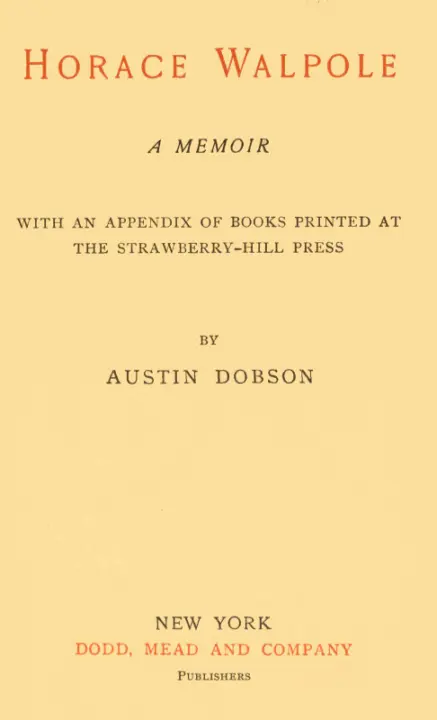
Horace Walpole: A memoir With an appendix of books printed at the Strawberry Hill Press
Austin Dobson
THE CLASSIC COLLECTION · 1895
"Collected Poems in Two Volumes, Vol. II" by Austin Dobson is a collection of poetry written in the late 19th century. This volume showcases a variety of lyrical poems that explore themes such as love, nostalgia, nature, and the passage of time, reflecting a keen observation of the world and a rich emotional landscape. The verses include ballads and more structured forms, often characterized by a light, playful tone mixed with deeper philosophical reflections. The opening of the collection presents a distinctly whimsical tone, beginning with the poem "At the Sign of the Lyre," where the poet welcomes readers to enjoy a selection of songs and ballads, promising pleasure and engagement with the lyrical form. The subsequent pieces, starting with "The Ladies of St. James's," juxtapose the charm of rustic beauty, embodied in the character Phyllida, with the artificiality of high society. Using vivid imagery and accessible language, the poems invite readers into scenes that are both relatable and richly decorated with emotional depth, setting the stage for the diverse themes and styles that Dobson employs throughout the volume.
Introduction adapted from the source catalogue; source summaries may be automatically generated.
Free to read · English · 30,546 words · No account needed
MAKE TIME FOR A GOOD BOOK
On by default. Untick to stop anonymous reading totals. Each page counts after 10 seconds in view. How this works.
Anonymous counting is on unless you have switched it off.
According to Mrs. Carter (Smith's Nollekens, 1828, i. 211), when Garrick acted, the hackney-chairs often stood "all round the Piazzas [Covent Garden], down Southampton-Street, and extended more than half-way along Maiden-Lane."
"A skill Preville could not disown."--Page 23.
Preville was the French Foote, circa 1760. His gifts as a comedian were of the highest order; and he had an extraordinary faculty for identifying himself with the parts he played. Sterne, in a letter to Garrick from Paris, in 1762, calls him "Mercury himself."
MOLLY TREFUSIS.--Page 32.
The epigram here quoted from "an old magazine" is to be found in the late Lord Neaves's admirable little volume, The Greek Anthology (Blackwood's Ancient Classics for English Readers). Those familiar with eighteenth-century literature will recognize in the succeeding verses but another echo of those lively stanzas of John Gay to "Molly Mogg of the Rose," which found so many imitators in his own day. Whether my heroine is to be identified with a certain "Miss Trefusis," whose Poems are sometimes to be found in the second-hand booksellers' catalogues, I know not. But if she is, I trust I have done her accomplished shade no wrong.
AN EASTERN APOLOGUE.--Page 43.
The initials "E. H. P." are those of the late eminent (and ill-fated) Orientalist, Professor Palmer. As my lines entirely owed their origin to his translations of Zoheir, I sent them to him. He was indulgent enough to praise them warmly. It is true he found anachronisms; but as he said these would cause no disturbance to orthodox Persians, I concluded I had succeeded in my little pastiche, and, with his permission, inscribed it to him. I wish now that it had been a more worthy tribute to one of the most erudite and versatile scholars this age has seen.
A REVOLUTIONARY RELIC.--Page 48.
"373. St. Pierre (Bernardin de), Paul et Virginie, 12mo, old calf. Paris, 1787. This copy is pierced throughout by a bullet-hole, and bears on one of the covers the words: 'a Lucile St. A.... chez M. Batemans, a Edmonds-Bury, en Angleterre,' very faintly written in pencil." (Extract from Catalogue.)
"Did she wander like that other?"--Page 50.
Lucile Desmoulins. See Carlyle's French Revolution, Vol. iii. Book vi.
Chap. ii.
"And its tender rain shall lave it."--Page 52.
It is by no means uncommon for an editor to interrupt some of these revolutionary letters by a "Here there are traces of tears."
"By 'Bysshe,' his epithet."--Page 81.
i.e. The Art of English Poetry, by Edward Bysshe, 1702.
THE BOOK-PLATE'S PETITION.--Page 87.
These lines were reprinted from Notes and Queries in Mr. Andrew Lang's instructive volume The Library, 1881, where the curious will find full information as to the enormities of the book-mutilators.
Your reading position is saved on this browser. Take it to another device with a library code. Reading pages adapt to text, rather than matching a printed edition.
Austin Dobson
Austin Dobson
Austin Dobson
Austin Dobson
BEHIND THE BOOK
This eBook is for the use of anyone anywhere in the United States and most other parts of the world at no cost and with almost no restrictions whatsoever. You may copy it, give it away or re-use it under the terms of the Project Gutenberg License included with this eBook or online at www.gutenberg.org. If you are not located in the United States, you will have to check the laws of the country where you are located before using this eBook. Read the source licence.
The original source file, including credits and licence, is retained by this library. Request an original-format copy at no charge. Please include the book title and Project Gutenberg identifier #24334.
KEEP YOUR CURIOSITY GOING

Eric Mackay
Edmund Gosse
Sophia Margaretta Hensley
Gilbert Parker
George MacDonald

Elizabeth Bibesco