THE CLASSIC COLLECTION✦A dead man’s diaryCLASSIC FREE BOOKS
A dead man’s diary
Coulson Kernahan
THE CLASSIC COLLECTION · 1889
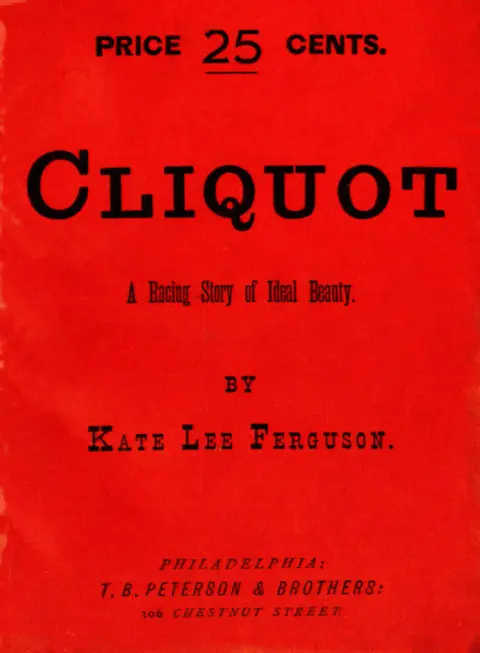
"Cliquot: A Racing Story of Ideal Beauty" by Kate Lee Ferguson is a romance novel likely written in the late 19th century. The story revolves around Neil Emory, a man with a troubled past, and his deep affections for Gwendoline Gwinn, juxtaposed against the backdrop of horse racing and a particularly dangerous stallion named Cliquot. As the plot unfolds, themes of love, ambition, and societal expectations are woven into a tapestry that includes elements of both personal struggle and the thrill of the racetrack. The opening of "Cliquot" introduces a riveting incident on the racetrack, where another jockey has been killed due to the violent behavior of the powerful stallion, Cliquot. Neil Emory, the horse's owner, grapples with the implications of this tragedy as he contemplates finding a new rider amidst a chaotic environment. The scene vividly depicts the tension and excitement of the racing world, while also hinting at Neil's complex emotions regarding his past and his feelings for Gwendoline. He is determined to win the upcoming race, not just for the financial stakes but also for personal redemption. The introduction sets the tone for a narrative rich in passionate love, fierce ambition, and the dangers of the sporting life.
Introduction adapted from the source catalogue; source summaries may be automatically generated.
Free to read · English · 37,818 words · No account needed
MAKE TIME FOR A GOOD BOOK
On by default. Untick to stop anonymous reading totals. Each page counts after 10 seconds in view. How this works.
Anonymous counting is on unless you have switched it off.
Like an arrow from a bow, swifter than a flying cloud, with heaving sides and quivering nostrils, the beautiful stallion rushes in to victory! He has cleared the string, leaving the other far behind, and, still galloping on, stops at length beyond the gate!
With difficulty his rider turns him towards the stand. Cliquot knows he has won. Rearing slightly and fretting a little, he is almost beyond the control of the exhausted jockey.
Near the fence, inside the field, Clovis had drawn her team, and one of the mares threw up her head at the approach of the stallion. He caught the restless movement, and, with a long, low, quivering neigh, reared high in air, cleared the fence with a bound, and dashed towards the mare, while his rider slid from his seat into the dust.
In a moment twenty hands caught the horses attached to the carriage; but Cliquot tore away, snorting and wheeling to look back as he ran.
Emory, who had witnessed all, hastened forward, and was about to lift the fallen jockey when the boy sprang to his feet, apparently unhurt. The blacksmith, who seemed always at hand, reached him; but, just as they were about to walk away, the boy sank upon his knees and covered his face with his hands.
“He is injured!” said Emory, who lingered by. “Where are you hurt?” he asked, putting his hand on the boy’s shoulder.
A low moan was the only answer.
“Call my carriage! Quick, Peleg!” Emory said, pointing across the field.
The boy did not stir or remove his hands till the conveyance drew up, and then, as Emory took him in his arms, he uttered a low cry and fainted, yes, fainted dead away, and Neil struggled into the carriage with his burden.
“Run for some water,” he said, turning to the man behind him. He sped off, and when he returned the gentleman was kneeling on the floor of the carriage, gazing like one bereft of his senses at the still, upturned face and its wealth of bronze-colored hair. It was the beautiful face of Gwendoline Gwinn!
“Come away, for God’s sake, come away, sir, before she recognizes you!” cried the blacksmith, pulling him from the vehicle.
Emory allowed himself to be dragged out, and before he could say a word the door was slammed and the carriage gone.
“Only a faint, thank God!” thought Peleg, as he picked up Gwendoline’s wig from where it had fallen when she was laid in the carriage. “She shan’t know from me that he found her out!” and he got her home safely, as he had often done before.
Your reading position is saved on this browser. Take it to another device with a library code. Reading pages adapt to text, rather than matching a printed edition.
BEHIND THE BOOK
This eBook is for the use of anyone anywhere in the United States and most other parts of the world at no cost and with almost no restrictions whatsoever. You may copy it, give it away or re-use it under the terms of the Project Gutenberg License included with this eBook or online at www.gutenberg.org. If you are not located in the United States, you will have to check the laws of the country where you are located before using this eBook. Read the source licence.
The original source file, including credits and licence, is retained by this library. Request an original-format copy at no charge. Please include the book title and Project Gutenberg identifier #66587.
KEEP YOUR CURIOSITY GOING
Coulson Kernahan

Maurice Baring
Frances Wright
Cécile Tormay

Frederic Jesup Stimson

W. H. P. (William Henry Pope) Jarvis