THE CLASSIC COLLECTION✦A dead man’s diaryCLASSIC FREE BOOKS
A dead man’s diary
Coulson Kernahan
THE CLASSIC COLLECTION · 1889
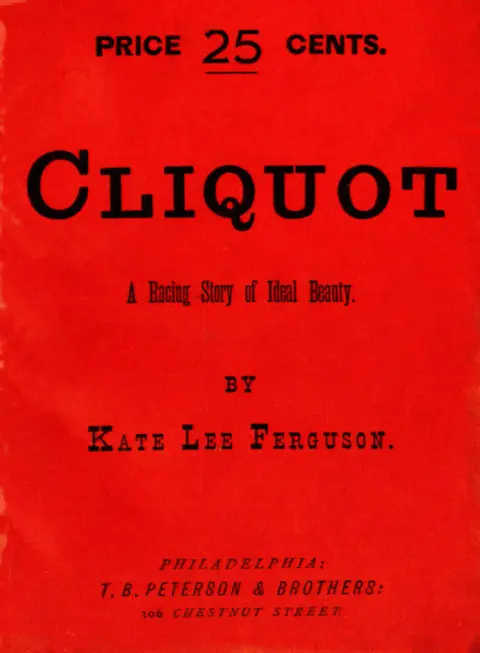
"Cliquot: A Racing Story of Ideal Beauty" by Kate Lee Ferguson is a romance novel likely written in the late 19th century. The story revolves around Neil Emory, a man with a troubled past, and his deep affections for Gwendoline Gwinn, juxtaposed against the backdrop of horse racing and a particularly dangerous stallion named Cliquot. As the plot unfolds, themes of love, ambition, and societal expectations are woven into a tapestry that includes elements of both personal struggle and the thrill of the racetrack. The opening of "Cliquot" introduces a riveting incident on the racetrack, where another jockey has been killed due to the violent behavior of the powerful stallion, Cliquot. Neil Emory, the horse's owner, grapples with the implications of this tragedy as he contemplates finding a new rider amidst a chaotic environment. The scene vividly depicts the tension and excitement of the racing world, while also hinting at Neil's complex emotions regarding his past and his feelings for Gwendoline. He is determined to win the upcoming race, not just for the financial stakes but also for personal redemption. The introduction sets the tone for a narrative rich in passionate love, fierce ambition, and the dangers of the sporting life.
Introduction adapted from the source catalogue; source summaries may be automatically generated.
Free to read · English · 37,818 words · No account needed
MAKE TIME FOR A GOOD BOOK
On by default. Untick to stop anonymous reading totals. Each page counts after 10 seconds in view. How this works.
Anonymous counting is on unless you have switched it off.
“Curse it!” he swore, harshly, “don’t give in, Jack! Hold the lad up! Here, give him this!” and he took a cup of brandy from the groom who was about to pour it on his horse’s back and put it to the lips of the boy, who, with a quick, low cry, broke away, dragging the blacksmith through the dust.
“Keep back!” yelled Jess. “He’s all right!”
The men and boys began to collect, and he could hardly get beyond the gate leading into the field.
“Mr. Emory, keep that crowd back,” he cried again, “or I’ll not answer for the consequences!” and Neil, pushing here and there, assisted by the police, dispersed the restless, curious stragglers of the race-course.
Peleg threw his arm around his half-exhausted companion and hurried him through the heat and dust to the shade, where an old buggy stood.
The track swarmed with people, and a hundred voices took up the cry:
“Cliquot wins! A thousand to one on Cliquot! Going, going, going, gone!”
“Pool, sir? Pool, sir, on Cliquot?” and the air was rent with the wild cries, oaths and bets on the stallion.
Thirty minutes, and again the bell sounded.
“Stop that accursed band!” yelled a big man, with five hundred on Bay Thomas, as that nag shot by in a mad bolt around the track.
A laugh from fifty mouths greeted him, as he went through the dust
roaring like a mad lion.
The bell again, and once more the horses move beyond the flag, all behaving pretty well. Cliquot’s rider is a little pale, but sitting quite at ease in his saddle. The blacksmith walks to the starting point, and, now and then, he and the boy speak to each other. This time there is no trouble about the start and they are off in a moment.
Round, as before, to the quarter-stretch; then, the black drops far
behind.
Only the two came thundering and panting on, and, when the string is reached, neck and neck are bay and stallion. On! together, on! How the dust flies and the sun pours down!
When opposite the stand, a hundred glasses are leveled at the horses, but not a shade of difference is seen in the speed of the two. Now they have reached the quarter-stretch. Bay Thomas’ rider uses his whip fast and quick. Cliquot’s carries no lash, but, with his slender knees pressed hard against his horse’s sides, with lips drawn tight above the clenched teeth, the red jockey swings around the curve, and, as he does so, leans over and, in a clear voice, cries:
“Up! up! there!”
Your reading position is saved on this browser. Take it to another device with a library code. Reading pages adapt to text, rather than matching a printed edition.
BEHIND THE BOOK
This eBook is for the use of anyone anywhere in the United States and most other parts of the world at no cost and with almost no restrictions whatsoever. You may copy it, give it away or re-use it under the terms of the Project Gutenberg License included with this eBook or online at www.gutenberg.org. If you are not located in the United States, you will have to check the laws of the country where you are located before using this eBook. Read the source licence.
The original source file, including credits and licence, is retained by this library. Request an original-format copy at no charge. Please include the book title and Project Gutenberg identifier #66587.
KEEP YOUR CURIOSITY GOING
Coulson Kernahan

Maurice Baring
Frances Wright
Cécile Tormay

Frederic Jesup Stimson

W. H. P. (William Henry Pope) Jarvis