
The Epic of Paul
William Cleaver Wilkinson
THE CLASSIC COLLECTION · 1886
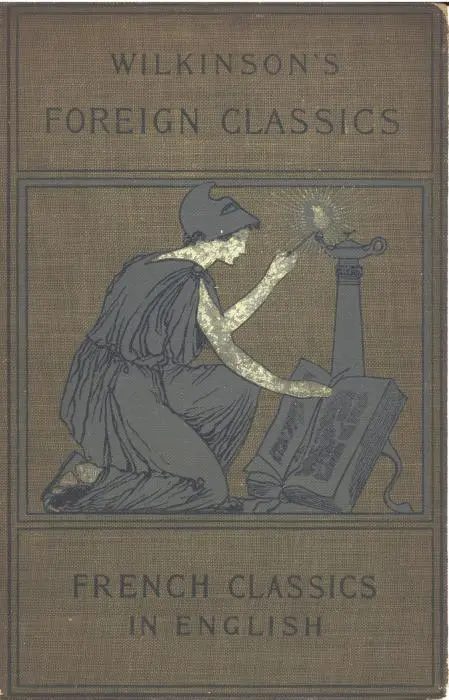
"Classic French Course in English" by William Cleaver Wilkinson is a literary guide published in the late 19th century. This work aims to introduce English-speaking readers to significant French literature, through selected extracts from notable authors, accompanied by critical insights and historical context. The book's intention is to foster appreciation for the richness of French literary tradition while providing a framework for understanding its major contributions. The opening of the text sets the stage by discussing the breadth and uniqueness of French literature, highlighting its brilliance and relevance across various fields, such as eloquence, philosophy, and comedy. Wilkinson emphasizes the particular challenges of compiling a coherent course on such a vast literature that continues to evolve. He lays the groundwork for future explorations of individual authors, suggesting that readers will gain a proportional and trustworthy understanding of French classics through selected extracts alongside authorial critiques, establishing the volume as a gateway to the appreciation of French cultural heritage.
Introduction adapted from the source catalogue; source summaries may be automatically generated.
Free to read · English · 79,104 words · No account needed
MAKE TIME FOR A GOOD BOOK
On by default. Untick to stop anonymous reading totals. Each page counts after 10 seconds in view. How this works.
Anonymous counting is on unless you have switched it off.
PROF. PHIL. The one you said,--"Fair Marchioness, your beautiful
eyes make me die of love."
M. JOUR. Yet I have never studied, and I did all right off at the
first shot.
The "Bourgeois Gentilhomme" is a very amusing comedy throughout.
From "Les Femmes Savantes" ("The Learned Women")--"The Blue-Stockings," we might perhaps freely render the title--we present one scene to indicate the nature of the comedy. There had grown to be a fashion in Paris, among certain women high in social rank, of pretending to the distinction of skill in literary criticism, and of proficiency in science. It was the Hotel de Rambouillet reduced to absurdity. That fashionable affectation Moliere made the subject of his comedy, "The Learned Women."
In the following extracts, Moliere satirizes, under the name of Trissotin, a contemporary writer, one Cotin. The poem which Trissotin reads for the learned women to criticise and admire, is an actual production of this gentleman. Imagine the domestic coterie assembled, and Trissotin, the poet, their guest. He is present, prepared to regale them with what he calls his sonnet. We need to explain that the original poem is thus inscribed: "To Mademoiselle de Longueville, now Duchess of Namur, on her Quartan Fever." The conceit of the sonneteer is that the fever is an enemy luxuriously lodged in the lovely person of its victim, and there insidiously plotting against her life:--
TRISSOTIN. Sonnet to the Princess Urania on her Fever, Your prudence sure is fast asleep, That thus luxuriously you keep And lodge magnificently so Your very hardest-hearted foe.
BELISE. Ah! what a pretty beginning!
ARMANDE. What a charming turn it has!
PHILAMINTE. He alone possesses the talent of making easy verses.
ARM. We must yield to prudence fast asleep.
BEL. Lodge one's very hardest-hearted foe is full of charms for
me.
PHIL. I like luxuriously and magnificently: these two adverbs joined together sound admirably.
BEL. Let us hear the rest.
TRISS. Your prudence sure is fast asleep, That thus luxuriously you keep And lodge magnificently so Your very hardest-hearted foe.
ARM. Prudence fast asleep.
BEL. To lodge one's foe.
PHIL. Luxuriously and magnificently.
TRISS. Drive forth that foe, whate'er men say, From out your chamber, decked so gay, Where, ingrate vile, with murderous knife, Bold she assails your lovely life.
BEL. Ah! gently. Allow me to breathe, I beseech you.
ARM.Give us time to admire, I beg.
PHIL. One feels, at hearing these verses, an indescribable something which goes through one's inmost soul, and makes one feel quite faint.
ARM. Drive forth that foe, whate'er men say, From out your chamber,
decked so gay--
Your reading position is saved on this browser. Take it to another device with a library code. Reading pages adapt to text, rather than matching a printed edition.
William Cleaver Wilkinson
William Cleaver Wilkinson
William Cleaver Wilkinson
BEHIND THE BOOK
This eBook is for the use of anyone anywhere in the United States and most other parts of the world at no cost and with almost no restrictions whatsoever. You may copy it, give it away or re-use it under the terms of the Project Gutenberg License included with this eBook or online at www.gutenberg.org. If you are not located in the United States, you will have to check the laws of the country where you are located before using this eBook. Read the source licence.
The original source file, including credits and licence, is retained by this library. Request an original-format copy at no charge. Please include the book title and Project Gutenberg identifier #23033.
KEEP YOUR CURIOSITY GOING
Cécile Tormay

Moritz Busch
John L. Ransom
Frances Wright
Cécile Tormay

Mabel Potter Daggett