THE CLASSIC COLLECTION✦An outlaw’s diary: the CommuneCLASSIC FREE BOOKS
An outlaw’s diary: the Commune
Cécile Tormay
THE CLASSIC COLLECTION · 1922
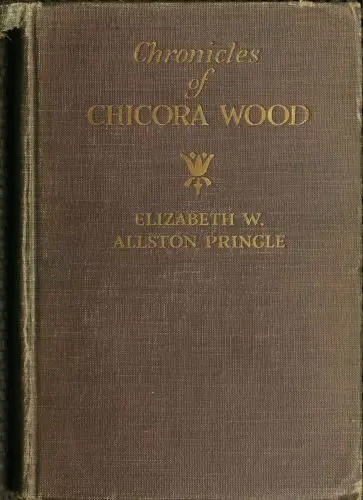
"Chronicles of Chicora Wood" by Elizabeth W. Allston Pringle is a memoir written in the early 20th century. The book provides a detailed account of the author's family and their plantation life in South Carolina, exploring themes of heritage, the passage of time, and the social complexities of the antebellum South. The narrative focuses on significant family members, particularly the author's father, Robert Francis Withers Allston, and reflects on both personal and historical challenges faced by the Allston family. The opening of the memoir introduces the reader to the author's contemplative and nostalgic perspective as she reflects on her family's legacy while seated on the piazza of Chicora Wood. Filled with vivid imagery of the natural surroundings and a deep sense of history, the author articulates a desire to preserve the memories of her ancestors and the beauty of their past. The first chapter delves into the lineage of the Allston family, emphasizing the struggles and triumphs of her father, a rice planter, as he navigates the complexities of land management, social responsibilities, and family legacy amidst the backdrop of a changing South. This rich narrative sets the stage for an exploration of the author's life and captivating family stories that lie ahead.
Introduction adapted from the source catalogue; source summaries may be automatically generated.
Free to read · English · 77,281 words · No account needed
MAKE TIME FOR A GOOD BOOK
On by default. Untick to stop anonymous reading totals. Each page counts after 10 seconds in view. How this works.
Anonymous counting is on unless you have switched it off.
Charley was a beautiful dancer, and very popular, and I am afraid something of a flirt, with his great, sleepy, hazel eyes, but he was most sedate as an escort, as solemn as a judge, and the girls minded his injunctions absolutely in all social matters, which was a great mercy, for the etiquette in their home towns was by no means as strict as that dictated by St. Cecilia standards.
Before the school term was over this spring I received an invitation from Mrs. David Williams, to spend two months with Serena and Mary at their farm near Staunton, Virginia, which I accepted with delight, and began the preparation at once for my summer outfit, which would have to be a little more elaborate than what I prepared for a summer at Plantersville. When the time came for leaving, my uncle Chancellor Lesesne took me to the station and put me on the train. He gave me many directions as to my conduct on the journey, as it was looked upon as a very hazardous departure from custom for me to make the journey alone; among other charges that he gave he said: “My dear niece, let nothing induce you to let a young man speak to you! It would be most improper to enter into conversation with any man, but the natural questions which you might have to ask of an official of the road, whom you will recognize by his uniform.” Then he bade me an affectionate and solemn farewell, which started me with a lump in my throat. The end of the eight months of teaching, not to speak of my other activities, always found me in a shattered condition. Toward the end of the last month the dropping of a slate startled me into disgraceful tears, which were almost impossible to stop. I used to be quite touched at the great care the girls took not to drop a book or even a pencil, and those who had annoyed me the most by their recklessness in this respect were the most careful now; this was wonderful, for I was awfully cross and irritable. After settling myself in my place, and getting out my book and fan and everything else I could possibly need, Uncle Henry’s words came to my mind with renewed force. I had insisted that I was not at all afraid, and would rather travel alone than waste two weeks of my good holiday and invitation, waiting until a party was going on to Virginia, who said they would take charge of me. But Uncle Henry had succeeded in making me feel that I was courting danger, disaster, and insult, and my strained nerves were delighted to seize and elaborate that theme, so that when we got to the place where I had to change cars for Staunton (I am not sure, but I think it was Alexandria), I got out and stood by my trunk (which had to be rechecked here) in perfect despair; a very nice-looking, gentlemanly young man came up and said: “Can I do anything for you?” With the last remnants of composure, I said, “No, thank you,” and watched him with dismay disappear into the car. At last the conductor came and stood a second at the door of the car and called: “All ’board!” I made a dart to the car, saying to myself, “Let the trunk go; I don’t care,” and got up the steps and into the car, to find not a seat, so I stood in the middle of the crowded car, with my heavy blue veil down to conceal the marks of agitation on my face, and my valise in my hand. Fortunately, the conductor rushed through, and I managed to say: “My trunk is out there.” In his great haste he looked where I pointed, rushed to the baggage-car and sent two men, who ran, seized the trunk, and pitched it aboard just as the train started. The conductor came back and asked me why under the sun I had not spoken to him before, “that it was a very near thing, and that if the trunk had been left there, in all probability it would never have been seen again, as things were pretty unsettled in these parts.” I was in no condition to enter into conversation; my throat ached so that when I tried to tell the man that I had not spoken to him because I had not seen him, he had trouble in understanding me. The rest of my journey was short, fortunately, and my hearty reception restored my equanimity, but it was some time before I had recovered my voice and spirits enough to be able to narrate all my experiences, to the great amusement of the party. I tell all this because it is hard to believe that such a state of things could have ever been possible, when we see the ease and aplomb with which very young girls move about the world, from end to end literally. But that was fifty-three years ago, and surely there is no one who would not say that we have made a wonderful advance in sense.
Your reading position is saved on this browser. Take it to another device with a library code. Reading pages adapt to text, rather than matching a printed edition.
BEHIND THE BOOK
This eBook is for the use of anyone anywhere in the United States and most other parts of the world at no cost and with almost no restrictions whatsoever. You may copy it, give it away or re-use it under the terms of the Project Gutenberg License included with this eBook or online at www.gutenberg.org. If you are not located in the United States, you will have to check the laws of the country where you are located before using this eBook. Read the source licence.
The original source file, including credits and licence, is retained by this library. Request an original-format copy at no charge. Please include the book title and Project Gutenberg identifier #56736.
KEEP YOUR CURIOSITY GOING
Cécile Tormay

Moritz Busch
John L. Ransom
Frances Wright
Cécile Tormay

Mabel Potter Daggett