THE CLASSIC COLLECTION✦An outlaw’s diary: the CommuneCLASSIC FREE BOOKS
An outlaw’s diary: the Commune
Cécile Tormay
THE CLASSIC COLLECTION · 1922
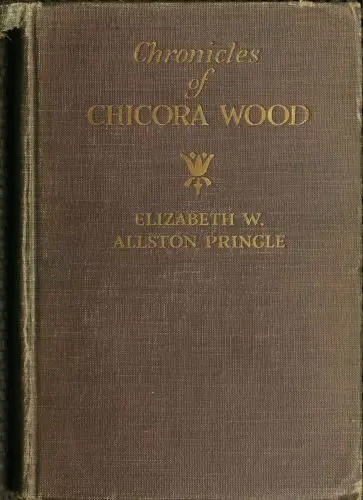
"Chronicles of Chicora Wood" by Elizabeth W. Allston Pringle is a memoir written in the early 20th century. The book provides a detailed account of the author's family and their plantation life in South Carolina, exploring themes of heritage, the passage of time, and the social complexities of the antebellum South. The narrative focuses on significant family members, particularly the author's father, Robert Francis Withers Allston, and reflects on both personal and historical challenges faced by the Allston family. The opening of the memoir introduces the reader to the author's contemplative and nostalgic perspective as she reflects on her family's legacy while seated on the piazza of Chicora Wood. Filled with vivid imagery of the natural surroundings and a deep sense of history, the author articulates a desire to preserve the memories of her ancestors and the beauty of their past. The first chapter delves into the lineage of the Allston family, emphasizing the struggles and triumphs of her father, a rice planter, as he navigates the complexities of land management, social responsibilities, and family legacy amidst the backdrop of a changing South. This rich narrative sets the stage for an exploration of the author's life and captivating family stories that lie ahead.
Introduction adapted from the source catalogue; source summaries may be automatically generated.
Free to read · English · 77,281 words · No account needed
MAKE TIME FOR A GOOD BOOK
On by default. Untick to stop anonymous reading totals. Each page counts after 10 seconds in view. How this works.
Anonymous counting is on unless you have switched it off.
Thankfully I escaped and went down to Charley, who was tired waiting for me. He was all admiration of my appearance, but Aunt had injected a new and fearful thought to my mind. “Not get a partner,” what an awful thought! I had always had my choice of partners, but now that I came to think, I had been away from town all the years of the War. Papa and Mamma had never allowed me to accept invitations to stay with my friends who had remained in Charleston. It was said that society was too informal and too gay for them to be willing for me to join it. Most of the dear boy friends whom I used to dance with had been killed or disabled, and I really was going into an unknown company. I suppose it was well that Aunt’s words had made me realize this, for it might have come with too great a shock without that. As we went in, Charley gave me my only pair of well worn slippers which he had carried, and I went into the dressing room and, taking off my walking boots, (an awful pair of English shoes, miles too big for me and stuffed with cotton, which I had worn for two years, we having been lucky to get them through the blockade), put them on. Then I braced myself up and went upstairs with Charley. Miss Annie Heyward received us and put me at my ease at once by asking if I could play a galop, for none of the girls who could play had arrived yet, and so she had to ask me etc., etc. I was delighted and went with alacrity to the piano, which was arranged most considerately, so that you faced the dancers, and you could enjoy watching them as you played. This was my forte, dance music. In Plantersville they said I could make any one dance, and it gave me almost as much pleasure as dancing itself. Soon the floor was full of whirling couples, and I had a chance to see how many of them I knew and how many I didn’t know. Alas, the latter were vastly in the majority, but, I reflected with joy, when ever I had no partner, I could play. So when Miss Heyward came to relieve me I was in a gale of spirits, and C. came to claim a promised dance; so I went through that, though with reluctance, for he was not as good a dancer as he had been fighter. I got on tant bien que mal, until glasses of water were handed round and people began to settle for “the German.” This was unknown to me, and I watched the bringing in of chairs and the happy couples placing themselves around the big room. Mr. Joe Manigault, a great society man and exquisite dancer from “before the War,” was to lead. Nearly all the chairs were filled and I was still at the piano. Then I saw Mr. M. take one young man after another into the piazza and walk them up and down, and I knew he was trying to induce them to let him present them to me so that they could ask me for the German. I could see them glance at me surreptitiously through the window, while walking. One after another returned to the room, not having yielded to Mr. M. At last, he found one who valiantly came forward, was introduced and asked for the pleasure, and I accepted with great alacrity, and never began to tease him about having ignominiously allowed Mr. M. to choose his partner for him until the German was well under way. And then I pointed to the row of “stags,” as they were called who would not take partners, relying on being “taken out,” being all good dancers. Then between times they could retire to the piazza and smoke. He was bright and able to answer my ungracious attacks, so that I got quite as good as I gave. Add to this that, as soon as any one danced with me, being thrown together in the figures of the German, they always wanted to dance with me again, and soon all the stags came up and were introduced, eager to be “taken out” by me; but nay, nay, I let them ornament the wall as far as I was concerned. And oh I had a glorious time, Mr. M. himself selecting me very often to lead the figures with him. He had to tell me just what to do, but I soon learned, and when it was my turn to play he would not let me, but suggested to one sweet quiet girl that played very well that she should take my turn, saying I had played twice my share earlier in the evening. We broke up at 12 exactly, as all the men are working hard and must get their sleep. They have formed a Cotillion Club and are going to give a dance once a month and I have been asked by three men for the next German. My ears are so sore from my adornments that I don’t think I will wear them again, though they are beautiful. Aunt was delighted with my account of the party, and laughed and chuckled over my first German partner, saying, “Men are fools, and always will be.”
Your reading position is saved on this browser. Take it to another device with a library code. Reading pages adapt to text, rather than matching a printed edition.
BEHIND THE BOOK
This eBook is for the use of anyone anywhere in the United States and most other parts of the world at no cost and with almost no restrictions whatsoever. You may copy it, give it away or re-use it under the terms of the Project Gutenberg License included with this eBook or online at www.gutenberg.org. If you are not located in the United States, you will have to check the laws of the country where you are located before using this eBook. Read the source licence.
The original source file, including credits and licence, is retained by this library. Request an original-format copy at no charge. Please include the book title and Project Gutenberg identifier #56736.
KEEP YOUR CURIOSITY GOING
Cécile Tormay

Moritz Busch
John L. Ransom
Frances Wright
Cécile Tormay

Mabel Potter Daggett