THE CLASSIC COLLECTION✦An outlaw’s diary: the CommuneCLASSIC FREE BOOKS
An outlaw’s diary: the Commune
Cécile Tormay
THE CLASSIC COLLECTION · 1852
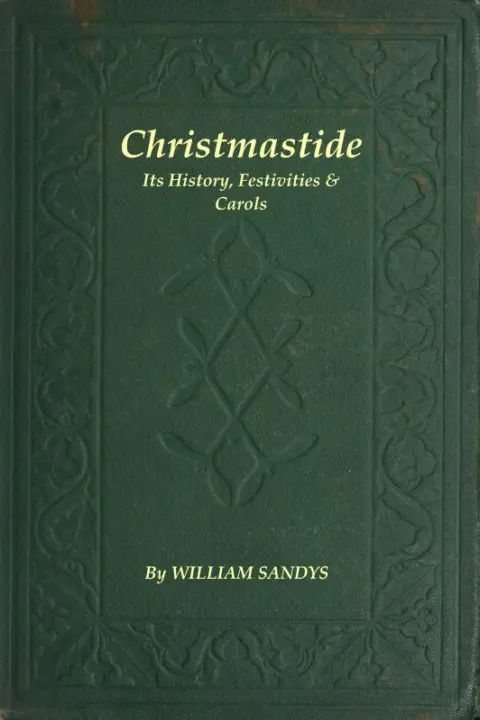
"Christmastide: Its History, Festivities, and Carols" by William Sandys is a historical account likely written in the mid-19th century. The book delves into the origins and customs surrounding the Christmas season, specifically focusing on English traditions from ancient to modern times. Sandys aims to explore both the ecclesiastical significance of Christmas and its transformation into a time of feasting and merriment, addressing the interplay of Christian and pagan traditions throughout history. At the start of the work, the author clarifies his intent to provide a popular and engaging recount of how Christmas has been celebrated in England, rather than a theological exposition. He reflects on the solemnity of the Nativity and its spiritual significance while contrasting this with the revelry and excesses that characterized Christmas feasts in the past. The opening sets the tone for a rich exploration of the historical festivities, customs, and the significance of various Christmas-related practices, paving the way for further detailed examination in subsequent chapters.
Introduction adapted from the source catalogue; source summaries may be automatically generated.
Free to read · English · 75,469 words · No account needed
MAKE TIME FOR A GOOD BOOK
On by default. Untick to stop anonymous reading totals. Each page counts after 10 seconds in view. How this works.
Anonymous counting is on unless you have switched it off.
The Inns of Court continued their revels as in former reigns. Sir Simon D’Ewes complains of some great irregularities at the Temple, in 1620, and some subsequent years, arising from gambling and quarrelling. In Christmas, 1622-3, the Society of the Middle Temple incurred the displeasure of the king—who apparently cared little for any one but himself—by a demonstration in favour of his amiable and talented daughter, Elizabeth of Bohemia. The lieutenant of the Middle Temple had thirty of the best gentlemen of the society to sup with him; during the meal, he took a cup of wine in one hand, and his drawn sword in the other, and drank a health to the distressed Lady Elizabeth, after which he kissed his sword, and swore to live and die in her service, and then passed the cup and sword round.
On the Twelfth Day in the same Christmas, a ludicrous scene occurred, for at dead of night, the gentlemen of Gray’s Inn, in order to make an end of their Christmas, shot off all the chambers they had borrowed from the Tower, which were as many as filled four carts. The king, who, as is well known, could not bear the sight of a naked sword, being awakened with the noise, started out of bed, crying out, “Treason! treason!” The city was in confusion, and the court in arms, the Earl of Arundel running to the king’s bed-chamber, with his sword drawn, to rescue his sovereign.
In 1607, there was a celebrated exhibition of the Christmas Prince, at St. John’s College, Oxford, conducted with more than usual pomp. A numerous court was appointed, and pageants and dramatic performances were from time to time exhibited; the “Prince,” Mr. Thomas Tucker, continuing in his office until Shrove Tuesday. There were some disturbances, in consequence of the inability of many people to find room, but probably not more than occur now occasionally at the Commemoration. Sir John Finett, who was master of the ceremonies to James the First and Charles the First, and who seems to have considered the settlement of points of etiquette as the very essence of good government, in his quaint publication, called ‘Philoxenis,’ gives many curious particulars of disputes, in several years, both in this reign and the following one, between the royal ambassadors; and claims of precedence, and fanciful privileges on the part of themselves and their wives; and of his own skill and finesse in arranging them, so as in general to give satisfaction, and prevent the peace of Europe from being disturbed, which, from his statement, but for his diplomatic powers, would appear to have been inevitable, had one ambassador’s wife got a back to her chair, while another only had an ottoman. On New Year’s Night, for instance, the intended mask was obliged to be postponed, in consequence of some scruple on these formal matters, of the French ambassador, but Sir John happily overcame this before Twelfth Day, when the mask was proceeded with, and the French, Venetian, and Savoyard ambassadors were present. In the following year the prince was a principal actor in the mask, and the French ambassador took umbrage, because the Spanish ambassador was invited. This schism was beyond Sir John Finett’s controul; a correspondence ensued, but the French ambassador was recalled before his time had expired. Many of the disputes remind one of the points of etiquette respecting the old French court privilege of the tabouret—as to wearing a cocked hat fore and aft, as it is called, or athwart the head—as to wearing a hat always in a club-room, or in the House of Commons, if a member—as to the number of yards to a peeress’ train—as to the feather in the cap of a Highland chief or chieftain—as to the persons entitled to wear long-tailed wigs, or short-tailed wigs, or wigs with a curly tail—and many other equally important points. However, etiquette is probably necessary for the good rule of society, and high and low have their own regulations. We find, in the East, it is considered a highly aristocratic privilege, on ceremonial occasions, that the palanquin should be borne crossways, instead of lengthways, probably because it has a greater chance of being in the way; but it is thought of so much importance, that a few years since, Sri Sunkur Bharti, and Sidha Lingayah Charanti, whoever those grandees might have been, contested the point by appeal to the privy council.
Your reading position is saved on this browser. Take it to another device with a library code. Reading pages adapt to text, rather than matching a printed edition.
BEHIND THE BOOK
This eBook is for the use of anyone anywhere in the United States and most other parts of the world at no cost and with almost no restrictions whatsoever. You may copy it, give it away or re-use it under the terms of the Project Gutenberg License included with this eBook or online at www.gutenberg.org. If you are not located in the United States, you will have to check the laws of the country where you are located before using this eBook. Read the source licence.
The original source file, including credits and licence, is retained by this library. Request an original-format copy at no charge. Please include the book title and Project Gutenberg identifier #47956.
KEEP YOUR CURIOSITY GOING
Cécile Tormay

Moritz Busch
John L. Ransom
Frances Wright
Cécile Tormay

Mabel Potter Daggett