THE CLASSIC COLLECTION✦An outlaw’s diary: the CommuneCLASSIC FREE BOOKS
An outlaw’s diary: the Commune
Cécile Tormay
THE CLASSIC COLLECTION · 1852
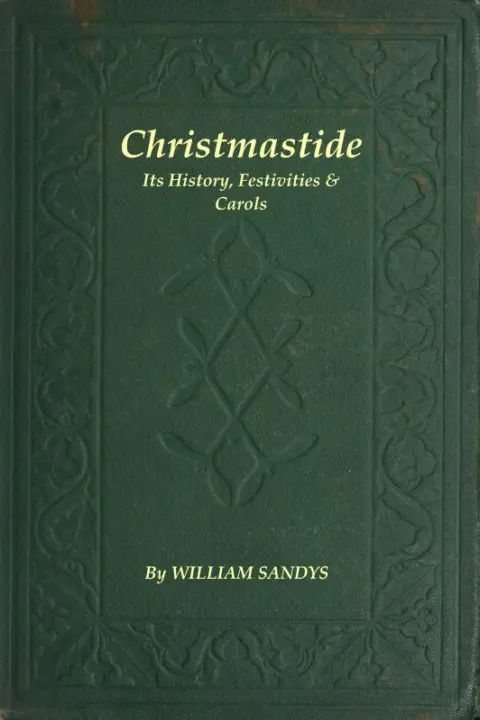
"Christmastide: Its History, Festivities, and Carols" by William Sandys is a historical account likely written in the mid-19th century. The book delves into the origins and customs surrounding the Christmas season, specifically focusing on English traditions from ancient to modern times. Sandys aims to explore both the ecclesiastical significance of Christmas and its transformation into a time of feasting and merriment, addressing the interplay of Christian and pagan traditions throughout history. At the start of the work, the author clarifies his intent to provide a popular and engaging recount of how Christmas has been celebrated in England, rather than a theological exposition. He reflects on the solemnity of the Nativity and its spiritual significance while contrasting this with the revelry and excesses that characterized Christmas feasts in the past. The opening sets the tone for a rich exploration of the historical festivities, customs, and the significance of various Christmas-related practices, paving the way for further detailed examination in subsequent chapters.
Introduction adapted from the source catalogue; source summaries may be automatically generated.
Free to read · English · 75,469 words · No account needed
MAKE TIME FOR A GOOD BOOK
On by default. Untick to stop anonymous reading totals. Each page counts after 10 seconds in view. How this works.
Anonymous counting is on unless you have switched it off.
THE term carol, appears originally to have signified a song, joined with a dance, a union frequently found in early religious ceremonies; and it is used in this sense by Chaucer, Boccacio, Spenser, and others. By some it has been derived from cantare, to sing, and rola, an interjection of joy. It was, however, applied to joyous singing, and thus to festive songs; and as these became more frequent at Christmas, it has for a long time past, though not exclusively yet more particularly, designated those sung at this feast. But strictly, it should be applied only to those of a cheerful character, and not to the Christmas hymn, which is of a more solemn cast; many of them, indeed, being more suitable for Passion Week than for Christmas; and a large and appropriate collection might be readily selected for that season, and an interesting work made to illustrate them. In practice, however, the word carol is applied indiscriminately to both classes, whether cheerful or solemn.
In the earlier times, music, both instrumental and vocal, was introduced into religious ceremonies, and was a necessary accompaniment to all the sacred feasts and games. Jubal’s harp or organ, whatever that instrument may have been, was doubtless, like the harp of David, used on such occasions, and the science of music was a necessary part of the education of many of the priesthood. In the records and sculptures of the Hebrews, Greeks, Romans, Egyptians, and other great nations of antiquity, and in the recent discoveries at ancient Nineveh, we find descriptions and representations connected with it.
The Hebrews, as we know, had numerous psalms and hymns, one of the earliest on record being that of Miriam and her companions, on the overthrow of the Egyptians, when they celebrated the downfall of the horse and his rider, with timbrels and with dances. The Druids had recourse to music, and the Anglo-Saxons and Gothic nations made great use of hymns in their public worship. Some early specimens of the primitive music have been handed down to us, but do not impress us with much respect for the powers of harmony of our forefathers, and their neumes, and other obscure and imperfect methods of notation, must have cramped them. Certain of the old chants have a pleasing solemnity, and it has of late been much the custom to revive or to imitate them, commencing even with the old Ambrosian chant; though, as our ancestors considered the introduction of the Gregorian chant to have been a great improvement on it, we may very safely be of the same opinion, as this is really fine, and we need not here trouble ourselves with the Lydian, Phrygian, or Dorian modes. With respect to the merits of ancient music, our taste and skill have been so gradually improving, that we can scarcely be judges of what—though flat, insipid, and meaningless to us—might have given much gratification to the less educated ears of former times. Even within the last few years, a great advance has been made in our own musical knowledge: pieces and composers, popular in the early part of this century, are now scarcely known; and recollected, perhaps (if at all), with amazement at their having ever been listened to; while works of the great masters, then thought impracticable, and containing difficulties not understood, or considered insuperable, are played and appreciated in most good musical meetings. More might be said on this subject, but want of space, and not of materials, compels a postponement, till some future opportunity. It may be mentioned, that much curious information, respecting our ancient national airs, with the tunes themselves, will be found in the very interesting work on the subject, by my friend, Mr. William Chappell, who, it is to be hoped, will, at no distant time, increase our obligation to him, by further publication from the large store in his possession, still unedited. Many of these airs are very pleasing, yet simple in construction, and still remain popular after the lapse of centuries; they are, however, much more recent than the ancient music before referred to.
Your reading position is saved on this browser. Take it to another device with a library code. Reading pages adapt to text, rather than matching a printed edition.
BEHIND THE BOOK
This eBook is for the use of anyone anywhere in the United States and most other parts of the world at no cost and with almost no restrictions whatsoever. You may copy it, give it away or re-use it under the terms of the Project Gutenberg License included with this eBook or online at www.gutenberg.org. If you are not located in the United States, you will have to check the laws of the country where you are located before using this eBook. Read the source licence.
The original source file, including credits and licence, is retained by this library. Request an original-format copy at no charge. Please include the book title and Project Gutenberg identifier #47956.
KEEP YOUR CURIOSITY GOING
Cécile Tormay

Moritz Busch
John L. Ransom
Frances Wright
Cécile Tormay

Mabel Potter Daggett