THE CLASSIC COLLECTION✦An outlaw’s diary: the CommuneCLASSIC FREE BOOKS
An outlaw’s diary: the Commune
Cécile Tormay
THE CLASSIC COLLECTION · 1852
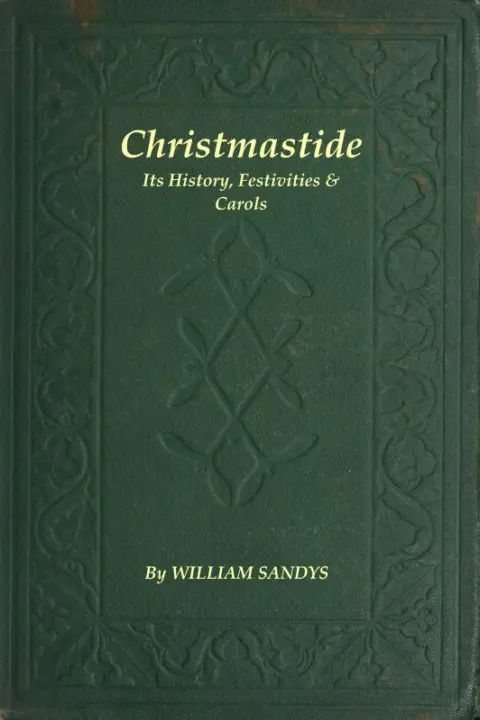
"Christmastide: Its History, Festivities, and Carols" by William Sandys is a historical account likely written in the mid-19th century. The book delves into the origins and customs surrounding the Christmas season, specifically focusing on English traditions from ancient to modern times. Sandys aims to explore both the ecclesiastical significance of Christmas and its transformation into a time of feasting and merriment, addressing the interplay of Christian and pagan traditions throughout history. At the start of the work, the author clarifies his intent to provide a popular and engaging recount of how Christmas has been celebrated in England, rather than a theological exposition. He reflects on the solemnity of the Nativity and its spiritual significance while contrasting this with the revelry and excesses that characterized Christmas feasts in the past. The opening sets the tone for a rich exploration of the historical festivities, customs, and the significance of various Christmas-related practices, paving the way for further detailed examination in subsequent chapters.
Introduction adapted from the source catalogue; source summaries may be automatically generated.
Free to read · English · 75,469 words · No account needed
MAKE TIME FOR A GOOD BOOK
On by default. Untick to stop anonymous reading totals. Each page counts after 10 seconds in view. How this works.
Anonymous counting is on unless you have switched it off.
These Mysteries abound in anachronisms: Pharaoh in his pursuit of the Israelites, when in fear of drowning, recommends his people to lift up their hearts to Mahownde, or Mahomet; Herod constantly swears by him, sometimes even calling him St. Mahomed, as the Sicilian peasants swear by Santu Diavolu, and promises to make one of his counsellors Pope, by way of reward; Noah’s wife swears by Mary; Caiaphas sings mass; and the Shepherds are acquainted with the fools of Gotham; but as individuals of this class are of a very ancient, as well as lasting, breed, the statement may be correct, if applied to some Gotham in Palestine. In the ‘Mactatio Abel,’ of the same collection, Cain is made to speak in the rudest dialect of West York, using the vulgarest phrases, with gross buffoonery.
The pilgrims and crusaders, on their return from the East, introduced other subjects, and the frequent use of the name of Mahomed or Mahomet may have some connection with them. The Christmas play of St. George and the Dragon—
“St. George! that swindg’d the dragon, and e’er since Sits on his horseback, at mine hostess’ door,”—
with the King of Egypt, and fair Sabra, his daughter, still extant in some parts of the country, may have the same origin. It is evidently of great antiquity; and the fact of its being performed in similar manner in the extreme northern and western parts of the country, a considerable part indeed being nearly identical, tends to prove this. “St. George!” was the old battle cry of the English, or “Sand Jors!” as an old German poem, of the fourteenth century, on the battle of Poictiers, calls it.
After the introduction of miracle-plays and mysteries, if there was a deficiency at any time of ecclesiastical performers, the clergy took secular players to assist them; and besides the fraternities and guilds, as before mentioned, some of the public schools also claimed an exclusive privilege of performing plays at particular times and places; the scholar of Paul’s School, indeed, applied to Richard the Second to prohibit inexperienced persons from presenting the ‘History of the Old Testament,’ which the clergy had been at great expense to represent publicly at Christmas. The parish-clerks were also famed for their representations, which seem frequently to have taken place at Clerkenwell, and occasionally lasted for several days. One is mentioned by Stow, in 1409, at Skinner’s Well, near Clerkenwell, which lasted eight days, commencing from the Creation of the World; which was indeed the favourite beginning, if we may judge from the sets of mysteries still extant; the authors thinking that date sufficiently remote: unlike some pedigree hunters, who some way down their ornamented tree, place a note, stating that about this time the world began; or the Chinese picture of the Creation, which has, in a corner, a Chinese mandarin looking on through a telescope. About the middle of the fifteenth century, moralities, or morals, appear to have been introduced, consisting of allegorical personifications, and with them the Vice with his dagger of lath and fool’s coat. The scripture-plays were not, however, immediately abandoned, and may be met with, though perhaps in the shape of a puppet-show, as late certainly as the time of Queen Anne, when at Heatley’s Booth, at Bartholomew Fair, might be seen the old Creation of the World, newly revived, commencing with the Creation of Adam and Eve, and finishing with rich Dives in Hell, and Lazarus in Abraham’s bosom. The French had representations similar to those of the English, at least as early in date; and, in 1313, Philippe-le-Bel exhibited, on the occasion of conferring knighthood on his children, the following spectacles:—‘Adam et Eve;’ ‘Les Trois Rois;’ ‘Le Meurte des Innocens;’ N. S. riant avec Sa Mère, et mangeant des pommes; Hérode et Caiphe en mitre, &c. In France, and in Spain, where they had their Autos Sacramentales, as they called these mysteries, from an equally early date, these performances have been continued to modern times among the country people, and most of their collections of carols contain two or three short mysteries. The plays exhibited at court, during the Christmas, were probably different from those of the clergy, and more in the nature of mummeries, or disguisings, with pageants, until the time of Queen Elizabeth, when the regular drama was performed before her, a practice which has been renewed in the elegant Christmas festivities of our present Queen.
Your reading position is saved on this browser. Take it to another device with a library code. Reading pages adapt to text, rather than matching a printed edition.
BEHIND THE BOOK
This eBook is for the use of anyone anywhere in the United States and most other parts of the world at no cost and with almost no restrictions whatsoever. You may copy it, give it away or re-use it under the terms of the Project Gutenberg License included with this eBook or online at www.gutenberg.org. If you are not located in the United States, you will have to check the laws of the country where you are located before using this eBook. Read the source licence.
The original source file, including credits and licence, is retained by this library. Request an original-format copy at no charge. Please include the book title and Project Gutenberg identifier #47956.
KEEP YOUR CURIOSITY GOING
Cécile Tormay

Moritz Busch
John L. Ransom
Frances Wright
Cécile Tormay

Mabel Potter Daggett