THE CLASSIC COLLECTION✦An outlaw’s diary: the CommuneCLASSIC FREE BOOKS
An outlaw’s diary: the Commune
Cécile Tormay
THE CLASSIC COLLECTION · 1852
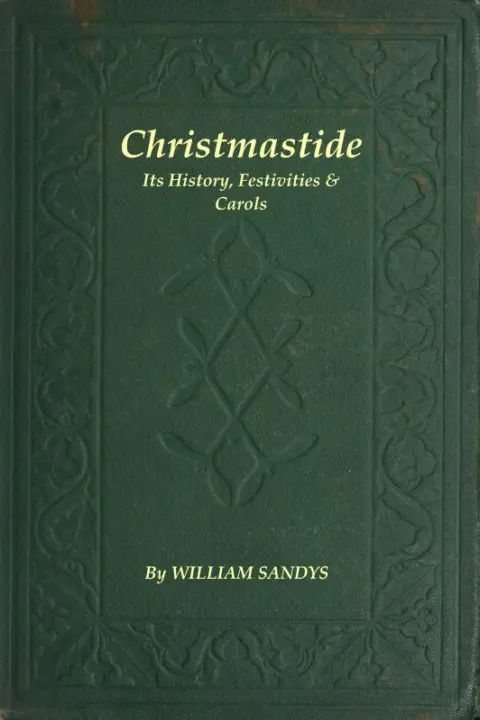
"Christmastide: Its History, Festivities, and Carols" by William Sandys is a historical account likely written in the mid-19th century. The book delves into the origins and customs surrounding the Christmas season, specifically focusing on English traditions from ancient to modern times. Sandys aims to explore both the ecclesiastical significance of Christmas and its transformation into a time of feasting and merriment, addressing the interplay of Christian and pagan traditions throughout history. At the start of the work, the author clarifies his intent to provide a popular and engaging recount of how Christmas has been celebrated in England, rather than a theological exposition. He reflects on the solemnity of the Nativity and its spiritual significance while contrasting this with the revelry and excesses that characterized Christmas feasts in the past. The opening sets the tone for a rich exploration of the historical festivities, customs, and the significance of various Christmas-related practices, paving the way for further detailed examination in subsequent chapters.
Introduction adapted from the source catalogue; source summaries may be automatically generated.
Free to read · English · 75,469 words · No account needed
MAKE TIME FOR A GOOD BOOK
On by default. Untick to stop anonymous reading totals. Each page counts after 10 seconds in view. How this works.
Anonymous counting is on unless you have switched it off.
The practice of New Year’s Gifts is of great antiquity in this country. In the twelfth century, Jocelin of Brakelond, when about to make a gift to his abbot, refers to it, as being according to the custom of the English; and, in very early times, the nobility, and persons connected with the court, gave these New Year’s Gifts to the monarch, who gave in return presents of money, or of plate, the amount of which in time became quite a matter of regulation; and the messenger, bringing the gift, had, also, a handsome fee given him. How much kindly feeling is caused by the interchange of these gifts, and how much taste and fancy displayed at Fortnum and Mason’s, and other places, to tempt us to purchase for the gratification of our younger friends, and receive our reward in the contemplation of their unfeigned pleasure and amusement! Humorous and witty, as well as elegant, bon-bons and souvenirs, drawing the money from us like so many magnets; as Nasgeorgus says—
“These giftes the husband gives his wife,
And father eke the childe,
And maister on his men bestowes
The like, with favour milde.”
There are some particulars in the wardrobe accounts of the New Year’s Gifts of Edward the Second, and also payments made to him to play at dice at Christmas; a custom existing probably long before his time, and certainly continued down to a comparatively recent period, gambling at the groom-porter’s having been observed as late as the time of George the Third. He also gave numerous gifts, being, as is well known, of extravagant and luxurious habits. In his eleventh year, especially, at Westminster, several knights received sumptuous presents of plate from him, and the king of the bean (Rex Fabæ) is mentioned as receiving handsome silver-gilt basins and ewers as New Year’s Gifts. Two of the kings of the bean named, are, Sir William de la Bech, and Thomas de Weston, squire of the king’s household. Edward kept several stately Christmasses, and one at Nottingham in 1324, with particular magnificence, glory, and resort of people. Even when a prisoner at Kenilworth in 1326-7, he kept up a degree of state, although his son, Edward the Third, then aged about sixteen years, was crowned on Christmas Day, 1326, the queen-mother keeping open court, with a great assembly of nobles, prelates, and burgesses, when it was decided to depose the father, whose melancholy fate is well known. Edward the Third became not only a great warrior, but, also, in many respects, a great monarch, and his Christmasses, with other feasts, were held with much splendour. One at Wells, where there were many strange and sumptuous shows made to pleasure the king and his guests, is particularly mentioned; but that at Windsor, in 1343-4, is by far the most distinguished in history, as the king then renewed the Round Table, and instituted the celebrated Order of the Garter, making St. George the patron; whether from the circumstance of the countess of Salisbury having dropped her garter (whence the old Welsh tune took its name of Margaret has lost her garter), cannot now be distinctly proved; but we may as well leave the balance in favour of gallantry. Suffice it, that never has any order of knighthood enrolled such a succession of royal, brave, and world-renowned characters. In 1347 at Guildford, and 1348 at Ottford, in Kent, there were great revellings at Christmas. In the first of these years, there were provided for the amusements of the court, eighty-four tunics of buckram, of divers colours; forty-two visors of different likenesses; twenty-eight crests; fourteen coloured cloaks; fourteen dragons’ heads; fourteen white tunics; fourteen heads of peacocks, with wings; fourteen coloured tunics, with peacocks’ eyes; fourteen heads of swans, with wings; fourteen coloured tunics of linen; and fourteen tunics, coloured, with stars of gold and silver. In the following year, quadrupeds were in the ascendancy, instead of the feathered creation, and amongst the things mentioned in the wardrobe expenses are, twelve heads of men, surmounted by those of elephants; twelve of men, having heads of lions over them; twelve of men’s heads, having bats’ wings; and, twelve heads of wodewoses, or wildmen. A good pantomime decorator would have been invaluable in those days. On New Year’s Eve 1358, Edward, with his gallant son, were in a different scene, fighting under the banners of Sir Walter de Mauny before the walls of Calais, which place the French thought had been betrayed to them; but the plot was counteracted, and they were defeated, and many French knights made captives, who were hospitably entertained by the English king on the following day, being New Year’s Day.
Your reading position is saved on this browser. Take it to another device with a library code. Reading pages adapt to text, rather than matching a printed edition.
BEHIND THE BOOK
This eBook is for the use of anyone anywhere in the United States and most other parts of the world at no cost and with almost no restrictions whatsoever. You may copy it, give it away or re-use it under the terms of the Project Gutenberg License included with this eBook or online at www.gutenberg.org. If you are not located in the United States, you will have to check the laws of the country where you are located before using this eBook. Read the source licence.
The original source file, including credits and licence, is retained by this library. Request an original-format copy at no charge. Please include the book title and Project Gutenberg identifier #47956.
KEEP YOUR CURIOSITY GOING
Cécile Tormay

Moritz Busch
John L. Ransom
Frances Wright
Cécile Tormay

Mabel Potter Daggett