THE CLASSIC COLLECTION✦An outlaw’s diary: the CommuneCLASSIC FREE BOOKS
An outlaw’s diary: the Commune
Cécile Tormay
THE CLASSIC COLLECTION · 1852
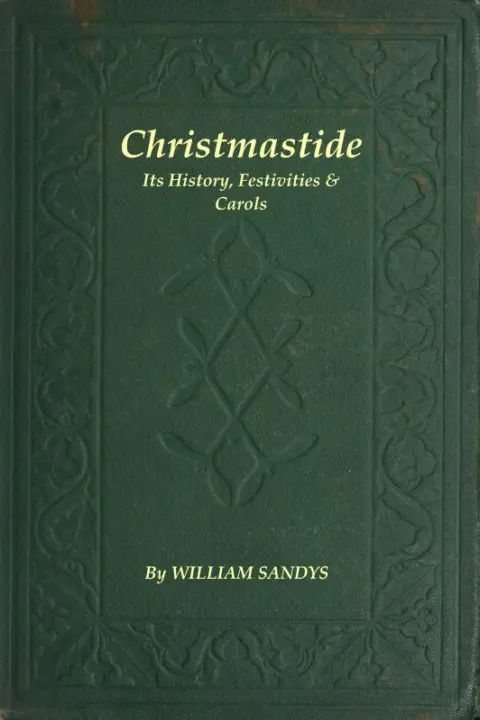
"Christmastide: Its History, Festivities, and Carols" by William Sandys is a historical account likely written in the mid-19th century. The book delves into the origins and customs surrounding the Christmas season, specifically focusing on English traditions from ancient to modern times. Sandys aims to explore both the ecclesiastical significance of Christmas and its transformation into a time of feasting and merriment, addressing the interplay of Christian and pagan traditions throughout history. At the start of the work, the author clarifies his intent to provide a popular and engaging recount of how Christmas has been celebrated in England, rather than a theological exposition. He reflects on the solemnity of the Nativity and its spiritual significance while contrasting this with the revelry and excesses that characterized Christmas feasts in the past. The opening sets the tone for a rich exploration of the historical festivities, customs, and the significance of various Christmas-related practices, paving the way for further detailed examination in subsequent chapters.
Introduction adapted from the source catalogue; source summaries may be automatically generated.
Free to read · English · 75,469 words · No account needed
MAKE TIME FOR A GOOD BOOK
On by default. Untick to stop anonymous reading totals. Each page counts after 10 seconds in view. How this works.
Anonymous counting is on unless you have switched it off.
At Christmas, 1176, Roderick, king of Connaught, kept court with Henry at Windsor, and in 1183, Henry kept the feast at Caen, in Normandy, and there wished his son Henry (who died not long afterwards) to receive homage from his brothers; but the impetuous Richard would not consent, the “merry” Christmas was, therefore, sadly interrupted, and fresh family feuds arose; they had previously been but too frequent, Henry’s life having been much embittered by the conduct of his sons.
When Richard himself came to the throne, he gave a splendid entertainment during Christmas, 1190, at Sicily, when on his way to the Crusades, inviting every one in the united English and French armies of the degree of a gentleman, and giving each a suitable present, according to his rank. Notwithstanding, however, the romance of Richard Cœur de Lion affirms that—
“Christmas is a time full honest,
Kyng Richard it honoured with gret feste;”
and an antiquary of course ought to consider these romances of equal authenticity with the old chronicles; yet one cannot help thinking that during Richard’s short reign, his captivity and his absence from his kingdom must have interfered with his Christmas celebrations; in fact, he, of the lion-heart, seems to have been more ornamental than useful in the pages of history.
John celebrated the feast pretty regularly, but seems occasionally to have selected a city or town for the purpose, where some great personage was allowed to provide for the entertainment; as, for instance, the celebrated Hubert de Burgh, at Canterbury, in 1203. In 1213, he kept his Christmas at Windsor with great festivity, and gave many presents. He was accustomed to make a present to his chancellor, every Christmas, of two marks of gold, according to ancient custom, no doubt by way of New Year’s gift, and gave him half that value at Easter and Whitsuntide. In 1214, he was keeping his Christmas at Worcester, when he was informed of the resolution of the barons to withdraw their allegiance, unless their claims were attended to. This information being ill-suited for the festivities then in progress, the king departed suddenly and shut himself up in the Temple; but the barons went to him on the Epiphany of 1215 with their demands, to which he promised a satisfactory answer at the ensuing Easter. The dissensions between himself and his barons, ending in Magna Charta, are well-known matters of history. In the following year the chief barons of the realm were under sentence of excommunication, and the city of London was under an interdict; but the citizens disregarded this, kept open their churches, rang their bells, enjoyed their turtle and whitebait (whatever the turtle and whitebait of that time might have been), drank their hippocras, ale, mead, and claret or clarré, and celebrated their Christmas with unusual festivity. The English had long been celebrated for their pre-eminence in drinking; as Iago says, “your Dane, your German, and your swag-bellied Hollander, are nothing to your English.” They probably inherited the talent from the Saxons, for their kings had their wine, mead, cyder, ale, pigment, and morat, to which their Norman successors added claret or clarré, garhiofilac, and hippocras. Morat was made from honey and mulberries; claret, pigment, hippocras, and garhiofilac (so called from the girofle or cloves contained in it), were different preparations of wine mixed with honey and spices, no doubt very palatable; and hippocras particularly was indispensable at all the great feasts. Garhiofilac was probably made of white wine, and claret of red wine, as there is an order of Henry the Third in existence, directing the keepers of his wines at York, to deliver to Robert de Monte Pessulano two tuns of white wine to make garhiofilac, and one tun of red wine to make claret for him at the ensuing Christmas, as he used to do in former years. These sheriffs were very useful persons in those times, and performed many offices for our olden monarchs that would somewhat surprise a modern high sheriff to perform now, when he is only called upon to attend to the higher duties of his office, and becomes officially one of the first men in his county. Henry the Third, in his twenty-sixth year, directed the sheriff of Gloucester, to cause twenty salmons to be bought for the king, and put into pies against Christmas; and the sheriff of Sussex to buy ten brawns with the heads, ten peacocks, and other provisions for the same feast.
Your reading position is saved on this browser. Take it to another device with a library code. Reading pages adapt to text, rather than matching a printed edition.
BEHIND THE BOOK
This eBook is for the use of anyone anywhere in the United States and most other parts of the world at no cost and with almost no restrictions whatsoever. You may copy it, give it away or re-use it under the terms of the Project Gutenberg License included with this eBook or online at www.gutenberg.org. If you are not located in the United States, you will have to check the laws of the country where you are located before using this eBook. Read the source licence.
The original source file, including credits and licence, is retained by this library. Request an original-format copy at no charge. Please include the book title and Project Gutenberg identifier #47956.
KEEP YOUR CURIOSITY GOING
Cécile Tormay

Moritz Busch
John L. Ransom
Frances Wright
Cécile Tormay

Mabel Potter Daggett