THE CLASSIC COLLECTION✦An outlaw’s diary: the CommuneCLASSIC FREE BOOKS
An outlaw’s diary: the Commune
Cécile Tormay
THE CLASSIC COLLECTION · 1852
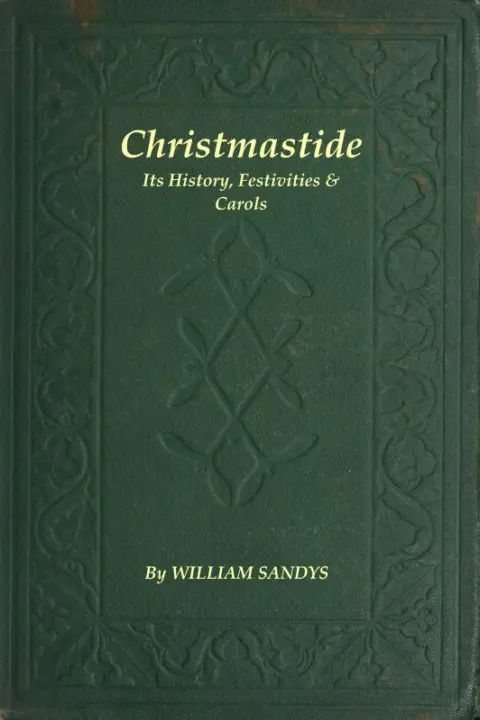
"Christmastide: Its History, Festivities, and Carols" by William Sandys is a historical account likely written in the mid-19th century. The book delves into the origins and customs surrounding the Christmas season, specifically focusing on English traditions from ancient to modern times. Sandys aims to explore both the ecclesiastical significance of Christmas and its transformation into a time of feasting and merriment, addressing the interplay of Christian and pagan traditions throughout history. At the start of the work, the author clarifies his intent to provide a popular and engaging recount of how Christmas has been celebrated in England, rather than a theological exposition. He reflects on the solemnity of the Nativity and its spiritual significance while contrasting this with the revelry and excesses that characterized Christmas feasts in the past. The opening sets the tone for a rich exploration of the historical festivities, customs, and the significance of various Christmas-related practices, paving the way for further detailed examination in subsequent chapters.
Introduction adapted from the source catalogue; source summaries may be automatically generated.
Free to read · English · 75,469 words · No account needed
MAKE TIME FOR A GOOD BOOK
On by default. Untick to stop anonymous reading totals. Each page counts after 10 seconds in view. How this works.
Anonymous counting is on unless you have switched it off.
The term is, however, sometimes used in the sense of news or tidings. Some writers have derived it from natalis, as signifying a cry of joy at Christmas, but this seems a doubtful etymology. It may have the same origin as yule, or gule, but it was not absolutely confined to Christmas time, though it was probably borrowed from its use then. It was frequently used as a sort of burden to carols. In a carol, or hymn, by Herrade de Landsberg, Abbess of Hohenbourg, as early as the twelfth century, saluting the holy “crêche,” or manger, she sings,
“Leto leta concio
Cinoël resonat tripudio,
Cinoël hoc in natalitio,
Cinoël, cinoël,
Noël, noël, noël,
Noël, noël, noël, noël, &c.”
In Normandy it is called nuel. In Burgundy the people pronounce noé for noël. A priest at Dijon, wishing to avoid this error, fell into the opposite extreme, and in one of his discourses repeated three or four times, “l’Arche de noël, et le patriarche Noé.” The Poitevins write nau; and in la vielle Bible des noëls, is found “chanter no.” Rabelais talks of “les beaulx et joyeulx noelz, en langaige poitevin,” and quotes the two last lines of the following commencement of one sung in Poitou, within the last twenty years, if not still.
“An sainct nau,
Chanteray sans point m’y feindre,
Je n’en daignerois rien craindre,
Car le jour est ferian,
Nau, nau, nau.”
Many early instances occur of its use as a cry of joy; as at the baptism of Charles the Sixth, of France, in December, 1368; the entry of Philip, Duke of Burgundy, with his sister, into Paris, in 1429; and the entry into Paris of Charles the Seventh, in 1437, where the people proclaimed their delight with loud shouts of noël.
“Ce jour vint le Roy à Verneuil,
Où il fut receu à grand joye
Du peuple joyeux à merveil,
En criant Noël par la voye.”
On the entry of Henry the Fifth into Rouen, in January, 1419, though this was about Christmas time, and on his return to London, he was received with cries of “Nowell! nowell!” and so afterwards, when the English Regent went through Paris in state, in 1428, “on crioit haultement nouel!” and again on the proclamation of Henry the Sixth.
Your reading position is saved on this browser. Take it to another device with a library code. Reading pages adapt to text, rather than matching a printed edition.
BEHIND THE BOOK
This eBook is for the use of anyone anywhere in the United States and most other parts of the world at no cost and with almost no restrictions whatsoever. You may copy it, give it away or re-use it under the terms of the Project Gutenberg License included with this eBook or online at www.gutenberg.org. If you are not located in the United States, you will have to check the laws of the country where you are located before using this eBook. Read the source licence.
The original source file, including credits and licence, is retained by this library. Request an original-format copy at no charge. Please include the book title and Project Gutenberg identifier #47956.
KEEP YOUR CURIOSITY GOING
Cécile Tormay

Moritz Busch
John L. Ransom
Frances Wright
Cécile Tormay

Mabel Potter Daggett