THE CLASSIC COLLECTION✦An outlaw’s diary: the CommuneCLASSIC FREE BOOKS
An outlaw’s diary: the Commune
Cécile Tormay
THE CLASSIC COLLECTION · 1852
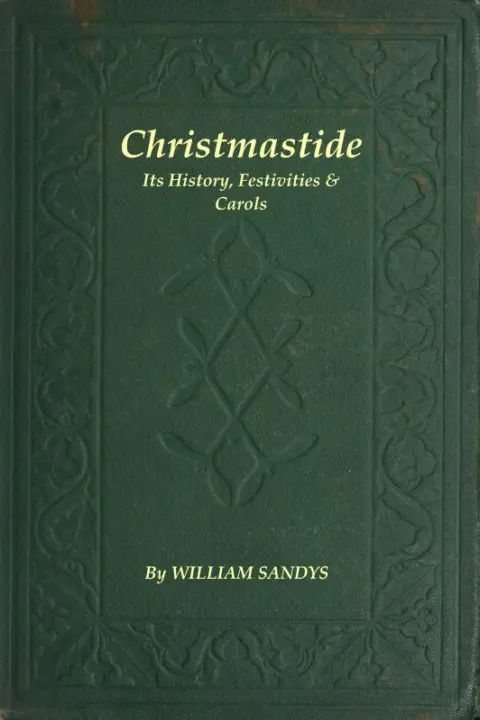
"Christmastide: Its History, Festivities, and Carols" by William Sandys is a historical account likely written in the mid-19th century. The book delves into the origins and customs surrounding the Christmas season, specifically focusing on English traditions from ancient to modern times. Sandys aims to explore both the ecclesiastical significance of Christmas and its transformation into a time of feasting and merriment, addressing the interplay of Christian and pagan traditions throughout history. At the start of the work, the author clarifies his intent to provide a popular and engaging recount of how Christmas has been celebrated in England, rather than a theological exposition. He reflects on the solemnity of the Nativity and its spiritual significance while contrasting this with the revelry and excesses that characterized Christmas feasts in the past. The opening sets the tone for a rich exploration of the historical festivities, customs, and the significance of various Christmas-related practices, paving the way for further detailed examination in subsequent chapters.
Introduction adapted from the source catalogue; source summaries may be automatically generated.
Free to read · English · 75,469 words · No account needed
MAKE TIME FOR A GOOD BOOK
On by default. Untick to stop anonymous reading totals. Each page counts after 10 seconds in view. How this works.
Anonymous counting is on unless you have switched it off.
The play of ‘Alexander the Great,’ acted in the north, and printed at Newcastle, in 1788, is very similar to the Cornish St. George; and others, all showing from their likeness a common origin, may be found in Scotland, Lancashire, Yorkshire, Gloucestershire, Dorsetshire, and other parts. In Yorkshire and Northumberland, and other places in the north, they had the sword or rapier dance, where the performers were dressed in frocks, or white shirts, with paper or pasteboard helmets,—calling themselves Hector, Paris, Guy of Warwick, and other great names, and performing many evolutions with their swords, accompanied by a fiddler or doctor, and a character called Bessy.
Cards, dancing, and music, are still resorted to; but the brawl, the pavan, the minuet, the gavot, the saraband, and even the country dance, excepting in the exhilirating form of Sir Roger de Coverley, have given place to the quadrille, the polka, and the galope; and if we look at the figures of some of the old dances, our drawing-room coryphees will not be sorry to be spared the task of learning them. Take the account of the brawl in one of our old plays, which one of the characters says she has forgotten: “Why! ’tis but two singles on the left, two on the right, three doubles, a traverse of six round; do this twice, curranto pace; a figure of eight, three singles broken down, come up, meet two doubles, fall back, and then honour.” But if we have not gained much in the exhibition of this accomplishment, it is amply made up in the quality of our domestic musical acquirements, where, instead of a ditty or lesson, or sonata, droned out on the virginals or harpsichord, our ladies now treat us not only with the elegant compositions of the talented Osborne, and other able modern writers, but with the classical works of Beethoven, Mozart, and other masters of the noble science. Many of our male amateurs also, both vocal and instrumental, have acquired considerable skill; but as they in general are pretty well aware of their own merits, it will not be necessary to remind them here. Singing, however, is more particularly in quest at Christmas time, but the old carol is rarely now to be met with, though several of them possess much pleasing harmony. One of the great gratifications, however, of these Christmas meetings, where they can take place, is the re-union, even though for a short space, of relations and friends, renewing, as it were, the bonds of love and friendship; casting off for a time the cares of the world; joining, if not audibly, yet mentally, in the praise of that Creator, who has given us so much “richly to enjoy;” and, if it be His will that loved and familiar faces, one by one, drop off, yet are we not left comfortless; for though they cannot return to us, we, through faith in Him, whose Nativity we now commemorate, shall join them, in that blessed region, where the cares and trials of our weary pilgrimage here will be forgotten, as a dream that is past; and hope shall be fulfilled, when “the desire cometh,” that “is a tree of life.”
Your reading position is saved on this browser. Take it to another device with a library code. Reading pages adapt to text, rather than matching a printed edition.
BEHIND THE BOOK
This eBook is for the use of anyone anywhere in the United States and most other parts of the world at no cost and with almost no restrictions whatsoever. You may copy it, give it away or re-use it under the terms of the Project Gutenberg License included with this eBook or online at www.gutenberg.org. If you are not located in the United States, you will have to check the laws of the country where you are located before using this eBook. Read the source licence.
The original source file, including credits and licence, is retained by this library. Request an original-format copy at no charge. Please include the book title and Project Gutenberg identifier #47956.
KEEP YOUR CURIOSITY GOING
Cécile Tormay

Moritz Busch
John L. Ransom
Frances Wright
Cécile Tormay

Mabel Potter Daggett