THE CLASSIC COLLECTION✦An outlaw’s diary: the CommuneCLASSIC FREE BOOKS
An outlaw’s diary: the Commune
Cécile Tormay
THE CLASSIC COLLECTION · 1852
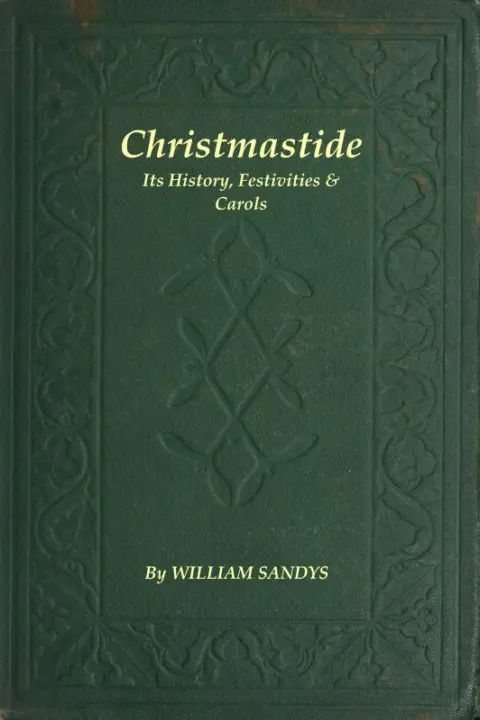
"Christmastide: Its History, Festivities, and Carols" by William Sandys is a historical account likely written in the mid-19th century. The book delves into the origins and customs surrounding the Christmas season, specifically focusing on English traditions from ancient to modern times. Sandys aims to explore both the ecclesiastical significance of Christmas and its transformation into a time of feasting and merriment, addressing the interplay of Christian and pagan traditions throughout history. At the start of the work, the author clarifies his intent to provide a popular and engaging recount of how Christmas has been celebrated in England, rather than a theological exposition. He reflects on the solemnity of the Nativity and its spiritual significance while contrasting this with the revelry and excesses that characterized Christmas feasts in the past. The opening sets the tone for a rich exploration of the historical festivities, customs, and the significance of various Christmas-related practices, paving the way for further detailed examination in subsequent chapters.
Introduction adapted from the source catalogue; source summaries may be automatically generated.
Free to read · English · 75,469 words · No account needed
MAKE TIME FOR A GOOD BOOK
On by default. Untick to stop anonymous reading totals. Each page counts after 10 seconds in view. How this works.
Anonymous counting is on unless you have switched it off.
In some parts, particularly in the west and north of the kingdom, the old Christmas play is still kept up, and a specimen is hereafter given. The subject of these plays, which agree in general effect, although varying in detail, is ‘St. George and the Dragon, with the King of Egypt, and Fair Sabra, his daughter;’ usually accompanied by ‘Father Christmas and the Doctor,’ and sometimes by very incongruous characters; as the great and exemplary man, whose loss the nation is now lamenting, as that of the first character in its history, the Duke of Wellington; and General Wolfe, who fights St. George, and then sings a song about his own death, beginning—
“Bold General Wolfe to his men did say,
Come, come, ye lads, come follow me,
To yonder mountain, which is so high;
Ye lads of honour, all for your honour,
Gain the victory or die.”
Occasionally burlesque characters are introduced, who have nothing to do with the piece, as Hub-Bub, Old Squire, &c., and they generally announce themselves, as one mentioned about 1760, by Jackson, in his ‘History of the Scottish Stage.’
“My name it is Captain Calf-tail, Calf-tail,
And on my back it is plain to be seen;
Although I am simple and wear a fool’s-cap,
I am dearly beloved of a queen.”
The buffoon of the piece used formerly to wear a calf-skin, “I’ll go put on my devilish robes, I mean my Christmas calf’s-skin suit, and then walk to the woods,” says Robin Goodfellow, in the time of James the First. “I’ll put me on my great carnation nose, and wrap me in a rousing calf-skin suit, and come like some hobgoblin.” The performers, who are usually young persons in humble life, are attired, including St. George and the Dragon, much in the same manner, having white trousers and waistcoats, showing their shirt-sleeves, and decorated with ribbons and handkerchiefs; each carrying a drawn sword or cudgel in his hand: as one of the Somersetshire mummers says, “Here comes I liddle man Jan wi’ my sword in my han!” They wear high caps of pasteboard, covered with fancy paper, and ornamented with beads, small pieces of looking-glass, bugles, &c., and generally have long strips of pith hanging down from the top, with shreds of different coloured cloth strung on them, the whole having a fanciful and smart effect. The Turk sometimes has a turban; Father Christmas is represented as a grotesque old man, with a large mask and comic wig, and a huge club in his hand; the Doctor has a three-cornered hat, and painted face, with some ludicrous dress, being the comic character of the piece; the lady is generally in the dress of last century, when it can be got up; and the hobby-horse, when introduced, which is rarely, has a representation of a horse’s hide. Wellington and Wolfe, when they appear, are dressed in any sort of uniform that can be procured for the nonce, and no doubt will now be found as militia men of the county where the play is represented.
Your reading position is saved on this browser. Take it to another device with a library code. Reading pages adapt to text, rather than matching a printed edition.
BEHIND THE BOOK
This eBook is for the use of anyone anywhere in the United States and most other parts of the world at no cost and with almost no restrictions whatsoever. You may copy it, give it away or re-use it under the terms of the Project Gutenberg License included with this eBook or online at www.gutenberg.org. If you are not located in the United States, you will have to check the laws of the country where you are located before using this eBook. Read the source licence.
The original source file, including credits and licence, is retained by this library. Request an original-format copy at no charge. Please include the book title and Project Gutenberg identifier #47956.
KEEP YOUR CURIOSITY GOING
Cécile Tormay

Moritz Busch
John L. Ransom
Frances Wright
Cécile Tormay

Mabel Potter Daggett