
Love Letters of a Violinist, and Other Poems
Eric Mackay
THE CLASSIC COLLECTION · 1907
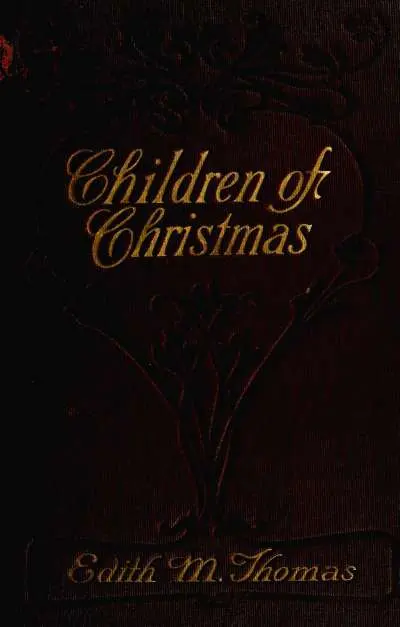
"Children of Christmas, and Others" by Edith Matilda Thomas is a collection of poems and stories written in the early 20th century. The work is centered around themes of childhood, family, and the warmth of the Christmas season, exploring the innocence and joy that comes with it. The stories often feature children and their interactions with the holiday traditions, emphasizing the magic and spirit of Christmas through various narratives. The opening of the collection introduces a series of charming pieces, each reflecting on different aspects of Christmas and childhood. The first poem, "Cradle Song," rejoices in the birth of a child at Christmas, showcasing a tender and holy atmosphere. This is followed by delightful tales, such as a child's thoughtful preparations for Santa Claus and the adventurous spirit of finding a Christmas tree in Nome. Through these verses, the opening captures a nostalgic and heartwarming imagery of the holiday, inviting readers to revel in the simple joys and blessings that come from the season and its celebrations.
Introduction adapted from the source catalogue; source summaries may be automatically generated.
Free to read · English · 16,660 words · No account needed
MAKE TIME FOR A GOOD BOOK
On by default. Untick to stop anonymous reading totals. Each page counts after 10 seconds in view. How this works.
Anonymous counting is on unless you have switched it off.
Thus runs the legend, which also saith
Spite of his pranks Buonamico became,
When the years were fled, and Tafi was gone,
A painter who rivaled his master's fame.
Upon a day of olden days,
A royal lad at school,
In mischief apt, with many a prank,
Defied the good dame's rule.
But England's prince no rod might strike,
Though rich was his desert;
Another must the penance bear,
Another feel the hurt!
The "whipping-boy" stood forth to take
The blows he had not earned;
Full meek he stood; no sense of wrong
Within his bosom burned.
Young Edward saw the rod upraised,
His "whipping-boy" to smite;
And suddenly his princely soul
Revolted at the sight.
The shame, the shame, the tingling shame
No blood of kings could brook!
Forward he sprung, the falling rod
In his own hand he took:
"Mine is the blame--be mine the shame
For what I only wrought;
Let none but me endure the pain
My deed alone has brought!"
Thus on a day of days, it chanced,
A royal schoolboy learned
That noble hearts in every age
A coward's shield have spurned.
In Rome, beside the Forum,
A cobbler had his shop,
Where, on his way to school,
The schoolboy loved to stop.
The sheets of well-tanned leather
Hung all about the wall;
The cobbler stitched and scolded,
Bent over last and awl.
'Twas not the cobbler's scolding
At which the schoolboys laughed,
Nor did they care to watch
His cunning handicraft.
It was a dapper person
With coat as black as night,
That offered to the schoolboy
An all-year-round delight--
A droll yet silent person,
"Good morrow"--all his speech;
He stood upon a rostrum,
As though to teach or preach.
It was the cobbler's raven,
"Good morrow!" clear and loud
He called, with mimic laughter
That charmed the truant crowd,
Until, at last, reminded
Of school and pedagogue,
Of lecture, and of ferrule
To point his apologue.
And now, would Master Corvus,
To while the time away,
Look 'round, to see what mischief
He might devise to-day.
Alas, the raven's cunning
No bound nor measure knew;
Alas, the cobbler's temper--
It never better grew!
And when his choicest leather
Embossed with claw and beak,
He saw--upon the raven
Swift vengeance he did wreak!
Which done, morose and sullen,
He sat him down once more;
Nor scolded when the schoolboys
Called through the open door:
"Good morrow, Master Corvus!"...
No shrill and joyous croak
Responded from within;
And then their anger broke.
"How daredst thou kill the raven,--
The better man of two?"
They seized and beat the cobbler,
Till he for life did sue.
Your reading position is saved on this browser. Take it to another device with a library code. Reading pages adapt to text, rather than matching a printed edition.
BEHIND THE BOOK
This eBook is for the use of anyone anywhere in the United States and most other parts of the world at no cost and with almost no restrictions whatsoever. You may copy it, give it away or re-use it under the terms of the Project Gutenberg License included with this eBook or online at www.gutenberg.org. If you are not located in the United States, you will have to check the laws of the country where you are located before using this eBook. Read the source licence.
The original source file, including credits and licence, is retained by this library. Request an original-format copy at no charge. Please include the book title and Project Gutenberg identifier #40598.
KEEP YOUR CURIOSITY GOING
Eric Mackay

Abby Morton Diaz
Helen Hunt Jackson
Edmund Gosse
Sophia Margaretta Hensley
Mary Frances Blaisdell