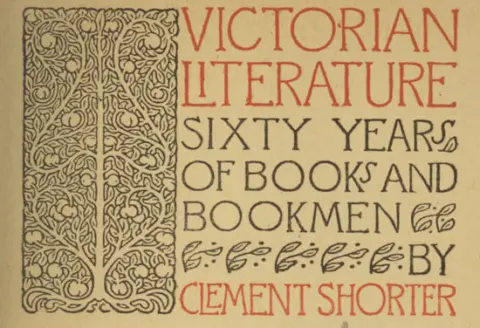
Victorian Literature: Sixty Years of Books and Bookmen
Clement King Shorter
THE CLASSIC COLLECTION · 1896
"Charlotte Brontë and Her Circle" by Clement King Shorter is a biographical account written in the late 19th century. The book explores the life and relationships of Charlotte Brontë, her family, and her contemporaries, adding new insights and letters that have not been previously published. The work seeks to present a more nuanced understanding of Charlotte and her sisters, challenging the notions established by earlier biographies, particularly that of Mrs. Gaskell. The opening of the book begins with a preface where Shorter acknowledges the contributions of various individuals who assisted him in compiling the new material about the Brontës. He expresses gratitude to friends and family who provided letters and information, highlighting the significance of these documents in painting a fuller picture of Charlotte's life. Additionally, the preface transitions smoothly into an overview of key figures in the Brontë family, including an exploration of Patrick Brontë and Maria Branwell, before launching into detailed accounts of Charlotte’s life and literary journey. Overall, the opening establishes the book's ambition to deepen the reader's appreciation of the Brontë sisters' literary legacy and the complexities of their lives, marked by personal struggles and creativity.
Introduction adapted from the source catalogue; source summaries may be automatically generated.
Free to read · English · 178,923 words · No account needed
MAKE TIME FOR A GOOD BOOK
On by default. Untick to stop anonymous reading totals. Each page counts after 10 seconds in view. How this works.
Anonymous counting is on unless you have switched it off.
{408} Thackeray writes to Mr. Brookfield, in October 1848, as follows:--'Old Dilke of the Athenaeum vows that Procter and his wife, between them, wrote Jane Eyre; and when I protest ignorance, says, "Pooh! you know who wrote it--you are the deepest rogue in England, etc." I wonder whether it can be true? It is just possible. And then what a singular circumstance is the + fire of the two dedications' [Jane Eyre to Thackeray, Vanity Fair to Barry Cornwall].--A Collection of Letters to W. M. Thackeray, 1847-1855. Smith and Elder.
{423} Chapters from Some Memories, by Anne Thackeray Ritchie. Macmillan and Co. Mrs. Ritchie and her publishers kindly permit me to incorporate her interesting reminiscence in this chapter.
{432} George Henry Lewes (1817-1878). Published Biographical History of Philosophy, 1845-46; Ranthorpe, 1847; Rose, Blanche, and Violet, 1848; Life of Goethe, 1855. Editor of the Fortnightly Review, 1865-66. Problems of Life and Mind, 1873-79; and many other works.
{434} Richard Hengist Horne (1803-1884). Published Cosmo de Medici, 1837; Orion, an epic poem in ten books, passed through six editions in 1843, the first three editions being issued at a farthing; A New Spirit of the Age, 1844; Letters of E. B. Browning to R. H. Horne, 1877.
{444} Printed by the kind permission of the Rev. C. W. Heald, of Chale,
I.W.
{446} Sir James Kay-Shuttleworth (1804-1877). A doctor of medicine, who was made a baronet in 1849, on resigning the secretaryship of the Committee of Council on Education; assumed the name of Shuttleworth on his marriage, in 1842, to Janet, the only child and heiress of Robert Shuttleworth of Gawthorpe Hall, Burnley (died 1872). His son, the present baronet, is the Right Hon. Sir Ughtred James Kay-Shuttleworth.
{457a} Some experiments on a farm of two acres.
{457b} Letters of Matthew Arnold, collected and arranged by George W. E.
Russell.
{468} Mr. Nicholls is the Mr. Macarthey of Shirley. Here is the reference which not unnaturally gratified him:--'Perhaps I ought to remark that, on the premature and sudden vanishing of Mr. Malone from the stage of Briarfield parish . . . there came as his successor, another Irish curate, Mr. Macarthey. I am happy to be able to inform you, with truth, that this gentleman did as much credit to his country as Malone had done it discredit; he proved himself as decent, decorous, and conscientious, as Peter was rampant, boisterous, and--(this last epithet I choose to suppress, because it would let the cat out of the bag). He laboured faithfully in the parish; the schools, both Sunday and day-schools, flourished under his sway like green bay-trees. Being human, of course he had his faults; these, however, were proper, steady-going, clerical faults: the circumstance of finding himself invited to tea with a dissenter would unhinge him for a week; the spectacle of a Quaker wearing his hat in the church, the thought of an unbaptized fellow-creature being interred with Christian rites--these things could make strange havoc in Mr. Macarthey's physical and mental economy; otherwise he was sane and rational, diligent and charitable.'--Shirley, chap. xxxvii.
Your reading position is saved on this browser. Take it to another device with a library code. Reading pages adapt to text, rather than matching a printed edition.
Clement King Shorter
Clement King Shorter
BEHIND THE BOOK
This eBook is for the use of anyone anywhere in the United States and most other parts of the world at no cost and with almost no restrictions whatsoever. You may copy it, give it away or re-use it under the terms of the Project Gutenberg License included with this eBook or online at www.gutenberg.org. If you are not located in the United States, you will have to check the laws of the country where you are located before using this eBook. Read the source licence.
The original source file, including credits and licence, is retained by this library. Request an original-format copy at no charge. Please include the book title and Project Gutenberg identifier #19011.
KEEP YOUR CURIOSITY GOING
Cécile Tormay

Moritz Busch
John L. Ransom
Frances Wright
Cécile Tormay

Mabel Potter Daggett