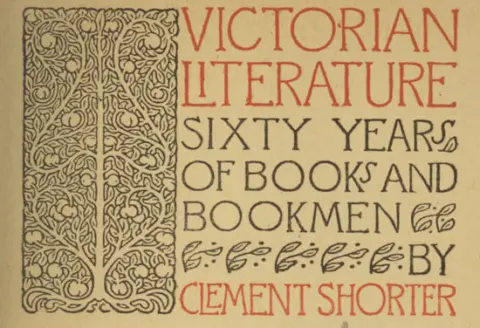
Victorian Literature: Sixty Years of Books and Bookmen
Clement King Shorter
THE CLASSIC COLLECTION · 1896
"Charlotte Brontë and Her Circle" by Clement King Shorter is a biographical account written in the late 19th century. The book explores the life and relationships of Charlotte Brontë, her family, and her contemporaries, adding new insights and letters that have not been previously published. The work seeks to present a more nuanced understanding of Charlotte and her sisters, challenging the notions established by earlier biographies, particularly that of Mrs. Gaskell. The opening of the book begins with a preface where Shorter acknowledges the contributions of various individuals who assisted him in compiling the new material about the Brontës. He expresses gratitude to friends and family who provided letters and information, highlighting the significance of these documents in painting a fuller picture of Charlotte's life. Additionally, the preface transitions smoothly into an overview of key figures in the Brontë family, including an exploration of Patrick Brontë and Maria Branwell, before launching into detailed accounts of Charlotte’s life and literary journey. Overall, the opening establishes the book's ambition to deepen the reader's appreciation of the Brontë sisters' literary legacy and the complexities of their lives, marked by personal struggles and creativity.
Introduction adapted from the source catalogue; source summaries may be automatically generated.
Free to read · English · 178,923 words · No account needed
MAKE TIME FOR A GOOD BOOK
On by default. Untick to stop anonymous reading totals. Each page counts after 10 seconds in view. How this works.
Anonymous counting is on unless you have switched it off.
It would seem quite clear to any careful investigator that the Reverend Patrick Bronte, Incumbent of Haworth, and the father of three famous daughters, was a much maligned man. We talk of the fierce light which beats upon a throne, but what is that compared to the fierce light which beats upon any man of some measure of individuality who is destined to live out his life in the quiet of a country village--in the very centre, as it were, of 'personal talk' and gossip not always kindly to the stranger within the gate? The view of Mr. Bronte, presented by Mrs. Gaskell in the early editions of her biography of Charlotte Bronte, is that of a severe, ill-tempered, and distinctly disagreeable character. It is the picture of a man who disliked the vanities of life so intensely, that the new shoes of his children and the silk dress of his wife were not spared by him in sudden gusts of passion. A stern old ruffian, one is inclined to consider him. His pistol-shooting rings picturesquely, but not agreeably, through Mrs. Gaskell's memoirs. It has been already explained in more than one quarter that this was not the real Patrick Bronte, and that much of the unfavourable gossip was due to the chatter of a dismissed servant, retailed to Mrs. Gaskell on one of her missions of inquiry in the neighbourhood. The stories of the burnt shoes and the mutilated dress have been relegated to the realm of myth, and the pistol-shooting may now be acknowledged as a harmless pastime not more iniquitous than the golfing or angling of a latter-day clergyman. It is certain, were the matter of much interest to-day, that Mr. Bronte was fond of the use of firearms. The present Incumbent of Haworth will point out to you, on the old tower of Haworth Church, the marks of pistol bullets, which he is assured were made by Mr. Bronte. I have myself handled both the gun and the pistol--this latter a very ornamental weapon, by the way, manufactured at Bradford--which Mr. Bronte possessed during the later years of his life. From both he had obtained much innocent amusement; but his son-in-law, Mr. Nicholls, who, at the distance of forty years still cherishes a reverent and enthusiastic affection for old Mr. Bronte, informs me that the bullet marks upon Haworth Church were the irresponsible frolic of a rather juvenile curate--Mr. Smith. All this is trivial enough in any case, and one turns very readily to more important factors in the life of the father of the Brontes. Patrick Bronte was born at Ahaderg, County Down, in Ireland, on St. Patrick's Day, March 17, 1777. He was one of the ten children of Hugh Brunty, farmer, and his nine brothers and sisters seem all of them to have spent their lives in their Irish home, to have married and been given in marriage, and to have gone to their graves in peace. Patrick alone had ambition, and, one must add, the opportune friend, without whom ambition counts for little in the great struggle of life. At sixteen he was a kind of village schoolmaster, or assistant schoolmaster, and at twenty-five, stirred thereto by the vicar of his parish, Mr. Tighe, he was on his way from Ireland to St. John's College, Cambridge. It was in 1802 that Patrick Bronte went to Cambridge, and entered his name in the college books. There, indeed, we find the name, not of Patrick Bronte, but of Patrick Branty, {28} and this brings us to an interesting point as to the origin of the name. In the register of his birth his name is entered, as are the births of his brothers and sisters, as 'Brunty' and 'Bruntee'; and it can scarcely be doubted that, as Dr. Douglas Hyde has pointed out, the original name was O'Prunty. {29} The Irish, at the beginning of the century, were well-nigh as primitive in some matters as were the English of a century earlier; and one is not surprised to see variations in the spelling of the Bronte name--it being in the case of his brothers and sisters occasionally spelt 'Brontee.' To me it is perfectly clear that for the change of name Lord Nelson was responsible, and that the dukedom of Bronte, which was conferred upon the great sailor in 1799, suggested the more ornamental surname. There were no Irish Brontes in existence before Nelson became Duke of Bronte; but all Patrick's brothers and sisters, with whom, it must be remembered, he was on terms of correspondence his whole life long, gradually, with a true Celtic sense of the picturesqueness of the thing, seized upon the more attractive surname. For this theory there is, of course, not one scrap of evidence; we only know that the register of Patrick's native parish gives us Brunty, and that his signature through his successive curacies is Bronte.
Your reading position is saved on this browser. Take it to another device with a library code. Reading pages adapt to text, rather than matching a printed edition.
Clement King Shorter
Clement King Shorter
BEHIND THE BOOK
This eBook is for the use of anyone anywhere in the United States and most other parts of the world at no cost and with almost no restrictions whatsoever. You may copy it, give it away or re-use it under the terms of the Project Gutenberg License included with this eBook or online at www.gutenberg.org. If you are not located in the United States, you will have to check the laws of the country where you are located before using this eBook. Read the source licence.
The original source file, including credits and licence, is retained by this library. Request an original-format copy at no charge. Please include the book title and Project Gutenberg identifier #19011.
KEEP YOUR CURIOSITY GOING
Cécile Tormay

Moritz Busch
John L. Ransom
Frances Wright
Cécile Tormay

Mabel Potter Daggett