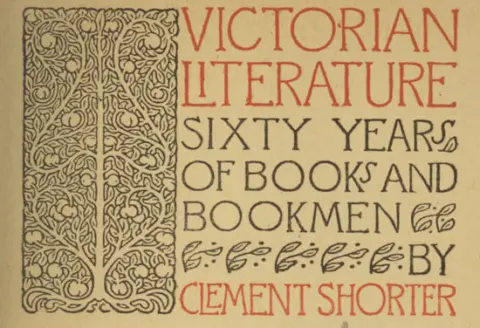
Victorian Literature: Sixty Years of Books and Bookmen
Clement King Shorter
THE CLASSIC COLLECTION · 1896
"Charlotte Brontë and Her Circle" by Clement King Shorter is a biographical account written in the late 19th century. The book explores the life and relationships of Charlotte Brontë, her family, and her contemporaries, adding new insights and letters that have not been previously published. The work seeks to present a more nuanced understanding of Charlotte and her sisters, challenging the notions established by earlier biographies, particularly that of Mrs. Gaskell. The opening of the book begins with a preface where Shorter acknowledges the contributions of various individuals who assisted him in compiling the new material about the Brontës. He expresses gratitude to friends and family who provided letters and information, highlighting the significance of these documents in painting a fuller picture of Charlotte's life. Additionally, the preface transitions smoothly into an overview of key figures in the Brontë family, including an exploration of Patrick Brontë and Maria Branwell, before launching into detailed accounts of Charlotte’s life and literary journey. Overall, the opening establishes the book's ambition to deepen the reader's appreciation of the Brontë sisters' literary legacy and the complexities of their lives, marked by personal struggles and creativity.
Introduction adapted from the source catalogue; source summaries may be automatically generated.
Free to read · English · 178,923 words · No account needed
MAKE TIME FOR A GOOD BOOK
On by default. Untick to stop anonymous reading totals. Each page counts after 10 seconds in view. How this works.
Anonymous counting is on unless you have switched it off.
'DEAR PAPA,--I write one hasty line just to tell you that I got here quite safely at ten o'clock last night without any damage or smash in tunnels or cuttings. Mr. and Mrs. Smith met me at the station and gave me a kind and cordial welcome. The weather was beautiful the whole way, and warm; it is the same to-day. I have not yet been out, but this afternoon, if all be well, I shall go to Mr. Thackeray's lecture. I don't know when I shall see the Exhibition, but when I do, I shall write and tell you all about it. I hope you are well, and will continue well and cheerful. Give my kind regards to Tabby and Martha, and--Believe me, your affectionate daughter,
It cannot be said that Charlotte Bronte and Thackeray gained by personal contact. 'With him I was painfully stupid,' she says. It was the case of Heine and Goethe over again. Heine in the presence of the king of German literature could talk only of the plums in the garden. Charlotte Bronte in the presence of her hero Thackeray could not express herself with the vigour and intelligence which belonged to her correspondence with Mr. Williams. Miss Bronte, again, was hyper-critical of the smaller vanities of men, and, as has been pointed out, she emphasised in Villette a trivial piece of not unpleasant egotism on Thackeray's part after a lecture--his asking her if she had liked it. This question, which nine men out of ten would be prone to ask of a woman friend, was 'over-eagerness' and 'naivete' in her eyes. Thackeray, on his side, found conversation difficult, if we may judge by a reminiscence by his daughter Mrs. Ritchie:--
'One of the most notable persons who ever came into our bow-windowed drawing-room in Young Street is a guest never to be forgotten by me--a tiny, delicate, little person, whose small hand nevertheless grasped a mighty lever which set all the literary world of that day vibrating. I can still see the scene quite plainly--the hot summer evening, the open windows, the carriage driving to the door as we all sat silent and expectant; my father, who rarely waited, waiting with us; our governess and my sister and I all in a row, and prepared for the great event. We saw the carriage stop, and out of it sprang the active well-knit figure of Mr. George Smith, who was bringing Miss Bronte to see our father. My father, who had been walking up and down the room, goes out into the hall to meet his guests, and then, after a moment's delay, the door opens wide, and the two gentlemen come in, leading a tiny, delicate, serious, little lady, pale, with fair straight hair, and steady eyes. She may be a little over thirty; she is dressed in a little barege dress, with a pattern of faint green moss. She enters in mittens, in silence, in seriousness; our hearts are beating with wild excitement. This, then, is the authoress, the unknown power whose books have set all London talking, reading, speculating; some people even say our father wrote the books--the wonderful books. To say that we little girls had been given Jane Eyre to read scarcely represents the facts of the case; to say that we had taken it without leave, read bits here and read bits there, been carried away by an undreamed-of and hitherto unimagined whirlwind into things, times, places, all utterly absorbing, and at the same time absolutely unintelligible to us, would more accurately describe our state of mind on that summer's evening as we look at Jane Eyre--the great Jane Eyre--the tiny little lady. The moment is so breathless that dinner comes as a relief to the solemnity of the occasion, and we all smile as my father stoops to offer his arm; for, though genius she may be, Miss Bronte can barely reach his elbow. My own personal impressions are that she is somewhat grave and stern, especially to forward little girls who wish to chatter. Mr. George Smith has since told me how she afterwards remarked upon my father's wonderful forbearance and gentleness with our uncalled-for incursions into the conversation. She sat gazing at him with kindling eyes of interest, lighting up with a sort of illumination every now and then as she answered him. I can see her bending forward over the table, not eating, but listening to what he said as he carved the dish before him.
Your reading position is saved on this browser. Take it to another device with a library code. Reading pages adapt to text, rather than matching a printed edition.
Clement King Shorter
Clement King Shorter
BEHIND THE BOOK
This eBook is for the use of anyone anywhere in the United States and most other parts of the world at no cost and with almost no restrictions whatsoever. You may copy it, give it away or re-use it under the terms of the Project Gutenberg License included with this eBook or online at www.gutenberg.org. If you are not located in the United States, you will have to check the laws of the country where you are located before using this eBook. Read the source licence.
The original source file, including credits and licence, is retained by this library. Request an original-format copy at no charge. Please include the book title and Project Gutenberg identifier #19011.
KEEP YOUR CURIOSITY GOING
Cécile Tormay

Moritz Busch
John L. Ransom
Frances Wright
Cécile Tormay

Mabel Potter Daggett