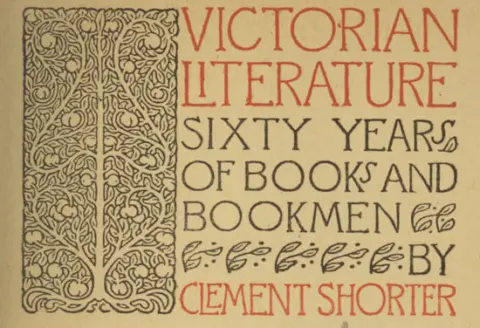
Victorian Literature: Sixty Years of Books and Bookmen
Clement King Shorter
THE CLASSIC COLLECTION · 1896
"Charlotte Brontë and Her Circle" by Clement King Shorter is a biographical account written in the late 19th century. The book explores the life and relationships of Charlotte Brontë, her family, and her contemporaries, adding new insights and letters that have not been previously published. The work seeks to present a more nuanced understanding of Charlotte and her sisters, challenging the notions established by earlier biographies, particularly that of Mrs. Gaskell. The opening of the book begins with a preface where Shorter acknowledges the contributions of various individuals who assisted him in compiling the new material about the Brontës. He expresses gratitude to friends and family who provided letters and information, highlighting the significance of these documents in painting a fuller picture of Charlotte's life. Additionally, the preface transitions smoothly into an overview of key figures in the Brontë family, including an exploration of Patrick Brontë and Maria Branwell, before launching into detailed accounts of Charlotte’s life and literary journey. Overall, the opening establishes the book's ambition to deepen the reader's appreciation of the Brontë sisters' literary legacy and the complexities of their lives, marked by personal struggles and creativity.
Introduction adapted from the source catalogue; source summaries may be automatically generated.
Free to read · English · 178,923 words · No account needed
MAKE TIME FOR A GOOD BOOK
On by default. Untick to stop anonymous reading totals. Each page counts after 10 seconds in view. How this works.
Anonymous counting is on unless you have switched it off.
It was not many months after this that we hear the last of poor Mr.
Price.
'January 24th, 1840.
'MY DEAR ELLEN,--Mr. Price is dead. He had fallen into a state of delicate health for some time, and the rupture of a blood-vessel carried him off. He was a strong, athletic-looking man when I saw him, and that is scarcely six months ago. Though I knew so little of him, and of course could not be deeply or permanently interested in what concerned him, I confess, when I suddenly heard he was dead, I felt both shocked and saddened: it was no shame to feel so, was it? I scold you, Ellen, for writing illegibly and badly, but I think you may repay the compliment with cent per cent interest. I am not in the humour for writing a long letter, so good-bye. God bless you.
There are many thoughts on marriage scattered through Charlotte's correspondence. It was a subject upon which she never wearied of asking questions, and of finding her own answers. 'I believe it is better to marry to love than to marry for love,' she says on one occasion. And in reference to the somewhat uncertain attitude of the admirer of one of her friends, she thus expresses herself to Miss Nussey:
'November 20th, 1840.
'MY DEAREST NELL,--That last letter of thine treated of matters so high and important I cannot delay answering it for a day. Now I am about to write thee a discourse, and a piece of advice which thou must take as if it came from thy grandmother. But in the first place, before I begin with thee, I have a word to whisper in the ear of Mr. Vincent, and I wish it could reach him. In the name of St. Chrysostom, St. Simon, and St. Jude, why does not that amiable young gentleman come forward like a man and say all that he has to say personally, instead of trifling with kinsmen and kinswomen. "Mr. Vincent," I say, "go personally, and say: 'Miss ---, I want to speak to you.' Miss --- will of course civilly answer: 'I am at your service, Mr. Vincent.' And then, when the room is cleared of all but yourself and herself, just take a chair nearer. Insist upon her laying down that silly . . . work, and listening to you. Then begin, in a clear, distinct, deferential, but determined voice: 'Miss ---, I have a question to put to you--a very important question: "Will you take me as your husband, for better, for worse. I am not a rich man, but I have sufficient to support us. I am not a great man, but I love you honestly and truly. Miss ---, if you knew the world better you would see that this is an offer not to be despised--a kind attached heart and a moderate competency." Do this, Mr. Vincent, and you may succeed. Go on writing sentimental and love-sick letters to ---, and I would not give sixpence for your suit." So much for Mr. Vincent. Now Miss ---'s turn comes to swallow the black bolus, called a friend's advice. Say to her: "Is the man a fool? is he a knave? a humbug, a hypocrite, a ninny, a noodle? If he is any or all of these, of course there is no sense in trifling with him. Cut him short at once--blast his hopes with lightning rapidity and keenness. Is he something better than this? has he at least common sense, a good disposition, a manageable temper? Then consider the matter." Say further: "You feel a disgust towards him now--an utter repugnance. Very likely, but be so good as to remember you don't know him; you have only had three or four days' acquaintance with him. Longer and closer intimacy might reconcile you to a wonderful extent. And now I'll tell you a word of truth, at which you may be offended or not as you like." Say to her: "From what I know of your character, and I think I know it pretty well, I should say you will never love before marriage. After that ceremony is over, and after you have had some months to settle down, and to get accustomed to the creature you have taken for your worse half, you will probably make a most affectionate and happy wife; even if the individual should not prove all you could wish, you will be indulgent towards his little follies and foibles, and will not feel much annoyance at them. This will especially be the case if he should have sense sufficient to allow you to guide him in important matters." Say also: "I hope you will not have the romantic folly to wait for what the French call 'une grande passion.' My good girl, 'une grande passion' is 'une grande folie.' Mediocrity in all things is wisdom; mediocrity in the sensations is superlative wisdom." Say to her: "When you are as old as I am (I am sixty at least, being your grandmother), you will find that the majority of those worldly precepts, whose seeming coldness shocks and repels us in youth, are founded in wisdom."
Your reading position is saved on this browser. Take it to another device with a library code. Reading pages adapt to text, rather than matching a printed edition.
Clement King Shorter
Clement King Shorter
BEHIND THE BOOK
This eBook is for the use of anyone anywhere in the United States and most other parts of the world at no cost and with almost no restrictions whatsoever. You may copy it, give it away or re-use it under the terms of the Project Gutenberg License included with this eBook or online at www.gutenberg.org. If you are not located in the United States, you will have to check the laws of the country where you are located before using this eBook. Read the source licence.
The original source file, including credits and licence, is retained by this library. Request an original-format copy at no charge. Please include the book title and Project Gutenberg identifier #19011.
KEEP YOUR CURIOSITY GOING
Cécile Tormay

Moritz Busch
John L. Ransom
Frances Wright
Cécile Tormay

Mabel Potter Daggett