
Charles Sumner: his complete works, volume 20 (of 20)
Charles Sumner
THE CLASSIC COLLECTION · 1874
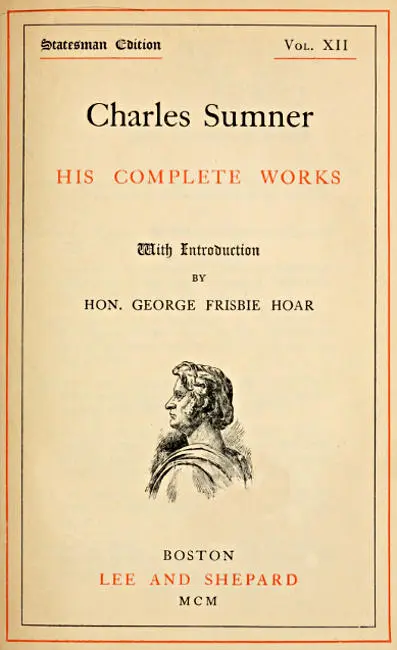
"Charles Sumner: His Complete Works, Volume 12 (of 20)" by Charles Sumner is a collection of political speeches and letters written during the mid-19th century. This volume centers on significant events and themes surrounding the American Civil War, including Reconstruction, emancipation, and the political battles of the time, particularly in relation to slavery and civil rights. Readers can expect to engage with powerful rhetoric and ideas that influenced the shaping of modern American political discourse. The opening of this volume presents multiple pieces, beginning with Sumner's speech delivered at a public meeting celebrating the victory of Abraham Lincoln in the 1864 presidential election. He joyfully proclaims this outcome as a monumental shift towards liberty and the end of slavery, portraying the Democratic party as corrupt and traitorous for its association with the rebellion. Following this, Sumner expresses his admiration for fellow politician James M. Ashley, discusses the case of the Florida war-steamer captured in Brazilian waters, and reflects on the need for justice and civil rights for freedmen. These excerpts establish both the urgency and optimism of the era, highlighting Sumner's strong commitment to liberty, justice, and the struggles faced by marginalized groups in the pursuit of equality.
Introduction adapted from the source catalogue; source summaries may be automatically generated.
Free to read · English · 117,723 words · No account needed
MAKE TIME FOR A GOOD BOOK
On by default. Untick to stop anonymous reading totals. Each page counts after 10 seconds in view. How this works.
Anonymous counting is on unless you have switched it off.
Forgetting laws, judicial decisions, history, and political literature, it was easy for the Chief Justice to forget how the religious sects of the country testified for the rights of the African, sometimes by individuals, and sometimes by corporate acts. Here the Quakers took the lead. As far back as 1688, a small body of German Quakers at Germantown, Pennsylvania, presented a protest to the Yearly Meeting against “buying, selling, and holding men in slavery,”[111] which was followed in 1696 by formal advice from this body that the members should “be careful not to encourage the bringing in of any more negroes, and that such that have negroes be careful of them.”[112] One of their number, George Keith, denounced Slavery with especial vigor, as “contrary to the religion of Christ, the rights of man, and sound reason and policy.”[113] At the beginning of the last century the Quakers of New England were agitated. In 1716, they sent forth a declaration from Nantucket, that “it is not agreeable to truth for Friends to purchase slaves and keep them term of life;”[114] and in 1730, Elihu Coleman, of Nantucket, wrote a tract in reprobation of Slavery as “anti-Christian,” and “very opposite both to Grace and Nature.”[115] In 1729, at Philadelphia, Ralph Sandiford exposed it in a pamphlet entitled “The Mystery of Iniquity”; and in 1737, Benjamin Lay gave to the world his work with the expressive title, “All Slave-Keepers, that keep the Innocent in Bondage, Apostates,”--and this was printed by Benjamin Franklin.[116] Then came the extraordinary labors of John Woolman, who, from 1746 to 1768, travelled through the Middle and Southern Colonies, an avowed Abolitionist, testifying against Slavery,--and of Anthony Benezet, who, by various writings, and by gratuitous instruction of negroes at an evening school, showed his sense of their common humanity. Meanwhile at their Yearly Meetings Slavery was condemned. In 1754, there was a recommendation “to advise and deal with such as engage” in the traffic, with the declared desire to guard against “promoting the bondage of such unhappy people.”[117] In 1776, it was declared “that the owners of slaves who refused to execute proper instruments for giving them their freedom were to be disowned.”[118] There are also reports of meetings,--in Rhode Island, in 1717, 1727, 1760, 1769, and thence, nearly every year, to 1787,--in New York, previous to 1759, and in 1767, 1771, 1772, 1774, 1775, 1776, 1777, 1781, 1782, 1784, 1785, 1787,--and in Virginia, in 1757, 1764, 1766, 1767, 1768, 1773, 1780, and thence annually, with but one intermission, to 1787,--where the rights of the African were recognized, and in most of them Slavery was condemned.[119] The meeting of 1782, in Rhode Island, spoke of “that iniquitous practice of holding or dealing with mankind as slaves.”[120] The meeting of 1776, in New York, refused “to employ or accept the services in the church, or receive the collections,” of those “who continue these poor people in bondage.”[121] The meeting of 1773, in Virginia, earnestly recommended manumissions, and quoted the words of the Prophet, “The people of the land have used oppression and exercised robbery.”[122] These are only illustrations of the extent to which the pretension of the Chief Justice was disowned.
Your reading position is saved on this browser. Take it to another device with a library code. Reading pages adapt to text, rather than matching a printed edition.
Charles Sumner

Charles Sumner

Charles Sumner

Charles Sumner
BEHIND THE BOOK
This eBook is for the use of anyone anywhere in the United States and most other parts of the world at no cost and with almost no restrictions whatsoever. You may copy it, give it away or re-use it under the terms of the Project Gutenberg License included with this eBook or online at www.gutenberg.org. If you are not located in the United States, you will have to check the laws of the country where you are located before using this eBook. Read the source licence.
The original source file, including credits and licence, is retained by this library. Request an original-format copy at no charge. Please include the book title and Project Gutenberg identifier #49789.
KEEP YOUR CURIOSITY GOING

David Patterson (Spirit) Hatch

David Patterson (Spirit) Hatch

David Patterson (Spirit) Hatch
Cécile Tormay

Moritz Busch
John L. Ransom