
Charles Sumner: his complete works, volume 20 (of 20)
Charles Sumner
THE CLASSIC COLLECTION · 1874
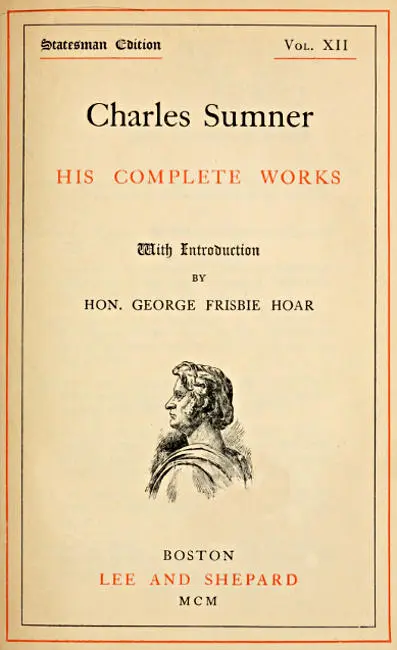
"Charles Sumner: His Complete Works, Volume 12 (of 20)" by Charles Sumner is a collection of political speeches and letters written during the mid-19th century. This volume centers on significant events and themes surrounding the American Civil War, including Reconstruction, emancipation, and the political battles of the time, particularly in relation to slavery and civil rights. Readers can expect to engage with powerful rhetoric and ideas that influenced the shaping of modern American political discourse. The opening of this volume presents multiple pieces, beginning with Sumner's speech delivered at a public meeting celebrating the victory of Abraham Lincoln in the 1864 presidential election. He joyfully proclaims this outcome as a monumental shift towards liberty and the end of slavery, portraying the Democratic party as corrupt and traitorous for its association with the rebellion. Following this, Sumner expresses his admiration for fellow politician James M. Ashley, discusses the case of the Florida war-steamer captured in Brazilian waters, and reflects on the need for justice and civil rights for freedmen. These excerpts establish both the urgency and optimism of the era, highlighting Sumner's strong commitment to liberty, justice, and the struggles faced by marginalized groups in the pursuit of equality.
Introduction adapted from the source catalogue; source summaries may be automatically generated.
Free to read · English · 117,723 words · No account needed
MAKE TIME FOR A GOOD BOOK
On by default. Untick to stop anonymous reading totals. Each page counts after 10 seconds in view. How this works.
Anonymous counting is on unless you have switched it off.
Strangely, he forgets also an important passage of history, being nothing less than the point-blank refusal of the Continental Congress to insert the word “white” in the Articles of Confederation. The question came up June 25, 1778, on these words: “The Free Inhabitants of each of these States (paupers, vagabonds, and fugitives from justice excepted) shall be entitled to all privileges and immunities of free citizens in the several States.” The delegates from South Carolina, acting in the spirit of the Dred Scott decision, moved, in behalf of their State, to limit this guaranty to “free white inhabitants.” On the question of inserting the word “white,” eleven States voted, two in favor of the insertion, one was divided, and eight were against it. South Carolina, not disheartened, made another attempt, by moving to add, after the words “the several States,” the further clause, “according to the law of such States respectively for the government of their own free white inhabitants,” thus seeking again to limit the operation of this guaranty. This proposition was also voted down by the same decisive majority of eight to three.[104] Such was the authoritative testimony of our fathers. And in harmony with this action was the Resolution for the Temporary Government of the Western Territory “ceded or to be ceded by individual States to the United States,” dated April 23, 1784, and drawn by Jefferson, and also the famous Ordinance for the Government of the Northwestern Territory, drawn by Nathan Dane, of Massachusetts, adopted by the Confederation July 13, 1787, in both of which the voters were without distinction of color.
Still more incomprehensible is the assertion of the Chief Justice, when we glance at the political literature of our country. Not only in Massachusetts, but elsewhere, the “axiom” of the Chief Justice, “which no one thought of disputing, or supposed to be open to dispute,” was denied. Nobody did this in more energetic terms than General Oglethorpe, the founder of Georgia, who, in a letter to Granville Sharp, wrote, under date of October 13, 1776: “My friends and I settled the colony of Georgia, and by charter were established trustees, to make laws, &c. We determined not to suffer Slavery there.… We would not suffer Slavery (which is against the Gospel, as well as the fundamental law of England) to be authorized under our authority; we refused, as trustees, to make a law permitting such a horrid crime.”[105] In the same spirit, John Wesley, the founder of Methodism, who had witnessed the workings of Slavery on our continent and in the West Indies, declared “American Slavery the vilest that ever saw the sun,” and the “execrable sum of all villanies.” “Men-buyers” he stigmatizes as “exactly on a level with men-stealers,” the slaveholder as “partaker with a thief, and not a jot honester,” and the means whereby slaves are procured as “nothing near so innocent as picking of pockets, housebreaking, or robbery upon the highway.”[106] So also spoke James Otis, in his famous pamphlet entitled “The Rights of the British Colonists Asserted and Proved,” first published in 1764, and reprinted in London, when he said: “The Colonists are, by the Law of Nature, free-born, as, indeed, all men are, white or black.… Does it follow that it is right to enslave a man because he is black? Will short curled hair, like wool, instead of Christian hair, as it is called by those whose hearts are as hard as the nether millstone, help the argument? Can any logical inference in favor of Slavery be drawn from a flat nose, a long or a short face?”[107] And so spoke Benjamin Rush, the patriot physician of Philadelphia, in “An Address to the Inhabitants of the British Settlements on the Slavery of the Negroes in America,” where Slavery is exhibited as “repugnant to the genius of Christianity” and inconsistent with “the justice and goodness of the Supreme Being,” and “a Christian slave” is called “a contradiction in terms.”[108] To these testimonies add the familiar words of statesmen, especially of Patrick Henry, “It is a debt that we owe to the purity of our religion, to show that it is at variance with that law that warrants Slavery,”[109]--and of Jefferson, in that memorable utterance, prompted by Slavery, “I tremble for my country, when I reflect that God is just, that His justice cannot sleep forever.”[110] All these sayings, directly repellent to the allegation of the Chief Justice, have often been cited in public speech, and most of them appear in a work entitled “Slavery and Antislavery,” by that devoted Abolitionist, William Goodell, published several years before the opinion of the Chief Justice.
Your reading position is saved on this browser. Take it to another device with a library code. Reading pages adapt to text, rather than matching a printed edition.
Charles Sumner

Charles Sumner

Charles Sumner

Charles Sumner
BEHIND THE BOOK
This eBook is for the use of anyone anywhere in the United States and most other parts of the world at no cost and with almost no restrictions whatsoever. You may copy it, give it away or re-use it under the terms of the Project Gutenberg License included with this eBook or online at www.gutenberg.org. If you are not located in the United States, you will have to check the laws of the country where you are located before using this eBook. Read the source licence.
The original source file, including credits and licence, is retained by this library. Request an original-format copy at no charge. Please include the book title and Project Gutenberg identifier #49789.
KEEP YOUR CURIOSITY GOING

David Patterson (Spirit) Hatch

David Patterson (Spirit) Hatch

David Patterson (Spirit) Hatch
Cécile Tormay

Moritz Busch
John L. Ransom