
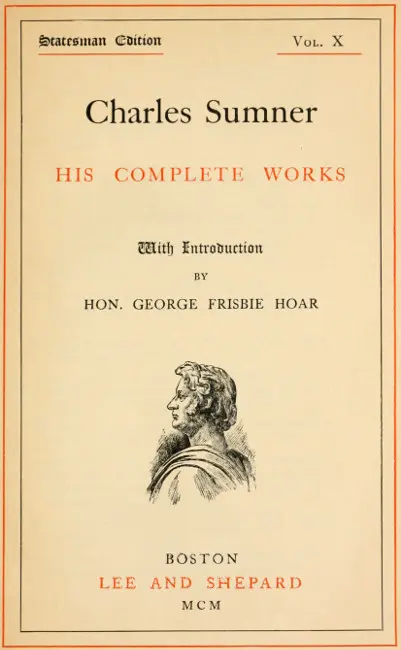
Charles Sumner: his complete works, volume 20 (of 20)
Charles Sumner
THE CLASSIC COLLECTION · 1872
"Charles Sumner: His Complete Works, Volume 10" by Charles Sumner is a historical account written in the late 19th century. This volume is part of a comprehensive collection of Sumner's speeches and writings, focusing on his discourse regarding the American Civil War, emphasizing issues of foreign relations, slavery, and the moral responsibilities of the United States amid conflict. Sumner, a prominent abolitionist and senator from Massachusetts, utilizes this work to advocate for human rights and to denounce the institutions that support slavery. The opening portion introduces Sumner's speech delivered at Cooper Institute in New York on September 10, 1863, wherein he addresses the potential dangers posed by England and France to American sovereignty during the Civil War. He discusses the perilous situation of the Union amid calls for foreign recognition of the Confederacy and the complicity of these nations with slavery. Sumner outlines several key areas of concern, including the nature of foreign intervention and the moral implications of acknowledging a regime built on slavery. He sets forth a detailed critique of the actions and policies of the British and French governments, reinforcing his belief that every inch of support for the Confederacy is a betrayal of the principles of liberty and civil rights.
Introduction adapted from the source catalogue; source summaries may be automatically generated.
Free to read · English · 116,772 words · No account needed
MAKE TIME FOR A GOOD BOOK
On by default. Untick to stop anonymous reading totals. Each page counts after 10 seconds in view. How this works.
Anonymous counting is on unless you have switched it off.
Though it be admitted that “ships of war,” like “munitions of war,” may be sold to a belligerent, as is asserted by the British Prime-Minister, echoing the Lord Chief Baron, it is obvious that it can be only with the distinction already mentioned, that the sale is a commercial transaction, pure and simple, and not in any respect a hostile expedition fitted out in England. The ship must be “exported” as an article of commerce, and must continue such until arrival at the belligerent port, where alone can it be fitted out and commissioned as a “ship of war,” when its hostile character will commence. Any attempt in England to impart a hostile character to the ship, or, in one word, to make England its naval base, must be criminal: but this is precisely what has been done. Ships are sent forth, armed and equipped. And, pray, how distinguish a ship armed and equipped from a regiment armed and equipped? It is not a munition, it is not even an article, but much more; and here is the distinction not to be overlooked. It is an organized force, and the nation sending it forth makes itself a party to the war,--all of which England has done. And here are the leonine footprints which point so badly.
(11.) Not content with misconstruing the decisions of our Supreme Court, making them a cover for naval expeditions to depredate on our commerce, our whole history is forgotten or misrepresented. It is forgotten, that, as early as 1793, under the administration of Washington, before any Act of Congress on the subject, the National Government recognized its liability, under the Law of Nations, for ships fitted out in its ports to depredate on British commerce; that Washington, in his speech at the opening of Congress, describes such ships as “vessels commissioned or equipped in a warlike form within the limits of the United States,” and also as “military expeditions or enterprises”;[29] and that Jefferson, vindicating this policy of repression, said, in a letter to the French Minister, that it was “our wish to preserve the morals of our citizens from being vitiated by courses of lawless plunder and murder”;[30] that, on this occasion, the National Government made the distinction between “munitions of war,” which a neutral might supply in the way of commerce to a belligerent, and “ships of war,” which a neutral was not allowed to supply or even to augment with arms; that Mr. Hammond, the British plenipotentiary at that time, by his letter of 8th May, 1793, after complaining of two French privateers, fitted out at Charleston to cruise against British commerce, expressly declares that “he conceives them to be breaches of that neutrality which the United States profess to observe, and direct contraventions of the proclamation which the President issued,”[31] and that very soon there were criminal proceedings, at British instigation, on account of these privateers, in which it was affirmed by the Court that such ships could not be fitted out in a neutral port without violation of international obligations; that promptly, on the representation of the British Government, a statute was enacted by Congress, in harmony with the Law of Nations, for the better maintenance of our neutrality;[32] that, in 1818, another statute followed in the nature of a Foreign Enlistment Act,[33] afterwards proposed as an example by Lord Castlereagh, when urging a similar statute upon Parliament;[34] that, in 1823, the conduct of the United States on this whole head was presented as a model by Mr. Canning;[35] that, in 1838, during the rebellion in Canada, on the appeal of the British Government, and to its special satisfaction, as was announced in Parliament by Lord Palmerston, at the time Foreign Secretary, our Government promptly declared its purpose “to maintain the supremacy of those laws which were passed to fulfil the obligations of the United States to all friendly nations who may be unfortunately engaged in foreign or domestic war,” and, not satisfied with existing powers, undertook to ask additional legislation from Congress; that Congress proceeded at once to the enactment of another statute, calculated to meet the immediate exigency, where it is provided that collectors, marshals, and other officers shall “seize and detain any vessel or any arms or munitions of war which may be provided or prepared for any military expedition or enterprise against the territory or dominions of any foreign prince or state.”[36] It is something to forget these things; but it is convenient to forget still further, that, at the Crimean War, in 1854, the British Government, jointly with France, made another appeal to the United States, that our citizens should “rigorously abstain from taking part in armaments of Russian privateers, or in any other measure opposed to the duties of a strict neutrality”;[37] and this appeal, declared by the British Government to be “in the spirit of just reciprocity,” was answered on our part by a sincere and determined vigilance, so that not a single British or French ship suffered from any cruiser fitted out in our ports. And it is also convenient to forget no less the solemn obligations of treaty, binding both parties:--
Your reading position is saved on this browser. Take it to another device with a library code. Reading pages adapt to text, rather than matching a printed edition.
Charles Sumner

Charles Sumner

Charles Sumner

Charles Sumner
BEHIND THE BOOK
This eBook is for the use of anyone anywhere in the United States and most other parts of the world at no cost and with almost no restrictions whatsoever. You may copy it, give it away or re-use it under the terms of the Project Gutenberg License included with this eBook or online at www.gutenberg.org. If you are not located in the United States, you will have to check the laws of the country where you are located before using this eBook. Read the source licence.
The original source file, including credits and licence, is retained by this library. Request an original-format copy at no charge. Please include the book title and Project Gutenberg identifier #48285.
KEEP YOUR CURIOSITY GOING

David Patterson (Spirit) Hatch

David Patterson (Spirit) Hatch

David Patterson (Spirit) Hatch
Cécile Tormay

Moritz Busch
John L. Ransom