
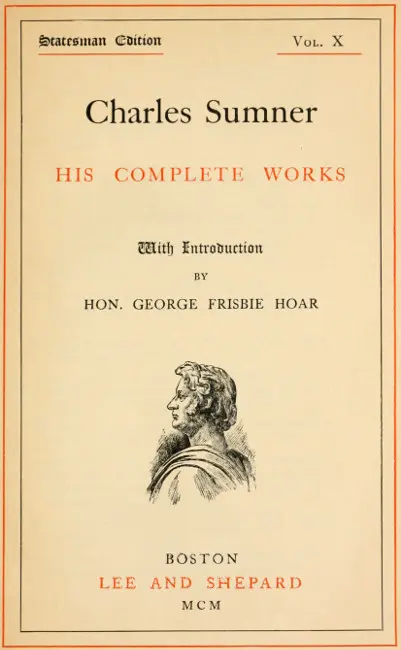
Charles Sumner: his complete works, volume 20 (of 20)
Charles Sumner
THE CLASSIC COLLECTION · 1872
"Charles Sumner: His Complete Works, Volume 10" by Charles Sumner is a historical account written in the late 19th century. This volume is part of a comprehensive collection of Sumner's speeches and writings, focusing on his discourse regarding the American Civil War, emphasizing issues of foreign relations, slavery, and the moral responsibilities of the United States amid conflict. Sumner, a prominent abolitionist and senator from Massachusetts, utilizes this work to advocate for human rights and to denounce the institutions that support slavery. The opening portion introduces Sumner's speech delivered at Cooper Institute in New York on September 10, 1863, wherein he addresses the potential dangers posed by England and France to American sovereignty during the Civil War. He discusses the perilous situation of the Union amid calls for foreign recognition of the Confederacy and the complicity of these nations with slavery. Sumner outlines several key areas of concern, including the nature of foreign intervention and the moral implications of acknowledging a regime built on slavery. He sets forth a detailed critique of the actions and policies of the British and French governments, reinforcing his belief that every inch of support for the Confederacy is a betrayal of the principles of liberty and civil rights.
Introduction adapted from the source catalogue; source summaries may be automatically generated.
Free to read · English · 116,772 words · No account needed
MAKE TIME FOR A GOOD BOOK
On by default. Untick to stop anonymous reading totals. Each page counts after 10 seconds in view. How this works.
Anonymous counting is on unless you have switched it off.
It is bad enough that all this should proceed from England. It is hard to bear. Why is it not stopped at once? One cruiser might, perhaps, elude a watchful government. But it is difficult to see how this can occur once, twice, three times,--and the cry is, Still they sail! Two powerful rams are announced, like stars at a theatre. Will they, also, be allowed to perform? I wish there were not too much reason to believe that all these performances are sustained by prevailing British sympathy. A Frenchman, accidentally prisoner on the Alabama at the destruction of two American ships, describes a British packet in sight whose crowded passengers made the sea resound with cheers, as they witnessed the captured ships handed over to the flames. The words of Lucretius were verified:--
“Suave etiam belli certamina magna tueri.”[23]
And these same cheers were echoed in Parliament, as the builder of the piratical craft gloried in his deed. The verse which filled the ancient theatre with glad applause declared sympathy with Humanity[24]; but English applause is now given to Slavery and its defenders: “I am an Englishman, and nothing of Slavery is foreign to me.” Accordingly, Slavery is helped by English arms, English gold, English ships, English speeches, English cheers. And yet, for the honor of England be it known, there are Englishmen who stand firm and unshaken amidst this painful recreancy. Their names cannot be forgotten. And still more for the honor of England be it spoken, the working classes, called to suffer the most, bravely bear their calamity, without joining the enemies of the Republic. Their cheers are for Freedom, and not for Slavery.
But the cheers of the House of Commons prevail in her Majesty’s Government. Municipal Law is violated, while International Law, in its most solemn obligation to do unto others as we would have them do unto us, is treated as the merest nullity. Eminent British functionaries, in Court and Parliament, vindicate the naval expeditions which in the name of Slavery are unleashed against a friendly power. Taking advantage of an admitted principle, that, after the concession of belligerent rights, “munitions of war” may be supplied, the Lord Chief Baron of the Exchequer tells us that “ships of war” may be supplied also. Lord Palmerston echoes Lord Chief Baron. Each vouches American authority. But they are mistaken. The steel which they strive to “impel” cannot be feathered from our sides. Since the earliest stage of its existence, the National Government has asserted a distinction between the two cases; and so has the Supreme Court, although there are words of Story latterly quoted to the contrary. The authority of the Supreme Court is positive on the two points into which the British apology is divided. The first is, that, even if a “ship of war” cannot be furnished, the offence is incomplete until the armament is put aboard, so that, where the ship, though fitted out and equipped in a British port, awaits an armament at sea, she is not liable to arrest. Such apology is an insult to the understanding and to common sense,--as if it were not obvious that the offence begins with the laying of the keel for the hostile ship, knowing it to be such:[25] and in this spirit the Supreme Court has decided that it is not necessary to find that a ship on leaving port was armed, or in a condition to commit hostilities; for citizens are restrained from such acts as are calculated to involve the country in war.[26] The second apology assumes, that, even if the armament were aboard, so that the “ship of war” is complete at all points, still the expedition would be lawful, if the fiction of a sale were adroitly managed. On this point, the Supreme Court, speaking by Chief-Justice Marshall, has left no doubt of its deliberate and most authoritative judgment. In the case before the Court the armament was aboard, but cleared as cargo; the men, too, were aboard, but enlisted for a commercial voyage; the ship, though fitted out to cruise against a nation with which we were at peace, was not commissioned as a privateer, and did not attempt to act as such, until she reached the river La Plata, where a commission was obtained and the crew reënlisted; yet, in the face of these extenuating circumstances, it was declared by the whole Court, that the neutrality of the United States had been violated, so that the guilty ship could not afterwards be recognized as a legitimate cruiser. All the disguises were to no purpose. The Court penetrated them every one, saying, that, if such a ship could lawfully sail, there would be on our part “a fraudulent neutrality, disgraceful to our own Government, and of which no nation would be the dupe.”[27] But a “neutrality” worse even than that condemned in advance by our Supreme Court, “of which no nation would be the dupe,” is now served out to us, which nothing can explain, short of the fatal war-spirit that has entered into Great Britain. There was a time when the Foreign Secretary of England, truly eminent as statesman and orator, Mr. Canning, said in the House of Commons: “If a war must come, let it come in the shape of satisfaction to be demanded for injuries, of rights to be asserted, of interests to be protected, of treaties to be fulfilled. But, in God’s name, let it not come on in the paltry, pettifogging way of fitting out ships in our harbors to cruise for gain. At all events, let the country disdain to be sneaked into a war.”[28] These noble words were uttered in reply to Lord John Russell and his associates in 1823, when trying to repeal the Foreign Enlistment Act, and to overturn the statute safeguards of British neutrality. They speak now with greater force even than then.
Your reading position is saved on this browser. Take it to another device with a library code. Reading pages adapt to text, rather than matching a printed edition.
Charles Sumner

Charles Sumner

Charles Sumner

Charles Sumner
BEHIND THE BOOK
This eBook is for the use of anyone anywhere in the United States and most other parts of the world at no cost and with almost no restrictions whatsoever. You may copy it, give it away or re-use it under the terms of the Project Gutenberg License included with this eBook or online at www.gutenberg.org. If you are not located in the United States, you will have to check the laws of the country where you are located before using this eBook. Read the source licence.
The original source file, including credits and licence, is retained by this library. Request an original-format copy at no charge. Please include the book title and Project Gutenberg identifier #48285.
KEEP YOUR CURIOSITY GOING

David Patterson (Spirit) Hatch

David Patterson (Spirit) Hatch

David Patterson (Spirit) Hatch
Cécile Tormay

Moritz Busch
John L. Ransom