
Charles Sumner: his complete works, volume 20 (of 20)
Charles Sumner
THE CLASSIC COLLECTION · 1872
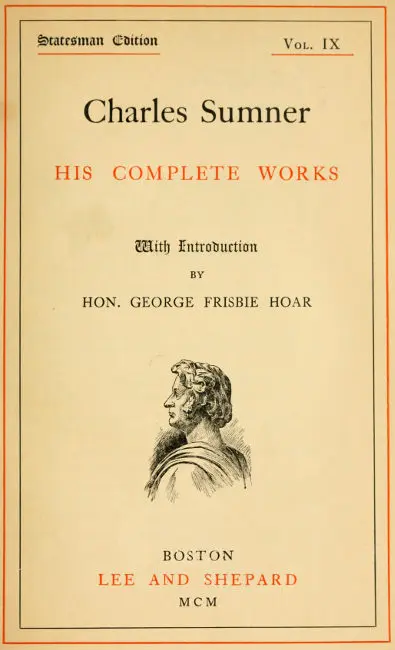
"Charles Sumner: His Complete Works, Volume 09" by Charles Sumner is a historical account written in the late 19th century. This volume focuses on a selection of speeches and writings by Sumner, a prominent abolitionist and U.S. Senator, addressing themes of civil rights, the powers of Congress during the Civil War, and the complexities of legality surrounding slavery and rebellion. The content showcases Sumner's efforts to intertwine legal, moral, and political arguments in his quest for justice and equality. The opening of this volume introduces a pivotal speech delivered by Sumner on May 19, 1862, which advocates for the confiscation of property owned by rebels and the emancipation of slaves held by those in rebellion against the United States. Sumner employs historical and legal references to assert that the ongoing Civil War is both rebellion and war, thus justifying Congress’s powers to act against traitors, both as criminals and enemies. He emphasizes the importance of remaining aligned with constitutional principles while arguing for decisive action to secure the nation’s unity and freedom for enslaved individuals. His compelling rhetoric and the historical context set the stage for a broader discussion on civil rights and governmental authority during a time of national crisis.
Introduction adapted from the source catalogue; source summaries may be automatically generated.
Free to read · English · 90,113 words · No account needed
MAKE TIME FOR A GOOD BOOK
On by default. Untick to stop anonymous reading totals. Each page counts after 10 seconds in view. How this works.
Anonymous counting is on unless you have switched it off.
Even if at another time the tax on cotton seemed politic, I doubt if it can be so regarded for some time to come. Considering the peculiar condition of things, there is small doubt that the country for the next five years will have greater interest in encouraging the production of cotton than in taxing it.
Sometimes it is said, that, if cotton is not taxed, the Cotton States will escape taxation, which would be a practical injustice to other parts of the country. But I am not satisfied that we cannot tax their slaves. Besides, the $200,000,000 of cotton exported assures the importation of $200,000,000 of foreign products, which, with twenty-five per cent duty, gives a revenue of $50,000,000 annually.
But if cotton must be taxed, it should not be by a specific tax, but by a tax ad valorem, and for obvious reason. Cotton is sold in the market under seven different grades, varying materially in value. These grades are classified as follows, beginning with the lowest or least valuable, and ending with the highest or most valuable: (1.) ordinary, (2.) good ordinary, (3.) low middling, (4.) middling, (5.) good middling, (6.) middling fair, (7.) Sea Island. For ten years, from 1850 to 1860, the average price of ordinary cotton was six and five eighths cents a pound, while middling fair, the highest grade except Sea Island, averaged twelve cents a pound. A tax of one cent a pound on ordinary cotton would be over fifteen per cent on its value, while one cent a pound on middling fair cotton would be eight and one third per cent, and the same tax on Sea Island cotton, commanding the highest price of all, would be less than five per cent.
The tax on cotton, if any is imposed, ought not to exceed five per cent ad valorem. In the natural course of events, without interruption of war, the cotton exported would have amounted in value for a year to $200,000,000. If to this we add the value of cotton used in the United States, $35,000,000, we shall have the sum-total of $235,000,000. A tax of five per cent ad valorem on this would be $11,750,000.
The proposed tax of one cent a pound is much larger. During the year ending the 30th of June, 1860, the value of the cotton exported was $191,806,555, and the number of pounds exported was 1,767,686,338. A tax of one cent a pound would be $17,676,863,--a very large sum, which I should be glad to pour into our Treasury. But, assuming the value of this cotton at ten and eight tenths cents a pound, the tax of one cent a pound will be above nine and one fourth per cent,--nearly double what the tax ought to be.
Your reading position is saved on this browser. Take it to another device with a library code. Reading pages adapt to text, rather than matching a printed edition.
Charles Sumner

Charles Sumner

Charles Sumner

Charles Sumner
BEHIND THE BOOK
This eBook is for the use of anyone anywhere in the United States and most other parts of the world at no cost and with almost no restrictions whatsoever. You may copy it, give it away or re-use it under the terms of the Project Gutenberg License included with this eBook or online at www.gutenberg.org. If you are not located in the United States, you will have to check the laws of the country where you are located before using this eBook. Read the source licence.
The original source file, including credits and licence, is retained by this library. Request an original-format copy at no charge. Please include the book title and Project Gutenberg identifier #48266.
KEEP YOUR CURIOSITY GOING

David Patterson (Spirit) Hatch

David Patterson (Spirit) Hatch

David Patterson (Spirit) Hatch
Cécile Tormay

Moritz Busch
John L. Ransom