
Charles Sumner: his complete works, volume 20 (of 20)
Charles Sumner
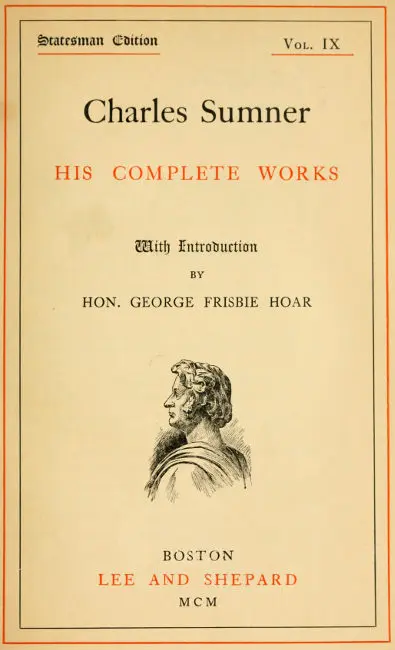
THE CLASSIC COLLECTION · 1872
"Charles Sumner: His Complete Works, Volume 09" by Charles Sumner is a historical account written in the late 19th century. This volume focuses on a selection of speeches and writings by Sumner, a prominent abolitionist and U.S. Senator, addressing themes of civil rights, the powers of Congress during the Civil War, and the complexities of legality surrounding slavery and rebellion. The content showcases Sumner's efforts to intertwine legal, moral, and political arguments in his quest for justice and equality. The opening of this volume introduces a pivotal speech delivered by Sumner on May 19, 1862, which advocates for the confiscation of property owned by rebels and the emancipation of slaves held by those in rebellion against the United States. Sumner employs historical and legal references to assert that the ongoing Civil War is both rebellion and war, thus justifying Congress’s powers to act against traitors, both as criminals and enemies. He emphasizes the importance of remaining aligned with constitutional principles while arguing for decisive action to secure the nation’s unity and freedom for enslaved individuals. His compelling rhetoric and the historical context set the stage for a broader discussion on civil rights and governmental authority during a time of national crisis.
Introduction adapted from the source catalogue; source summaries may be automatically generated.
Free to read · English · 90,113 words · No account needed
MAKE TIME FOR A GOOD BOOK
On by default. Untick to stop anonymous reading totals. Each page counts after 10 seconds in view. How this works.
Anonymous counting is on unless you have switched it off.
While it is easy to see that these interesting instances are only slightly applicable to our country, yet I do not disown any suggestion of caution or clemency they inculcate. Other instances in our own history are more applicable. All are aware that during the Revolution the property of Tories, loyalists, and refugees was confiscated; but I doubt if Senators know the extent to which this was done, or the animosity by which it was impelled. Out of many illustrations, I select the early language of the patriot Hawley, of Massachusetts, in a letter to Elbridge Gerry, under date of July 17, 1776. “Can we subsist,” said this patriot, “did any state ever subsist, without exterminating traitors?… It is amazingly wonderful, that, having no capital punishment for our intestine enemies, we have not been utterly ruined before now.”[42] The statutes of the time are most authentic testimony. I hold in my hand a list, amounting to eighty-eight in number, which I have arranged according to States. Some are very severe, as may be imagined from the titles, which I proceed to give; but they show, beyond assertion or argument, how, under the exigencies of war for National Independence, the power of confiscation was recognized and employed. Each title is a witness.
1. New Hampshire.--To confiscate estates of sundry persons therein named. November 28, 1778.
2. Massachusetts.--To prevent the return of certain persons therein named, and others who had left that State, or either of the United States, and joined the enemies thereof. 1778.
3. To confiscate the estates of certain notorious conspirators against the government and liberties of the inhabitants of the late Province, now State, of Massachusetts Bay. 1779.
4. For repealing two laws of the State, and for asserting the rights of that free and sovereign Commonwealth to expel such aliens as may be dangerous to the peace and good order of government. March 24, 1784.
5. In addition to an Act made and passed March 24, 1784, repealing two laws of this State. November 10, 1784.
6. Rhode Island.--To confiscate and sequester estates, and banish persons of certain descriptions. October, 1775.
7-13. To confiscate and sequester estates, and banish persons of certain descriptions. February, March, May, June, July, August, October, 1776.
14, 15. To confiscate and sequester estates, and banish persons of certain descriptions. February, October, 1778.
16-20. To confiscate and sequester estates, and banish persons
of certain descriptions. February, May, August, September,
October, 1779.
21-23. To confiscate and sequester estates, and banish persons of certain descriptions. July, September, October, 1780.
24, 25. To confiscate and sequester estates, and banish persons of certain descriptions. January, May, 1781.
26-28. To confiscate and sequester estates, and banish persons of certain descriptions. June, October, November, 1782.
29-32. To confiscate and sequester estates, and banish persons of certain descriptions. February, May, June, October, 1783.
Your reading position is saved on this browser. Take it to another device with a library code. Reading pages adapt to text, rather than matching a printed edition.
Charles Sumner

Charles Sumner

Charles Sumner

Charles Sumner
BEHIND THE BOOK
This eBook is for the use of anyone anywhere in the United States and most other parts of the world at no cost and with almost no restrictions whatsoever. You may copy it, give it away or re-use it under the terms of the Project Gutenberg License included with this eBook or online at www.gutenberg.org. If you are not located in the United States, you will have to check the laws of the country where you are located before using this eBook. Read the source licence.
The original source file, including credits and licence, is retained by this library. Request an original-format copy at no charge. Please include the book title and Project Gutenberg identifier #48266.
KEEP YOUR CURIOSITY GOING

David Patterson (Spirit) Hatch

David Patterson (Spirit) Hatch

David Patterson (Spirit) Hatch
Cécile Tormay

Moritz Busch
John L. Ransom