
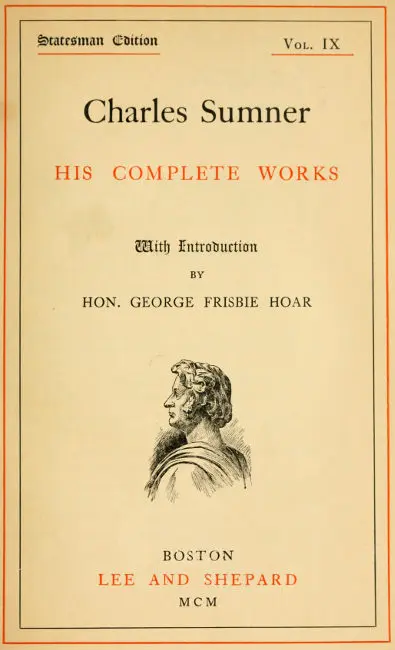
Charles Sumner: his complete works, volume 20 (of 20)
Charles Sumner
THE CLASSIC COLLECTION · 1872
"Charles Sumner: His Complete Works, Volume 09" by Charles Sumner is a historical account written in the late 19th century. This volume focuses on a selection of speeches and writings by Sumner, a prominent abolitionist and U.S. Senator, addressing themes of civil rights, the powers of Congress during the Civil War, and the complexities of legality surrounding slavery and rebellion. The content showcases Sumner's efforts to intertwine legal, moral, and political arguments in his quest for justice and equality. The opening of this volume introduces a pivotal speech delivered by Sumner on May 19, 1862, which advocates for the confiscation of property owned by rebels and the emancipation of slaves held by those in rebellion against the United States. Sumner employs historical and legal references to assert that the ongoing Civil War is both rebellion and war, thus justifying Congress’s powers to act against traitors, both as criminals and enemies. He emphasizes the importance of remaining aligned with constitutional principles while arguing for decisive action to secure the nation’s unity and freedom for enslaved individuals. His compelling rhetoric and the historical context set the stage for a broader discussion on civil rights and governmental authority during a time of national crisis.
Introduction adapted from the source catalogue; source summaries may be automatically generated.
Free to read · English · 90,113 words · No account needed
MAKE TIME FOR A GOOD BOOK
On by default. Untick to stop anonymous reading totals. Each page counts after 10 seconds in view. How this works.
Anonymous counting is on unless you have switched it off.
[95] Chap. 107, sec. 59.
[96] Chap. 34, sec. 11.
[97] Law and Practice of Legislative Assemblies, § 248, pp. 95, 96.
[98] Ibid., § 248 and note.
[99] Stansbury’s Report of the Trial of James H. Peck, Appendix, p. 499.
[100] System des heutigen Römischen Rechts, Band II. p. 329, § 97.
[101] Notes on Virginia, Query XIII.: Writings, Vol. VIII. p. 367.
[102] The Fugitive Slave Act.
[103] Milton, Of Reformation in England, Book II.: Prose Works, ed.
Symmons, Vol. I. p. 29.
[104] Senate Journal, July 17, 1862, pp. 872-874. Congressional Globe, 37th Cong. 2d Sess., p. 3406.
[105] Statutes at Large, Vol. XII. p. 627.
[106] Works (London, 1801), Vol. III. p. 69.
[107] At this Convention Mr. Sumner was nominated for reëlection as Senator. See, post, pp. 240, 241.
[108] United States Statutes at Large, Vol. XII., Appendix, p. 1267.
[109] The pen with which the President signed the final proclamation was given by him to George Livermore, author of the “Historical Research respecting the Opinions of the Founders of the Republic on Negroes as Slaves, as Citizens, and as Soldiers.”
[110] Joint Resolution on the Subject of Retaliation, May 1, 1863: Public Laws of the Confederate States of America, 1st Cong. 3d Sess., (Richmond, 1863,) p. 167.
[111] John A. Andrew.
[112] In the delivery of the speech Mr. Sumner was interrupted here by an inquiry from the audience: “What about that vacant chair?” Cries answered: “Put him out!” The Voice: “He challenges inquiry. I ask him, What about the vacant chair?” Repeated cries: “Put him out!” Mr. Sumner: “Let him stay. The gentleman asks about the vacant chair. I refer him to the history of my country for answer.” [Tremendous applause.]
[113] Here the same voice that had already interrupted said: “Without reservation?” Mr. Sumner replied: “Yes, without reservation.”
[114] Speech at Bristol, previous to the Election, 1780: Works (London, 1801), Vol. IV. pp. 72, 73.
[115] Horace, Epist. I. vi. 67, 68.
[116] Congressional Globe, 37th Cong. 2d Sess., p. 2342; Senate
Journal, p. 527.
[117] See, ante, Vol. VI. pp. 20-23.
[118] Letter to Doctor Gordon, July 16, 1788: Writings, Vol. II. pp.
426, 427.
[119] November 7, 1775: American Archives, Fourth Series, Vol. III.
col. 1385.
[120] November 27, 1775: Ibid., Vol. IV. col. 202.
[121] Letter to the Secretary of State, March 30, 1776: Ibid., Fifth
Series, Vol. II. col. 160.
[122] Letter to Joseph Reed, December 15, 1775: Life and Correspondence of Joseph Reed, Vol. I. p. 135.
[123] John Adams, Notes of Debates in the Continental Congress, October 6, 1775: Works, Vol. II. p. 458.
[124] An Historical Research, by George Livermore, p. 187.
[125] Proclamation, dated at Bermuda, April 2, 1814. An Exposition of the Causes and Character of the Late War, by A. J. Dallas, (Philadelphia, 1815,) p. 70. Life and Writings of A. J. Dallas, by his Son, G. M. Dallas, Appendix, No. 5, p. 356.
[126] Report of Quartermaster-General, November 15, 1841: Senate Documents, 27th Cong. 2d Sess., No. 1, p. 110.
[127] Works, Vol. II. p. 428.
[128] Secret Journals, Vol. I. p. 108. Ante, Vol. III. p. 403.
Your reading position is saved on this browser. Take it to another device with a library code. Reading pages adapt to text, rather than matching a printed edition.
Charles Sumner

Charles Sumner

Charles Sumner

Charles Sumner
BEHIND THE BOOK
This eBook is for the use of anyone anywhere in the United States and most other parts of the world at no cost and with almost no restrictions whatsoever. You may copy it, give it away or re-use it under the terms of the Project Gutenberg License included with this eBook or online at www.gutenberg.org. If you are not located in the United States, you will have to check the laws of the country where you are located before using this eBook. Read the source licence.
The original source file, including credits and licence, is retained by this library. Request an original-format copy at no charge. Please include the book title and Project Gutenberg identifier #48266.
KEEP YOUR CURIOSITY GOING

David Patterson (Spirit) Hatch

David Patterson (Spirit) Hatch

David Patterson (Spirit) Hatch
Cécile Tormay

Moritz Busch
John L. Ransom