
Charles Sumner: his complete works, volume 20 (of 20)
Charles Sumner
THE CLASSIC COLLECTION · 1900
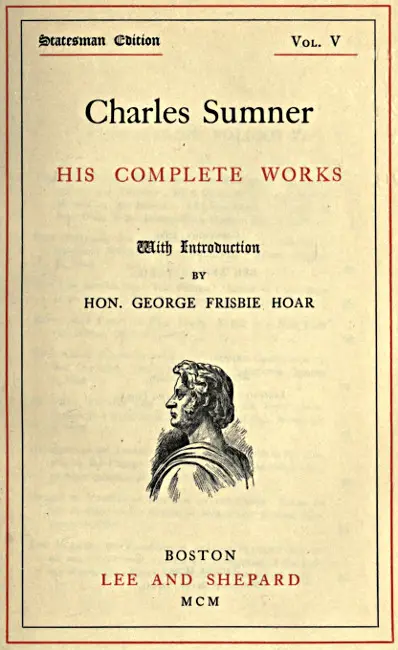
"Charles Sumner: his complete works, volume 05 (of 20)" by Charles Sumner is a historical collection of speeches and writings from the prominent abolitionist and senator, compiled during the mid-19th century. This volume particularly focuses on the moral and political arguments against slavery, documenting Sumner's impassioned calls for justice, liberty, and ethical governance in a nation grappling with the deeply entrenched institution of slavery. As a key figure in the fight for abolition, Sumner’s essays and addresses reveal not only his philosophy but also the broader socio-political climate of the time. The opening of this volume presents an address by Sumner, delivered before a large audience in New York in 1855, consisting of powerful rhetoric discussing the necessity, practicability, and dignity of the antislavery cause. He reflects on the transformation of public sentiment regarding slavery from its past oppression to a burgeoning movement for freedom, emphasizing the moral obligation to end the injustice. Sumner points out the legal and social dynamics of slavery while advocating for a unified front among the North to combat the tyranny of the slave system and its impact on both enslaved individuals and society at large. Through this address, he lays the groundwork for a compelling argument that resonates with the urgency and ethical imperatives of his time.
Introduction adapted from the source catalogue; source summaries may be automatically generated.
Free to read · English · 112,653 words · No account needed
MAKE TIME FOR A GOOD BOOK
On by default. Untick to stop anonymous reading totals. Each page counts after 10 seconds in view. How this works.
Anonymous counting is on unless you have switched it off.
[78] Statutes of the Territory of Kansas, passed at the First Session of the Legislative Assembly, 1855, and the Act of Congress organizing said Territory, and other Acts of Congress having immediate relation thereto, Shawnee M. L. School, 1855, Chap. 151, pp. 715-717. Mr. Sumner’s copy of this curious volume, which once belonged to Mr. Seward, is lettered on the back, “Laws of Kansas; Territorial Legislature, alias The Ruffians’ Legislature.”
[79] This story is told of Sir James Marriott, the Admiralty Judge. (Basil Montagu’s Essays: Barrister.) Something similar may be traced to Lord Mansfield, not usually pedantic or technical, in the Debate on the Right of Parliament to tax America, Feb. 10, 1766. (Hansard, Parliamentary History, XVI. 176.)
[80] Mr. Crampton, the British Minister at Washington, was dismissed. Lawrence’s Wheaton (ed. 1863), p. 438, note. See also Executive Documents, 34th Cong. 1st Sess., No. 107.
[81] Statutes at Large, Vol. I. p. 424.
[82] Ibid., Vol. II. p. 443.
[83] Mr. Douglas’s Report on the Affairs of Kansas: Senate Reports, 34th Cong. 1st Sess., No. 34, p. 29.
“Emigravit is the inscription on the tombstone where he lies.”
This is the verse of Longfellow on the artist Albert Dürer, buried at
Nuremberg.
[85] Livy, XXXVII. 46. See, also, Smith, Dictionary of Greek and Roman Antiquities, art. COLONIA.
[86] Massachusetts Special Laws, Vol. X. p. 282.
[87] Hon. John Carter Brown, of Providence, R. I.
[88] Hon. John M. S. Williams, of Cambridge, afterwards an earnest member of the Republican party, and for some time Chairman of its Republican State Committee, in Massachusetts.
[89] Hon. A. A. Lawrence, of Boston.
[90] Hon. Reuben A. Chapman, of Springfield, afterward Chief Justice of the Supreme Court of Massachusetts.
[91] Mr. Evans, of South Carolina, here interrupted Mr. Sumner to say that he did not know of any such address. Mr. Sumner replied, that “it was in a speech or letter of one of the gentlemen enlisted in obtaining emigrants in South Carolina.”--Congressional Globe, 34th Cong. 1st Sess., Appendix, p. 538.
[92] Mr. Douglas was born in Vermont.
[93] Mr. Butler, of South Carolina, in his two days’ speech reviewing and denouncing Mr. Sumner, while the latter was suffering at home, said of this passage: “The best part of his late speech is a periphrasis of Demosthenes, almost a servile imitation of the apostrophe of Demosthenes. I never saw such a remarkable resemblance.… I do not say it is a plagiarism; but it is a remarkable imitation, as far as one man incapable of comprehending the true spirit of Demosthenes could imitate him.”--Speech in the Senate, June 12th and 13th, 1856: Congressional Globe, 34th Cong. 1st Sess., Appendix, p. 634.
[94] At this point, Mr. Sumner, having spoken three hours, yielded for a motion to adjourn. On the next day, May 20th, he concluded.
[95] Hansard, Parliamentary History, XVIII. 33, 34.
Your reading position is saved on this browser. Take it to another device with a library code. Reading pages adapt to text, rather than matching a printed edition.
Charles Sumner

Charles Sumner

Charles Sumner

Charles Sumner
BEHIND THE BOOK
This eBook is for the use of anyone anywhere in the United States and most other parts of the world at no cost and with almost no restrictions whatsoever. You may copy it, give it away or re-use it under the terms of the Project Gutenberg License included with this eBook or online at www.gutenberg.org. If you are not located in the United States, you will have to check the laws of the country where you are located before using this eBook. Read the source licence.
The original source file, including credits and licence, is retained by this library. Request an original-format copy at no charge. Please include the book title and Project Gutenberg identifier #48035.
KEEP YOUR CURIOSITY GOING

David Patterson (Spirit) Hatch

David Patterson (Spirit) Hatch

David Patterson (Spirit) Hatch
Cécile Tormay

Moritz Busch
John L. Ransom