
Charles Sumner: his complete works, volume 20 (of 20)
Charles Sumner
THE CLASSIC COLLECTION · 1900
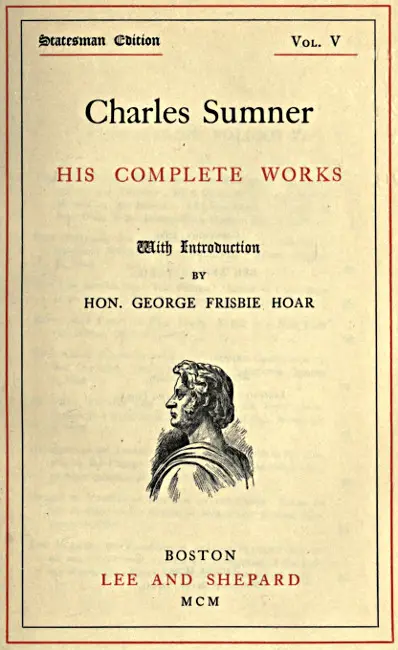
"Charles Sumner: his complete works, volume 05 (of 20)" by Charles Sumner is a historical collection of speeches and writings from the prominent abolitionist and senator, compiled during the mid-19th century. This volume particularly focuses on the moral and political arguments against slavery, documenting Sumner's impassioned calls for justice, liberty, and ethical governance in a nation grappling with the deeply entrenched institution of slavery. As a key figure in the fight for abolition, Sumner’s essays and addresses reveal not only his philosophy but also the broader socio-political climate of the time. The opening of this volume presents an address by Sumner, delivered before a large audience in New York in 1855, consisting of powerful rhetoric discussing the necessity, practicability, and dignity of the antislavery cause. He reflects on the transformation of public sentiment regarding slavery from its past oppression to a burgeoning movement for freedom, emphasizing the moral obligation to end the injustice. Sumner points out the legal and social dynamics of slavery while advocating for a unified front among the North to combat the tyranny of the slave system and its impact on both enslaved individuals and society at large. Through this address, he lays the groundwork for a compelling argument that resonates with the urgency and ethical imperatives of his time.
Introduction adapted from the source catalogue; source summaries may be automatically generated.
Free to read · English · 112,653 words · No account needed
MAKE TIME FOR A GOOD BOOK
On by default. Untick to stop anonymous reading totals. Each page counts after 10 seconds in view. How this works.
Anonymous counting is on unless you have switched it off.
[43] Journals of the House of Commons, Vol. IX. p. 509. May’s Law of Parliament, p. 407, ed. 1851.
[44] May’s Law of Parliament, pp. 415, 418.
[45] Ibid., p. 425.
[46] Hon. George P. Marsh.
[47] Webster’s Works, Vol. VI. pp. 406, 409.
[48] Wheaton, Elements of International Law (ed. Lawrence, 1863), note, pp. 334, 335, Part II. Ch. 4.
[49] Exec. Doc., 34th Cong. 1st Sess., 1855-56, No. 1, p. 9.
[50] Ibid., p. 30.
[51] Commentaries on the Constitution, § 1838.
[52] Foster et al. v. Neilson, 2 Peters, 314
[53] Ware v. Hylton et al., 3 Dallas, 284.
[54] Ibid., 261.
[55] 1 United States Statutes at Large, 578.
[56] Annals of Congress, 5th Cong., 1797-1799, col. 2120.
[57] Ibid., col. 2123.
[58] Ibid., col. 2126.
[59] Executive Documents, 29th Cong. 1st Sess., No. 2, p. 11.
[60] 9 United States Statutes at Large, pp. 109, 110.
[61] Executive Documents, 33d Cong. 1st Sess., 1853-54, No. 108, pp.
40, 42.
[62] United States Statutes at Large, Vol. XI. p. 720. Wheaton, Elements of International Law (ed. Lawrence, 1863), note, p. 335, Part II. Ch. 4.
[63] This illustration, deemed necessary to expose the hateful violence to a beautiful region for the sake of Slavery, was denounced by Mr. Cass, in the Senate, while Mr. Sumner was absent, as “an unpatriotic metaphor”, and the critical Senator added: “I believe that hundreds of thousands of copies of that production which contains this passage, and many others equally objectionable, were sent through the country during the last Presidential election.”--Congressional Globe, 34th Cong. 3d Sess., p. 90, December 11, 1856.
[64] Florus, Epitome Rerum Romanarum, Lib. IV. cap. 2, § 4. Five years later the fury of the propagandists broke forth in the war here foretold.
[65] Congressional Globe, 34th Cong. 1st Sess., Appendix, p. 107,
February 28, 1856.
[66] Hildreth, History of the United States, Vol. VI. p. 713.
[67] Referring to this provision of the Missouri Bill, Mr. Niles italicizes “forever,” thus showing his construction of the word.--Niles’s Weekly Register, March 11, 1820.
[68] This letter, which the Columbian Centinel, of Boston, April 1, 1820, properly styles “tell-tale,” was addressed to the Editor of the Charleston City Gazette, under date of March 2, 1820.
[69] Act to organize the Territories of Nebraska and Kansas, Sec. 14: Statutes at Large, Vol. X. p. 283.
[70] Senator of Missouri at Washington from 1843 to 1855, and for several sessions President pro tempore of the Senate.
[71] Message relative to Affairs in the Territory of Kansas, January 24, 1856: Executive Documents, 34th Cong. 1st Sess., No. 28, p. 4.
[72] Hon. S. C. Pomeroy, afterwards for many years Senator of Kansas at
Washington.
[73] Hon. Wilson Shannon.
[74] Burke, Speech in the Impeachment of Warren Hastings, February 16, 1788: Works (London, 1822), Vol. XIII. p. 202.
[75] Horatio Greenough, the earliest of our sculptors, and also
excellent with his pen.
[76] Cicero, Oratio in Catilinam I. 12.
[77] This review Mr. Sumner was disabled from making, as will appear in
the sequel.
Your reading position is saved on this browser. Take it to another device with a library code. Reading pages adapt to text, rather than matching a printed edition.
Charles Sumner

Charles Sumner

Charles Sumner

Charles Sumner
BEHIND THE BOOK
This eBook is for the use of anyone anywhere in the United States and most other parts of the world at no cost and with almost no restrictions whatsoever. You may copy it, give it away or re-use it under the terms of the Project Gutenberg License included with this eBook or online at www.gutenberg.org. If you are not located in the United States, you will have to check the laws of the country where you are located before using this eBook. Read the source licence.
The original source file, including credits and licence, is retained by this library. Request an original-format copy at no charge. Please include the book title and Project Gutenberg identifier #48035.
KEEP YOUR CURIOSITY GOING

David Patterson (Spirit) Hatch

David Patterson (Spirit) Hatch

David Patterson (Spirit) Hatch
Cécile Tormay

Moritz Busch
John L. Ransom