
Charles Sumner: his complete works, volume 20 (of 20)
Charles Sumner
THE CLASSIC COLLECTION · 1900
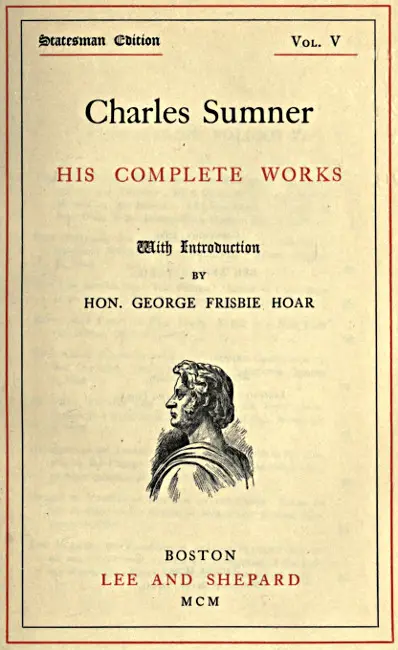
"Charles Sumner: his complete works, volume 05 (of 20)" by Charles Sumner is a historical collection of speeches and writings from the prominent abolitionist and senator, compiled during the mid-19th century. This volume particularly focuses on the moral and political arguments against slavery, documenting Sumner's impassioned calls for justice, liberty, and ethical governance in a nation grappling with the deeply entrenched institution of slavery. As a key figure in the fight for abolition, Sumner’s essays and addresses reveal not only his philosophy but also the broader socio-political climate of the time. The opening of this volume presents an address by Sumner, delivered before a large audience in New York in 1855, consisting of powerful rhetoric discussing the necessity, practicability, and dignity of the antislavery cause. He reflects on the transformation of public sentiment regarding slavery from its past oppression to a burgeoning movement for freedom, emphasizing the moral obligation to end the injustice. Sumner points out the legal and social dynamics of slavery while advocating for a unified front among the North to combat the tyranny of the slave system and its impact on both enslaved individuals and society at large. Through this address, he lays the groundwork for a compelling argument that resonates with the urgency and ethical imperatives of his time.
Introduction adapted from the source catalogue; source summaries may be automatically generated.
Free to read · English · 112,653 words · No account needed
MAKE TIME FOR A GOOD BOOK
On by default. Untick to stop anonymous reading totals. Each page counts after 10 seconds in view. How this works.
Anonymous counting is on unless you have switched it off.
“Our citizens have been shot at, and in two instances murdered, our houses invaded, hay-ricks burnt, corn and other provisions plundered, cattle driven off, all communication cut off between us and the States, wagons on the way to us with provisions stopped and plundered, and the drivers taken prisoners, and we in hourly expectation of an attack. Nearly every man has been in arms in the village. Fortifications have been thrown up, by incessant labor night and day. The sound of the drum and the tramp of armed men resounded through our streets, families fleeing with their household goods for safety. Day before yesterday the report of cannon was heard at our house, from the direction of Lecompton. Last Thursday one of our neighbors,--one of the most peaceable and excellent of men, from Ohio,--on his way home, was set upon by a gang of twelve men on horseback, and shot down. Over eight hundred men are gathered under arms at Lawrence. As yet no act of violence has been perpetrated by those on our side. No blood of retaliation stains our hands. We stand, and are ready to act, purely in the defence of our homes and lives.”
The catalogue is not yet complete. On the 15th of December, when the people assembled to vote on the Constitution submitted for adoption, only a few days after the Treaty of Peace between the Governor on the one side and the town of Lawrence on the other, another and fifth irruption was made. But I leave all this untold. Enough of these details has been given.
Five several times and more have these invaders entered Kansas in armed array, and thus five several times and more have they trampled upon the organic law of the Territory. These extraordinary expeditions are simply the extraordinary witnesses to successive, uninterrupted violence. They stand out conspicuous, but not alone. The spirit of evil, in which they had their origin, is wakeful and incessant. From the beginning it hung upon the skirts of this interesting Territory, harrowing its peace, disturbing its prosperity, and keeping its inhabitants under the painful alarms of war. All security of person, property, and labor was overthrown; and when I urge this incontrovertible fact, I set forth a wrong which is small only by the side of the giant wrong for the consummation of which all this is done. Sir, what is man, what is government, without security, in the absence of which nor man nor government can proceed in development or enjoy the fruits of existence? Without security civilization is cramped and dwarfed. Without security there is no true Freedom. Nor shall I say too much, when I declare that security, guarded of course by its parent Freedom, is the true end and aim of government. Of this indispensable boon the people of Kansas are despoiled,--absolutely, totally. All this is aggravated by the nature of their pursuits, rendering them peculiarly sensitive to interruption, and at the same time attesting their innocence. They are for the most part engaged in the cultivation of the soil, which from time immemorial has been the sweet employment of undisturbed industry. Contented in the returns of bounteous Nature and the shade of his own trees, the husbandman is not aggressive; accustomed to produce, and not to destroy, he is essentially peaceful, unless his home is invaded, when his arm derives vigor from the soil he treads, and his soul inspiration from the heavens beneath whose canopy he daily toils. Such are the people of Kansas, whose security has been overthrown. Scenes from which Civilization averts her countenance are part of their daily life. Border incursions, which in barbarous ages or barbarous lands fretted and harried an exposed people, are here renewed, with this peculiarity, that our border robbers do not simply levy blackmail and drive off a few cattle, like those who acted under the inspiration of the Douglas of other days,--they do not seize a few persons, and sweep them away into captivity, like the African slave-traders, whom we brand as pirates,--but they commit a succession of deeds in which border sorrows and African wrongs are revived together on American soil, while, for the time being, all protection is annulled, and the whole Territory is enslaved.
Your reading position is saved on this browser. Take it to another device with a library code. Reading pages adapt to text, rather than matching a printed edition.
Charles Sumner

Charles Sumner

Charles Sumner

Charles Sumner
BEHIND THE BOOK
This eBook is for the use of anyone anywhere in the United States and most other parts of the world at no cost and with almost no restrictions whatsoever. You may copy it, give it away or re-use it under the terms of the Project Gutenberg License included with this eBook or online at www.gutenberg.org. If you are not located in the United States, you will have to check the laws of the country where you are located before using this eBook. Read the source licence.
The original source file, including credits and licence, is retained by this library. Request an original-format copy at no charge. Please include the book title and Project Gutenberg identifier #48035.
KEEP YOUR CURIOSITY GOING

David Patterson (Spirit) Hatch

David Patterson (Spirit) Hatch

David Patterson (Spirit) Hatch
Cécile Tormay

Moritz Busch
John L. Ransom