
Charles Sumner: his complete works, volume 20 (of 20)
Charles Sumner
THE CLASSIC COLLECTION · 1900
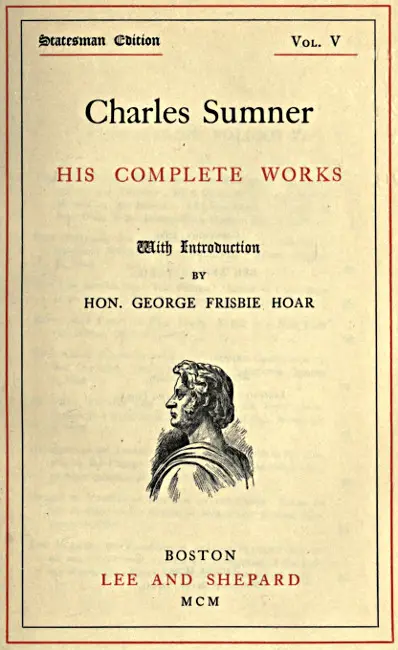
"Charles Sumner: his complete works, volume 05 (of 20)" by Charles Sumner is a historical collection of speeches and writings from the prominent abolitionist and senator, compiled during the mid-19th century. This volume particularly focuses on the moral and political arguments against slavery, documenting Sumner's impassioned calls for justice, liberty, and ethical governance in a nation grappling with the deeply entrenched institution of slavery. As a key figure in the fight for abolition, Sumner’s essays and addresses reveal not only his philosophy but also the broader socio-political climate of the time. The opening of this volume presents an address by Sumner, delivered before a large audience in New York in 1855, consisting of powerful rhetoric discussing the necessity, practicability, and dignity of the antislavery cause. He reflects on the transformation of public sentiment regarding slavery from its past oppression to a burgeoning movement for freedom, emphasizing the moral obligation to end the injustice. Sumner points out the legal and social dynamics of slavery while advocating for a unified front among the North to combat the tyranny of the slave system and its impact on both enslaved individuals and society at large. Through this address, he lays the groundwork for a compelling argument that resonates with the urgency and ethical imperatives of his time.
Introduction adapted from the source catalogue; source summaries may be automatically generated.
Free to read · English · 112,653 words · No account needed
MAKE TIME FOR A GOOD BOOK
On by default. Untick to stop anonymous reading totals. Each page counts after 10 seconds in view. How this works.
Anonymous counting is on unless you have switched it off.
With this force they were able, on the succeeding day, in some places, to intimidate the judges of elections, in others to substitute judges of their own appointment, in others to wrest the ballot-boxes from their rightful possessors, and everywhere to exercise a complete control of the election, and thus, by preternatural audacity of usurpation, impose a Legislature upon the free people of Kansas. Thus was conquered the Sebastopol of that Territory!
It was not enough to secure the Legislature. The election of a member of Congress recurred on the 1st of October, 1855, and the same foreigners, who had learned their strength, again manifested it. Another invasion, in controlling numbers, came from Missouri, and once more forcibly exercised the electoral franchise in Kansas.
At last, in the latter days of November, 1855, a storm, long gathering, burst upon the heads of the devoted people. The ballot-boxes had been violated, and a Legislature installed, which proceeded to carry out the conspiracy of the invaders; but the good people of the Territory, born to Freedom, and educated as American citizens, showed no signs of submission. Slavery, though recognized by pretended law, was in many places practically an outlaw. To the lawless borderers this was hard to bear; and, like the heathen of old, they raged, particularly against the town of Lawrence, already known, by the firmness of its principles and the character of its citizens, as citadel of the good cause. On this account they threatened, in their peculiar language, to “wipe it out.” Soon the hostile power was gathered for this purpose. The wickedness of this invasion was enhanced by the way in which it began. A citizen of Kansas, by the name of Dow, was murdered by a partisan of Slavery, in the name of “law and order.” Such an outrage naturally aroused indignation and provoked threats. The professors of “law and order” allowed the murderer to escape, and, still further to illustrate the irony of the name they assumed, seized the friend of the murdered man, whose few neighbors soon rallied for his rescue. This transaction, though totally disregarded in its chief front of wickedness, became the excuse for unprecedented excitement. The weak Governor,[73] with no faculty higher than servility to Slavery,--whom the President, in official delinquency, had appointed to a trust worthy only of a well-balanced character,--was frightened from his propriety. By proclamation he invoked the Territory. By telegraph he invoked the President. The Territory would not respond to his senseless appeal. The President was false. But the proclamation was circulated throughout the border counties of Missouri; and Platte, Clay, Carroll, Saline, Howard, and Jackson, each of them, contributed a volunteer company, recruited from the roadsides, and armed with weapons which chance afforded, known as “the shot-gun militia,”--with a Missouri officer as commissary-general, dispensing rations, and another Missouri officer as general-in-chief,--with two wagon-loads of rifles, belonging to Missouri, drawn by six mules, from its arsenal at Jefferson City,--with seven pieces of cannon, belonging to the United States, from its arsenal at Liberty; and this formidable force, amounting to at least 1,800 men, terrible with threats, oaths, and whiskey, crossed the borders, and encamped in larger part on the Wakarusa, over against the doomed town of Lawrence, now threatened with destruction. With these invaders was the Governor, who by this act levied war upon the people he was sent to protect. In camp with him was the original Catiline of the conspiracy, while by his side were the docile Chief Justice and the docile Judges. But this is not the first instance in which an unjust governor has found tools where he ought to have found justice. In the great impeachment of Warren Hastings, the British orator by whom it was conducted exclaims, in words strictly applicable to the misdeed I here denounce: “Had he not the Chief Justice, the tamed and domesticated Chief Justice, who waited on him like a familiar spirit?”[74] Thus was this invasion countenanced by those who should have stood in the breach against it. For more than a week it continued, while deadly conflict was imminent. I do not dwell on the heroism by which it was encountered, or the mean retreat to which it was compelled; for that is not necessary in exhibiting the Crime which you are to judge. But I cannot forbear to add other features, furnished in a letter written at the time by a clergyman, who saw and was part of what he describes.
Your reading position is saved on this browser. Take it to another device with a library code. Reading pages adapt to text, rather than matching a printed edition.
Charles Sumner

Charles Sumner

Charles Sumner

Charles Sumner
BEHIND THE BOOK
This eBook is for the use of anyone anywhere in the United States and most other parts of the world at no cost and with almost no restrictions whatsoever. You may copy it, give it away or re-use it under the terms of the Project Gutenberg License included with this eBook or online at www.gutenberg.org. If you are not located in the United States, you will have to check the laws of the country where you are located before using this eBook. Read the source licence.
The original source file, including credits and licence, is retained by this library. Request an original-format copy at no charge. Please include the book title and Project Gutenberg identifier #48035.
KEEP YOUR CURIOSITY GOING

David Patterson (Spirit) Hatch

David Patterson (Spirit) Hatch

David Patterson (Spirit) Hatch
Cécile Tormay

Moritz Busch
John L. Ransom