
Charles Sumner: his complete works, volume 20 (of 20)
Charles Sumner
THE CLASSIC COLLECTION · 1900
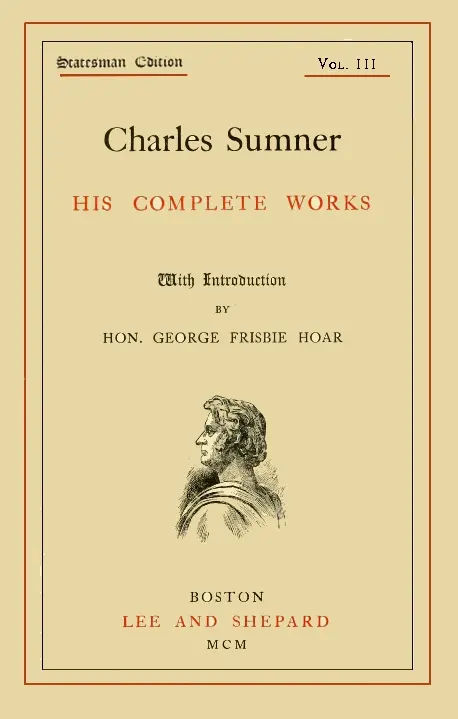
"Charles Sumner: his complete works, volume 03 (of 20)" by Charles Sumner is a historical collection written in the late 19th century. This volume of Sumner's works includes speeches, letters, and addresses primarily focused on the principles of liberty, equality, and the fight against slavery. Sumner, a prominent abolitionist and senator, addresses pivotal topics during a time of significant social and political upheaval in America. The opening of the volume introduces Sumner's impassioned commitment to the abolition of slavery and the importance of adhering to the Declaration of Independence. He expresses his regret for not being able to attend a public meeting celebrating the Ordinance of Freedom in Ohio, emphasizing the need for the national government to be emancipated from the control of slavery. In subsequent portions, he delivers a speech to the Free-Soil Party convention, reinforcing the idea that their party's core mission aligns with the ideals of freedom and human rights. Sumner's rhetoric is rich with historical references and appeals to moral responsibility, setting the stage for his influential arguments against the injustices of slavery and for the advancement of freedom in America.
Introduction adapted from the source catalogue; source summaries may be automatically generated.
Free to read · English · 105,117 words · No account needed
MAKE TIME FOR A GOOD BOOK
On by default. Untick to stop anonymous reading totals. Each page counts after 10 seconds in view. How this works.
Anonymous counting is on unless you have switched it off.
There is one other special provision of the Constitution, which I have reserved to this stage, not so much from its superior importance, but because it fitly stands by itself. This alone, if practically applied, would carry Freedom to all within its influence. It is an Amendment proposed by the First Congress, as follows:--
"No person shall be deprived of life, liberty, or property, without due process of law."
Under this great ægis the liberty of every person within the national jurisdiction is unequivocally placed. I say every person. Of this there can be no question. The word "person" in the Constitution embraces every human being within its sphere, whether Caucasian, Indian, or African, from the President to the slave. Show me a person within the national jurisdiction, and I confidently claim for him this protection, no matter what his condition or race or color. The natural meaning of the clause is clear, but a single fact of its history places it in the broad light of noon. As originally recommended by Virginia, North Carolina, and Rhode Island, it was restricted to the freeman. Its language was, "No freeman ought to be deprived of his life, liberty, or property, but by the law of the land."[153] In rejecting this limitation, the authors of the Amendment revealed their purpose, that no person, under the National Government, of whatever character, should be deprived of liberty without due process of law,--that is, without due presentment, indictment, or other judicial proceeding. But this Amendment is nothing less than an express guaranty of Personal Liberty, and an express prohibition of its invasion anywhere, at least within the national jurisdiction.
[153] Journal of Federal Convention, Supplement, pp. 419, 441, 455. Elliot's Debates, II. 484, III. 211, IV. 223.
Sir, apply these principles, and Slavery will again be as when Washington took his first oath as President. The Union Flag of the Republic will become once more the flag of Freedom, and at all points within the national jurisdiction will refuse to cover a slave. Beneath its beneficent folds, wherever it is carried, on land or sea, Slavery will disappear, like darkness under the arrows of the ascending sun,--like the Spirit of Evil before the Angel of the Lord.
In all national territories Slavery will be impossible.
On the high seas, under the national flag, Slavery will be impossible.
In the District of Columbia Slavery will instantly cease.
Inspired by these principles, Congress can give no sanction to Slavery by the admission of new Slave States.
Nowhere under the Constitution can the Nation, by legislation or otherwise, support Slavery, hunt slaves, or hold property in man.
Your reading position is saved on this browser. Take it to another device with a library code. Reading pages adapt to text, rather than matching a printed edition.
Charles Sumner

Charles Sumner

Charles Sumner

Charles Sumner
BEHIND THE BOOK
This eBook is for the use of anyone anywhere in the United States and most other parts of the world at no cost and with almost no restrictions whatsoever. You may copy it, give it away or re-use it under the terms of the Project Gutenberg License included with this eBook or online at www.gutenberg.org. If you are not located in the United States, you will have to check the laws of the country where you are located before using this eBook. Read the source licence.
The original source file, including credits and licence, is retained by this library. Request an original-format copy at no charge. Please include the book title and Project Gutenberg identifier #45637.
KEEP YOUR CURIOSITY GOING

David Patterson (Spirit) Hatch

David Patterson (Spirit) Hatch

David Patterson (Spirit) Hatch
Cécile Tormay

Moritz Busch
John L. Ransom