
Charles Sumner: his complete works, volume 20 (of 20)
Charles Sumner
THE CLASSIC COLLECTION · 1900
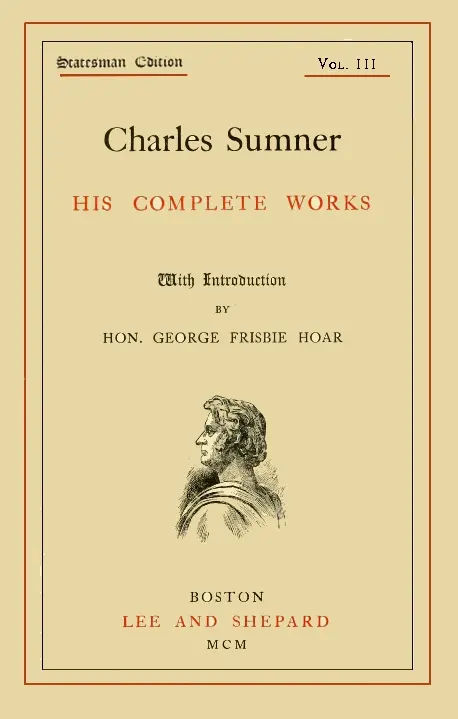
"Charles Sumner: his complete works, volume 03 (of 20)" by Charles Sumner is a historical collection written in the late 19th century. This volume of Sumner's works includes speeches, letters, and addresses primarily focused on the principles of liberty, equality, and the fight against slavery. Sumner, a prominent abolitionist and senator, addresses pivotal topics during a time of significant social and political upheaval in America. The opening of the volume introduces Sumner's impassioned commitment to the abolition of slavery and the importance of adhering to the Declaration of Independence. He expresses his regret for not being able to attend a public meeting celebrating the Ordinance of Freedom in Ohio, emphasizing the need for the national government to be emancipated from the control of slavery. In subsequent portions, he delivers a speech to the Free-Soil Party convention, reinforcing the idea that their party's core mission aligns with the ideals of freedom and human rights. Sumner's rhetoric is rich with historical references and appeals to moral responsibility, setting the stage for his influential arguments against the injustices of slavery and for the advancement of freedom in America.
Introduction adapted from the source catalogue; source summaries may be automatically generated.
Free to read · English · 105,117 words · No account needed
MAKE TIME FOR A GOOD BOOK
On by default. Untick to stop anonymous reading totals. Each page counts after 10 seconds in view. How this works.
Anonymous counting is on unless you have switched it off.
[151] Opinion against the Constitutionality of a National Bank, Feb. 15, 1791: Memoir, Correspondence, etc., Vol. IV. p. 523; Writings, Vol. VII. p. 556. See also Letter to Judge Johnson, June 12, 1823: Memoir, Correspondence, etc., Vol. IV. p. 374; Works, Vol. VII. p. 297.
[152] Debates, etc., of the Massachusetts Convention, February 1, 1788. See also Life of Samuel Adams, by William V. Wells, Vol. III. pp. 271, 272, 325, 331.
Beyond all question, the National Government, ordained by the Constitution, is not general or universal, but special and particular. It is a government of limited powers. It has no power which is not delegated. Especially is this clear with regard to an institution like Slavery. The Constitution contains no power to make a king, or to support kingly rule. With similar reason it may be said, that it contains no power to make a slave, or to support a system of Slavery. The absence of all such power is hardly more clear in the one case than in the other. But if there be no such power, all national legislation upholding Slavery must be unconstitutional and void. The stream cannot be higher than the fountain-head. Nay, more, nothing can come out of nothing; the stream cannot exist, if there be no spring from which it is fed.
At the risk of repetition, but for the sake of clearness, review now this argument, and gather it together. Considering that Slavery is of such an offensive character that it can find sanction only in "positive law," and that it has no such "positive" sanction in the Constitution,--that the Constitution, according to its Preamble, was ordained to "establish justice" and "secure the blessings of liberty,"--that, in the Convention which framed it, and also elsewhere at the time, it was declared not to sanction Slavery,--that, according to the Declaration of Independence, and the Address of the Continental Congress, the Nation was dedicated to "Liberty," and the "rights of human nature,"--that, according to the principles of the Common Law, the Constitution must be interpreted openly, actively, and perpetually for Freedom,--that, according to the decision of the Supreme Court, it acts upon slaves, not as property, but as PERSONS,--that, at the first organization of the National Government under Washington, Slavery had no national favor, existed nowhere on the national territory, beneath the national flag, but was openly condemned by Nation, Church, Colleges, and Literature of the time,--and, finally, that, according to an Amendment of the Constitution, the National Government can exercise only powers delegated to it, among which is none to support Slavery,--considering these things, Sir, it is impossible to avoid the single conclusion, that Slavery is in no respect a national institution, and that the Constitution nowhere upholds property in man.
Your reading position is saved on this browser. Take it to another device with a library code. Reading pages adapt to text, rather than matching a printed edition.
Charles Sumner

Charles Sumner

Charles Sumner

Charles Sumner
BEHIND THE BOOK
This eBook is for the use of anyone anywhere in the United States and most other parts of the world at no cost and with almost no restrictions whatsoever. You may copy it, give it away or re-use it under the terms of the Project Gutenberg License included with this eBook or online at www.gutenberg.org. If you are not located in the United States, you will have to check the laws of the country where you are located before using this eBook. Read the source licence.
The original source file, including credits and licence, is retained by this library. Request an original-format copy at no charge. Please include the book title and Project Gutenberg identifier #45637.
KEEP YOUR CURIOSITY GOING

David Patterson (Spirit) Hatch

David Patterson (Spirit) Hatch

David Patterson (Spirit) Hatch
Cécile Tormay

Moritz Busch
John L. Ransom