
Charles Sumner: his complete works, volume 20 (of 20)
Charles Sumner
THE CLASSIC COLLECTION · 1900
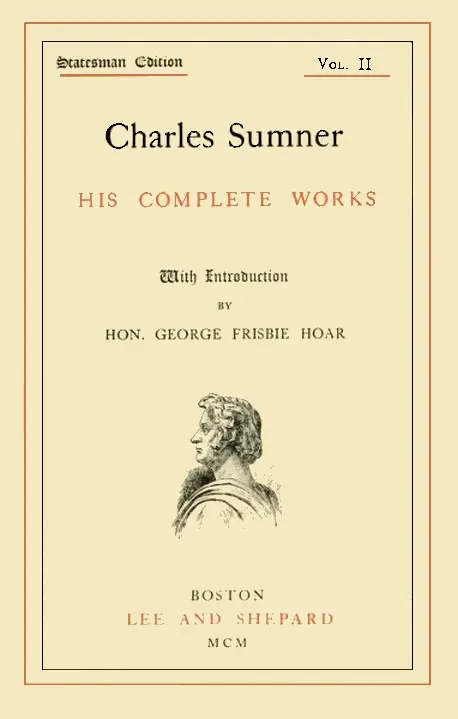
"Charles Sumner: his complete works, volume 02 (of 20)" by Charles Sumner is a historical collection of lectures, speeches, and writings written in the mid-19th century. This volume prominently tackles the theme of slavery, with particular focus on the injustices of both white slavery in the Barbary States and black slavery in America. It features a range of oratory efforts, advocating for human rights and the abolition of slavery as a moral and political imperative. The opening of this volume presents a lecture given by Sumner titled "White Slavery in the Barbary States," which elaborates on the historical context and moral implications of slavery both historically and in his contemporary society. He explores the origins and definitions of slavery, emphasizing that it is rooted in violence and force rather than justice or rights. Through this lens, he compares the plight of enslaved whites in North Africa to that of enslaved African Americans, revealing the complexities and shared horrors of servitude. The preliminary narrative sets the stage for a deeper investigation into the concepts of freedom, justice, and progress, positioning the fight against slavery as a universal human struggle.
Introduction adapted from the source catalogue; source summaries may be automatically generated.
Free to read · English · 122,700 words · No account needed
MAKE TIME FOR A GOOD BOOK
On by default. Untick to stop anonymous reading totals. Each page counts after 10 seconds in view. How this works.
Anonymous counting is on unless you have switched it off.
Lord! what honor falls to a knight that he kills many men! The hangman killeth more with a better title. It were better to be butchers of beasts than butchers of our brethren, for this were more unnatural.--WYCLIFFE, Of the Seven Deadly Sins.
Gueres ou peu il s'est aydé des gens d'espée en ses ambassades, si-non que de ses gens de plume, ayant opinion que l'espée ne sceut tant bien entendre ses affaires, ny les conduire et démesler, comme la plume.--BRANTÔME, Vies des Hommes Illustres et Grands Capitaines François, Discours XLV.
He lives in fame that died in virtue's cause.
SHAKESPEARE, Titus Andronicus, Act I. Sc. 2.
Honors thrive,
When rather from our acts we them derive
Than our foregoers.
All's Well that Ends Well, Act II. Sc. 3.
The purest treasure mortal times afford
Is spotless reputation: that away,
Men are but gilded loam or painted clay.
Richard II., Act I. Sc. 1.
'Tis death to me to be at enmity:
I hate it, and desire all good men's love.
Richard III., Act II. Sc. 1.
Never any state
Could rise or stand without this thirst of glory,
Of noble works, as well the mould as story.
For else what governor would spend his days
In envious travel for the public good?
Who would in books search after dead men's ways?
F. GREVILLE, LORD BROOKE, Fame and Honor.
Boccaline has this passage of soldiers. They came to Apollo to have their profession made the eighth liberal science, which he granted. As soon as it was noised up and down, it came to the butchers, and they desired their profession might be made the ninth. "For," say they, "the soldiers have this honor for the killing of men: now we kill as well as they; but we kill beasts for the preserving of men, and why should not we have honor likewise done to us?" Apollo could not answer their reasons, so he reversed his sentence, and made the soldier's trade a mystery, as the butcher's is.--SELDEN, Table Talk: War.
The soldiers say they fight for honor, when the truth is they have their honor in their pocket.--Ibid.
Certainly, as some men have sinned in the principles of Humanity, and must answer for not being men, so others offend, if they be not more.... For great constitutions, and such as are constellated unto knowledge, do nothing, till they outdo all; they come short of themselves, if they go not beyond others.... A man should be something that all men are not, and individual in somewhat beside his proper name.
SIR THOMAS BROWNE, Vulgar Errors: Of Credulity and Supinity.
Your reading position is saved on this browser. Take it to another device with a library code. Reading pages adapt to text, rather than matching a printed edition.
Charles Sumner

Charles Sumner

Charles Sumner

Charles Sumner
BEHIND THE BOOK
This eBook is for the use of anyone anywhere in the United States and most other parts of the world at no cost and with almost no restrictions whatsoever. You may copy it, give it away or re-use it under the terms of the Project Gutenberg License included with this eBook or online at www.gutenberg.org. If you are not located in the United States, you will have to check the laws of the country where you are located before using this eBook. Read the source licence.
The original source file, including credits and licence, is retained by this library. Request an original-format copy at no charge. Please include the book title and Project Gutenberg identifier #45473.
KEEP YOUR CURIOSITY GOING

David Patterson (Spirit) Hatch

David Patterson (Spirit) Hatch

David Patterson (Spirit) Hatch
Cécile Tormay

Moritz Busch
John L. Ransom