
Charles Sumner: his complete works, volume 20 (of 20)
Charles Sumner
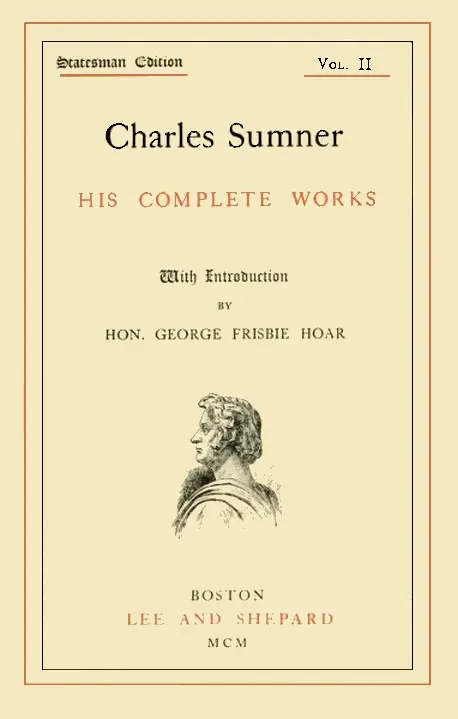
THE CLASSIC COLLECTION · 1900
"Charles Sumner: his complete works, volume 02 (of 20)" by Charles Sumner is a historical collection of lectures, speeches, and writings written in the mid-19th century. This volume prominently tackles the theme of slavery, with particular focus on the injustices of both white slavery in the Barbary States and black slavery in America. It features a range of oratory efforts, advocating for human rights and the abolition of slavery as a moral and political imperative. The opening of this volume presents a lecture given by Sumner titled "White Slavery in the Barbary States," which elaborates on the historical context and moral implications of slavery both historically and in his contemporary society. He explores the origins and definitions of slavery, emphasizing that it is rooted in violence and force rather than justice or rights. Through this lens, he compares the plight of enslaved whites in North Africa to that of enslaved African Americans, revealing the complexities and shared horrors of servitude. The preliminary narrative sets the stage for a deeper investigation into the concepts of freedom, justice, and progress, positioning the fight against slavery as a universal human struggle.
Introduction adapted from the source catalogue; source summaries may be automatically generated.
Free to read · English · 122,700 words · No account needed
MAKE TIME FOR A GOOD BOOK
On by default. Untick to stop anonymous reading totals. Each page counts after 10 seconds in view. How this works.
Anonymous counting is on unless you have switched it off.
[185] July, 1830, Vol. IV. pp. 28-63.
Mr. Stackpole has been removed from strongest family ties, from a large cluster of friends, from enjoyments richly spread by competency and taste, and from opportunities of usefulness which were before him in ample fields, while his sun of life was still high and glowing in the heavens. He has passed away as a shadow. Let us clasp and hold fast the memory of his virtues.
AN ORATION BEFORE THE LITERARY SOCIETIES OF AMHERST COLLEGE AT THEIR ANNIVERSARY, AUGUST 11, 1847.
But if there be in Glory aught of good,
It may by means far different be attained,
Without ambition, war, or violence,--
By deeds of peace, by wisdom eminent,
By patience, temperance.
MILTON, Paradise Regained.
Da veniam scriptis, quorum non gloria nobis
Causa, sed utilitas officiumque fuit.
OVID, Epist. ex Ponto, III. ix., 55, 56.
Singulari in eo negotio usus opera Flacci Pomponii, consularis viri, nati ad omnia quæ recte facienda sunt, simplicique virtute, merentis semper quam captantis gloriam.--VELLEIUS PATERCULUS, Hist., Lib. II. Cap. 129.
Non privatim solum, sed publice furimus. Homicidia compescimus, et singulas cædes; quid bella, et occisarum gentium gloriosum scelus?--SENECA, Epist. XCV. § 30.
Tanto major famæ sitis est quam
Virtutis! Quis enim virtutem amplectitur ipsam,
Præmia si tollas?
JUVENAL, Sat. X. 140-142.
Wealth and children are the ornament of this present life; but good works, which are permanent, are better, in the sight of thy Lord, with respect to the reward, and better with respect to hope.--Koran, tr. Sale, Ch. 18.
For ages mingled with his parent dust,
Fame still records Nushirovan the Just.
From the PERSIAN, by Sir William Jones: Life, p. 98.
Then Peredur returned to his mother and her company, and he said to her, "Mother, those were not angels, but honorable knights." Then his mother swooned away.--The Mabinogion, tr. Lady Charlotte Guest, Vol. I. p. 300.
One day he met a poor woman weeping bitterly; and when he inquired the cause, she told him that her only brother, her sole stay and support in the world, had been carried into captivity by the Moors. Dominick could not ransom her brother; he had given away all his money, and even sold his books, to relieve the poor; but he offered all he could,--he offered up himself to be exchanged as a slave in place of her brother. The woman, astonished at such a proposal, fell upon her knees before him. She refused his offer, but she spread the fame of the young priest far and wide.--JAMESON, Legends of the Monastic Orders: St. Dominick.
Your reading position is saved on this browser. Take it to another device with a library code. Reading pages adapt to text, rather than matching a printed edition.
Charles Sumner

Charles Sumner

Charles Sumner

Charles Sumner
BEHIND THE BOOK
This eBook is for the use of anyone anywhere in the United States and most other parts of the world at no cost and with almost no restrictions whatsoever. You may copy it, give it away or re-use it under the terms of the Project Gutenberg License included with this eBook or online at www.gutenberg.org. If you are not located in the United States, you will have to check the laws of the country where you are located before using this eBook. Read the source licence.
The original source file, including credits and licence, is retained by this library. Request an original-format copy at no charge. Please include the book title and Project Gutenberg identifier #45473.
KEEP YOUR CURIOSITY GOING

David Patterson (Spirit) Hatch

David Patterson (Spirit) Hatch

David Patterson (Spirit) Hatch
Cécile Tormay

Moritz Busch
John L. Ransom