READ · DISCOVER · ENJOYClassic literature · Always free
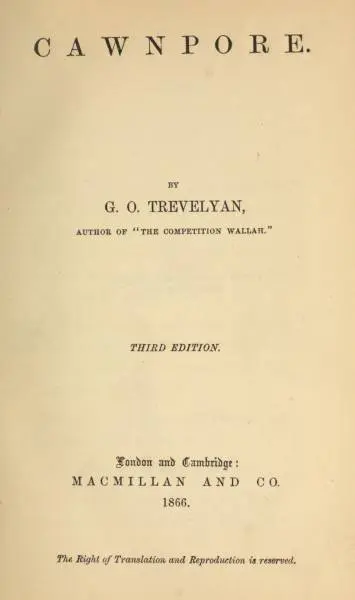
Cawnpore — digital edition cover

THE CLASSIC COLLECTION · 1866

Cawnpore

"Cawnpore" by George Otto Trevelyan is a historical account written in the mid-19th century. The book delves into the events surrounding the violent upheaval at Cawnpore during the Indian Rebellion of 1857, focusing on the tensions between British colonial forces and local sepoy troops. Trevelyan's exploration is rich in details, particularly regarding the complexities of colonial power dynamics and human relationships in a time of growing unrest." "The opening of "Cawnpore" introduces the geographical and historical context of Cawnpore, emphasizing its significance as a military station and detailing the diverse population comprising British soldiers, civilians, and native troops. Trevelyan sets the stage for the looming crisis by discussing the uneasy state of relations between these groups, highlighting the underlying tensions festering among the sepoys. As the narrative unfolds, there are hints at unrest due to a combination of various grievances, including rumors about greased cartridges and other perceived insults to religious faiths, laying the groundwork for the insurrection that is to come."

Introduction adapted from the source catalogue; source summaries may be automatically generated.

Start reading ↓

Free to read · English · 82,027 words · No account needed

MAKE TIME FOR A GOOD BOOK

Cawnpore

On by default. Untick to stop anonymous reading totals. Each page counts after 10 seconds in view. How this works.

Anonymous counting is on unless you have switched it off.

Cawnpore

These women had spent their girlhood in the pleasant watering-places and country homes of our island, surrounded by all of English comfort and refinement that Eastern wealth could buy. Their later years had slipped away amidst the secure plenty and languid ease of an European household in India. In spacious saloons, alive with swinging punkahs; where closed and darkened windows excluded the heated atmosphere, and produced a counterfeit night, while through a mat of wetted grass poured a stream of artificial air; with piles of ice, and troops of servants, and the magazines of the preceding month, and the sensation novels of the preceding season, monotonous, but not ungrateful, the even days flew by. Early married life has in Bengal peculiar charms. Settled down in some out-station, with no society save that of a casual road-surveyor or a distant planter, the world forgetting, and by the world remembered only at such times as there is talk concerning the chances of official promotion, the young pair have full leisure and a fair plea for indulging in that delicious habit of mutual selfishness which changes existence into a perpetual honeymoon, until that sorrowful epoch, when the children are too old to be kept any longer in the enervating climate of Hindostan; when the period arrives for writing to mothers-in-law, and sisters, and London bankers, and Brighton schoolmasters; when even the pale pet of four years old, who still answers to the name of baby, must go home at the beginning of next cold season, and ought to have gone before the end of last. Then begin the troubles of an Anglo-Indian family.

But though such ladies are often destined to endure the wearing anxiety of an unnatural separation, they never know what it is to experience a moment of physical privation. The services of menials, who make up by their number and obsequiousness what they lack in energy,--the unwearied attention of an affectionate partner and friend shield them from distress and excuse them from exertion. To have slept four in a cabin on board an outward-bound steamer,--to have passed a night in a palanquin, or a day at a posting-house where there was no tea, and only milk enough for the little ones;--had hitherto appeared to the Cawnpore ladies the last conceivable extremity of destitution and discomfort. Now, the Red Sea in July would have been to them an Elysium, and a luncheon on Peninsular and Oriental ale and cheese a priceless banquet. By a sudden turn of fortune they had been placed beneath the heel of those beings whom they had ever regarded with that unconscious aversion and contempt of race which is never so intense as in a female breast. Those who were to them most dear and trusted were absent from their side, save when a not unkindly bullet released the husband from his post, and restored him to the wife, if but to die. Accustomed to those frequent ablutions which, in England at least a duty, are in India a necessity, they had not a single spongeful of water for washing from the commencement to the close of the siege. They who, from childhood upwards, in the comprehensive and pretty phrase which ladies love, "had had everything nice about them," were now herded together in fetid misery, where delicacy and modesty were hourly shocked, though never for a moment impaired. Unshod, unkempt, ragged and squalid, haggard and emaciated, parched with drought and faint with hunger, they sat waiting to hear that they were widows. Each morning deepened the hollow in the youngest cheek, and added a new furrow to the fairest brow. Want, exposure, and depression, speedily decimated that hapless company. In those regions, a hideous train of diseases stand always within call: fever, and apoplexy, and the fell scourge of cholera, and dysentery, plague more ghastly still. It was of fever that Miss Brightman died, worn out with nursing a boy who had been shot through his first red coat. Sir George Parker, the cantonment magistrate, complained of sickness and headache, accompanied by a sensation of drowsiness and oppression, which gradually deepened into insensibility, and thence into death. Such, too, was the fate of Colonel Williams of the Fifty-sixth Native Infantry, and of the Rev. Joseph Rooney, the Catholic priest, in spite of the devoted care of the Irish soldiery. The horrors which all shared and witnessed overset the balance of more than one highly-wrought organization. A missionary of the Propagation Society, as each day drew in, would bring his aged mother into the verandah for a breath of the evening. At length a musket-ball, shot, we may hope, at a venture, struck down the poor old lady with a painful wound. Her sufferings affected the reason of her son, and he died a raving maniac. Woe was it in those days unto them that were with child. There were infants born during the terrible three weeks;--infants who had no future. There were women who underwent more than all the anguish of maternity, with less than none of the hope and joy. The medical stores had all been destroyed in the conflagration. There remained no drugs, and cordials, and opiates; no surgical instruments and appliances to cure, to alleviate, or to deaden. Perhaps it was as well that the absence of saws and tourniquets rendered impracticable the more critical operations: for here, as at Lucknow, it was found that, during the months of an Indian summer, within the circuit of a beleagured fortification the consequences of amputation were invariably fatal. Science could not regret that she was powerless, when her most successful effort would hardly have prolonged an agony.

Your reading position is saved on this browser. Take it to another device with a library code. Reading pages adapt to text, rather than matching a printed edition.

BEHIND THE WORDS

About George Otto Trevelyan

George Otto Trevelyan (1838–1928). Explore Cawnpore in this collection. These books span history.

Explore this author’s books →

THE READERS’ VERDICT

How did this story stay with you?

Not rated yet
Your rating for Cawnpore

Be the first to share your verdict.

One rating per browser, which you can change or remove. A necessary browser identifier remembers your vote. How ratings work

A GOOD STORY DESERVES COMPANY

Pass this book along.

A great read is even better when it’s shared.

SEND A LITTLE INSPIRATION

Share this book

BEHIND THE BOOK

Edition & source details.

Title
Cawnpore
Author
George Otto Trevelyan
First publication (Open Library catalogue match)
1866
Digital edition publisher
Project Gutenberg
Gutenberg release date
2016-03-06
Language
English
Source edition imprint
Not stated in source catalogue
Source identifier
Project Gutenberg #51383
Contributors
No additional named contributors in source metadata

Public-domain source & licence

This eBook is for the use of anyone anywhere in the United States and most other parts of the world at no cost and with almost no restrictions whatsoever. You may copy it, give it away or re-use it under the terms of the Project Gutenberg License included with this eBook or online at www.gutenberg.org. If you are not located in the United States, you will have to check the laws of the country where you are located before using this eBook. Read the source licence.

Full source licence and obtaining an original copy

The original source file, including credits and licence, is retained by this library. Request an original-format copy at no charge. Please include the book title and Project Gutenberg identifier #51383.

the full Project Gutenberg License must appear
prominently whenever any copy of a Project Gutenberg work (any work
on which the phrase “Project Gutenberg” appears, or with which the
phrase “Project Gutenberg” is associated) is accessed, displayed,
performed, viewed, copied or distributed:

This eBook is for the use of anyone anywhere in the United States and most
other parts of the world at no cost and with almost no restrictions
whatsoever. You may copy it, give it away or re-use it under the terms
of the Project Gutenberg™ License included with this eBook or online
at www.gutenberg.org. If you
are not located in the United States, you will have to check the laws
of the country where you are located before using this eBook.

1.E.2. If an individual Project Gutenberg electronic work is
derived from texts not protected by U.S. copyright law (does not
contain a notice indicating that it is posted with permission of the
copyright holder), the work can be copied and distributed to anyone in
the United States without paying any fees or charges. If you are
redistributing or providing access to a work with the phrase “Project
Gutenberg” associated with or appearing on the work, you must comply
either with the requirements of paragraphs 1.E.1 through 1.E.7 or
obtain permission for the use of the work and the Project Gutenberg
trademark as set forth in paragraphs 1.E.8 or 1.E.9.

1.E.3. If an individual Project Gutenberg electronic work is posted
with the permission of the copyright holder, your use and distribution
must comply with both paragraphs 1.E.1 through 1.E.7 and any
additional terms imposed by the copyright holder. Additional terms
will be linked to the Project Gutenberg License for all works
posted with the permission of the copyright holder found at the
beginning of this work.

1.E.4. Do not unlink or detach or remove the full Project Gutenberg
License terms from this work, or any files containing a part of this
work or any other work associated with Project Gutenberg.

1.E.5. Do not copy, display, perform, distribute or redistribute this
electronic work, or any part of this electronic work, without
prominently displaying the sentence set forth in paragraph 1.E.1 with
active links or immediate access to the full terms of the Project
Gutenberg License.

1.E.6. You may convert to and distribute this work in any binary,
compressed, marked up, nonproprietary or proprietary form, including
any word processing or hypertext form. However, if you provide access
to or distribute copies of a Project Gutenberg work in a format
other than “Plain Vanilla ASCII” or other format used in the official
version posted on the official Project Gutenberg website
(www.gutenberg.org), you must, at no additional cost, fee or expense
to the user, provide a copy, a means of exporting a copy, or a means
of obtaining a copy upon request, of the work in its original “Plain
Vanilla ASCII” or other form. Any alternate format must include the
full Project Gutenberg License as specified in paragraph 1.E.1.

1.E.7. Do not charge a fee for access to, viewing, displaying,
performing, copying or distributing any Project Gutenberg works
unless you comply with paragraph 1.E.8 or 1.E.9.

1.E.8. You may charge a reasonable fee for copies of or providing
access to or distributing Project Gutenberg electronic works
provided that:

• You pay a royalty fee of 20% of the gross profits you derive from
the use of Project Gutenberg works calculated using the method
you already use to calculate your applicable taxes. The fee is owed
to the owner of the Project Gutenberg trademark, but he has
agreed to donate royalties under this paragraph to the Project
Gutenberg Literary Archive Foundation. Royalty payments must be paid
within 60 days following each date on which you prepare (or are
legally required to prepare) your periodic tax returns. Royalty
payments should be clearly marked as such and sent to the Project
Gutenberg Literary Archive Foundation at the address specified in
Section 4, “Information about donations to the Project Gutenberg
Literary Archive Foundation.”

• You provide a full refund of any money paid by a user who notifies
you in writing (or by e-mail) within 30 days of receipt that s/he
does not agree to the terms of the full Project Gutenberg™
License. You must require such a user to return or destroy all
copies of the works possessed in a physical medium and discontinue
all use of and all access to other copies of Project Gutenberg™
works.

• You provide, in accordance with paragraph 1.F.3, a full refund of
any money paid for a work or a replacement copy, if a defect in the
electronic work is discovered and reported to you within 90 days of
receipt of the work.

• You comply with all other terms of this agreement for free
distribution of Project Gutenberg™ works.


1.E.9. If you wish to charge a fee or distribute a Project
Gutenberg™ electronic work or group of works on different terms than
are set forth in this agreement, you must obtain permission in writing
from the Project Gutenberg Literary Archive Foundation, the manager of
the Project Gutenberg™ trademark. Contact the Foundation as set
forth in Section 3 below.

1.F.

1.F.1. Project Gutenberg volunteers and employees expend considerable
effort to identify, do copyright research on, transcribe and proofread
works not protected by U.S. copyright law in creating the Project
Gutenberg™ collection. Despite these efforts, Project Gutenberg™
electronic works, and the medium on which they may be stored, may
contain “Defects,” such as, but not limited to, incomplete, inaccurate
or corrupt data, transcription errors, a copyright or other
intellectual property infringement, a defective or damaged disk or
other medium, a computer virus, or computer codes that damage or
cannot be read by your equipment.

1.F.2. LIMITED WARRANTY, DISCLAIMER OF DAMAGES - Except for the “Right
of Replacement or Refund” described in paragraph 1.F.3, the Project
Gutenberg Literary Archive Foundation, the owner of the Project
Gutenberg™ trademark, and any other party distributing a Project
Gutenberg™ electronic work under this agreement, disclaim all
liability to you for damages, costs and expenses, including legal
fees. YOU AGREE THAT YOU HAVE NO REMEDIES FOR NEGLIGENCE, STRICT
LIABILITY, BREACH OF WARRANTY OR BREACH OF CONTRACT EXCEPT THOSE
PROVIDED IN PARAGRAPH 1.F.3. YOU AGREE THAT THE FOUNDATION, THE
TRADEMARK OWNER, AND ANY DISTRIBUTOR UNDER THIS AGREEMENT WILL NOT BE
LIABLE TO YOU FOR ACTUAL, DIRECT, INDIRECT, CONSEQUENTIAL, PUNITIVE OR
INCIDENTAL DAMAGES EVEN IF YOU GIVE NOTICE OF THE POSSIBILITY OF SUCH
DAMAGE.

1.F.3. LIMITED RIGHT OF REPLACEMENT OR REFUND - If you discover a
defect in this electronic work within 90 days of receiving it, you can
receive a refund of the money (if any) you paid for it by sending a
written explanation to the person you received the work from. If you
received the work on a physical medium, you must return the medium
with your written explanation. The person or entity that provided you
with the defective work may elect to provide a replacement copy in
lieu of a refund. If you received the work electronically, the person
or entity providing it to you may choose to give you a second
opportunity to receive the work electronically in lieu of a refund. If
the second copy is also defective, you may demand a refund in writing
without further opportunities to fix the problem.

1.F.4. Except for the limited right of replacement or refund set forth
in paragraph 1.F.3, this work is provided to you ‘AS-IS’, WITH NO
OTHER WARRANTIES OF ANY KIND, EXPRESS OR IMPLIED, INCLUDING BUT NOT
LIMITED TO WARRANTIES OF MERCHANTABILITY OR FITNESS FOR ANY PURPOSE.

1.F.5. Some states do not allow disclaimers of certain implied
warranties or the exclusion or limitation of certain types of
damages. If any disclaimer or limitation set forth in this agreement
violates the law of the state applicable to this agreement, the
agreement shall be interpreted to make the maximum disclaimer or
limitation permitted by the applicable state law. The invalidity or
unenforceability of any provision of this agreement shall not void the
remaining provisions.

1.F.6. INDEMNITY - You agree to indemnify and hold the Foundation, the
trademark owner, any agent or employee of the Foundation, anyone
providing copies of Project Gutenberg™ electronic works in
accordance with this agreement, and any volunteers associated with the
production, promotion and distribution of Project Gutenberg™
electronic works, harmless from all liability, costs and expenses,
including legal fees, that arise directly or indirectly from any of
the following which you do or cause to occur: (a) distribution of this
or any Project Gutenberg work, (b) alteration, modification, or
additions or deletions to any Project Gutenberg work, and (c) any
Defect you cause.

Section 2. Information about the Mission of Project Gutenberg

Project Gutenberg is synonymous with the free distribution of
electronic works in formats readable by the widest variety of
computers including obsolete, old, middle-aged and new computers. It
exists because of the efforts of hundreds of volunteers and donations
from people in all walks of life.

Volunteers and financial support to provide volunteers with the
assistance they need are critical to reaching Project Gutenberg’s
goals and ensuring that the Project Gutenberg collection will
remain freely available for generations to come. In 2001, the Project
Gutenberg Literary Archive Foundation was created to provide a secure
and permanent future for Project Gutenberg and future
generations. To learn more about the Project Gutenberg Literary
Archive Foundation and how your efforts and donations can help, see
Sections 3 and 4 and the Foundation information page at www.gutenberg.org.

Section 3. Information about the Project Gutenberg Literary Archive Foundation

The Project Gutenberg Literary Archive Foundation is a non-profit
501(c)(3) educational corporation organized under the laws of the
state of Mississippi and granted tax exempt status by the Internal
Revenue Service. The Foundation’s EIN or federal tax identification
number is 64-6221541. Contributions to the Project Gutenberg Literary
Archive Foundation are tax deductible to the full extent permitted by
U.S. federal laws and your state’s laws.

The Foundation’s business office is located at 41 Watchung Plaza #516,
Montclair NJ 07042, USA, +1 (862) 621-9288. Email contact links and up
to date contact information can be found at the Foundation’s website
and official page at www.gutenberg.org/contact

Section 4. Information about Donations to the Project Gutenberg
Literary Archive Foundation

Project Gutenberg™ depends upon and cannot survive without widespread
public support and donations to carry out its mission of
increasing the number of public domain and licensed works that can be
freely distributed in machine-readable form accessible by the widest
array of equipment including outdated equipment. Many small donations
($1 to $5,000) are particularly important to maintaining tax exempt
status with the IRS.

The Foundation is committed to complying with the laws regulating
charities and charitable donations in all 50 states of the United
States. Compliance requirements are not uniform and it takes a
considerable effort, much paperwork and many fees to meet and keep up
with these requirements. We do not solicit donations in locations
where we have not received written confirmation of compliance. To SEND
DONATIONS or determine the status of compliance for any particular state
visit www.gutenberg.org/donate.

While we cannot and do not solicit contributions from states where we
have not met the solicitation requirements, we know of no prohibition
against accepting unsolicited donations from donors in such states who
approach us with offers to donate.

International donations are gratefully accepted, but we cannot make
any statements concerning tax treatment of donations received from
outside the United States. U.S. laws alone swamp our small staff.

Please check the Project Gutenberg web pages for current donation
methods and addresses. Donations are accepted in a number of other
ways including checks, online payments and credit card donations. To
donate, please visit: www.gutenberg.org/donate.

Section 5. General Information About Project Gutenberg electronic works

Professor Michael S. Hart was the originator of the Project
Gutenberg concept of a library of electronic works that could be
freely shared with anyone. For forty years, he produced and
distributed Project Gutenberg eBooks with only a loose network of
volunteer support.

Project Gutenberg eBooks are often created from several printed
editions, all of which are confirmed as not protected by copyright in
the U.S. unless a copyright notice is included. Thus, we do not
necessarily keep eBooks in compliance with any particular paper
edition.

Most people start at our website which has the main PG search
facility: www.gutenberg.org.

This website includes information about Project Gutenberg,
including how to make donations to the Project Gutenberg Literary
Archive Foundation, how to help produce our new eBooks, and how to
subscribe to our email newsletter to hear about new eBooks.


KEEP YOUR CURIOSITY GOING

Your next chapter awaits.