THE CLASSIC COLLECTION✦An outlaw’s diary: the CommuneCLASSIC FREE BOOKS
An outlaw’s diary: the Commune
Cécile Tormay
THE CLASSIC COLLECTION · 1866
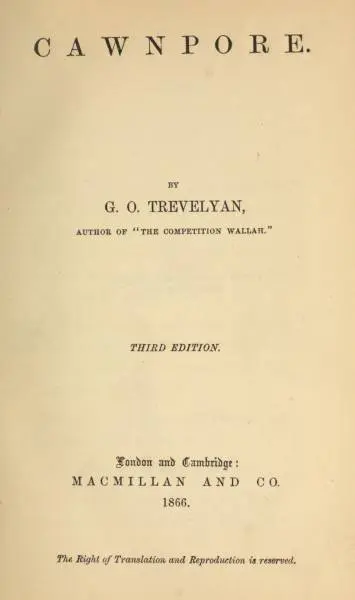
"Cawnpore" by George Otto Trevelyan is a historical account written in the mid-19th century. The book delves into the events surrounding the violent upheaval at Cawnpore during the Indian Rebellion of 1857, focusing on the tensions between British colonial forces and local sepoy troops. Trevelyan's exploration is rich in details, particularly regarding the complexities of colonial power dynamics and human relationships in a time of growing unrest." "The opening of "Cawnpore" introduces the geographical and historical context of Cawnpore, emphasizing its significance as a military station and detailing the diverse population comprising British soldiers, civilians, and native troops. Trevelyan sets the stage for the looming crisis by discussing the uneasy state of relations between these groups, highlighting the underlying tensions festering among the sepoys. As the narrative unfolds, there are hints at unrest due to a combination of various grievances, including rumors about greased cartridges and other perceived insults to religious faiths, laying the groundwork for the insurrection that is to come."
Introduction adapted from the source catalogue; source summaries may be automatically generated.
Free to read · English · 82,027 words · No account needed
MAKE TIME FOR A GOOD BOOK
On by default. Untick to stop anonymous reading totals. Each page counts after 10 seconds in view. How this works.
Anonymous counting is on unless you have switched it off.
And now commenced to our brethren and sisters a period of unspeakable woe; the ante-chamber of ruin; the penultimate syllable of their dismal story. After the destruction of the thatched barrack, dearth of house-room forced two hundred of our women and children to spend twelve days of twice twelve hours without ceiling over head or flooring under foot. At night they lay on the bare ground, exposed to every noxious influence and exhalation that was abroad in the air; and in the morning they rose, those among them who rose at all, to endure, bareheaded often, and always roofless, the blazing fury of the tropical beams. The men off guard attempted to contrive for them a partial protection, by stretching canvas screens across a framework of muskets and poles; but these canopies were soon fired by the rebel shells, and the poor creatures were reduced to cower beneath the shelter of our earthwork, feebly chasing the shadow thrown by the sun as he rose and set. It is impossible for a home-staying Englishman to realize the true character of the great troubles in 1857, unless he constantly bears in mind that all which he reads was devised, and done, and endured beneath the vertical rays of an Eastern summer, and in a temperature varying from a hundred and twenty to a hundred and thirty-eight degrees in the shade. If there are any whose experience of heat is limited to a field-day at Wimbledon in the month of August, or to a tramp over Norfolk stubbles when the dogs are too thirsty to work, and the boy has carried off the beer to the wrong spinney, they will obtain a more just notion from a sad tale simply told than from pages of unscientific rhetoric.
This is what befell Mrs. M----, the wife of the surgeon at a certain station on the southern confines of the insurrection. "I heard," she says, "a number of shots fired, and, looking out, I saw my husband driving furiously from the mess-house, waving his wip. I ran to him, and, seeing a bearer with my child in his arms, I caught her up, and got into the buggy. At the mess-house we found all the officers assembled, together with sixty sepoys, who had remained faithful. We went off in one large party, amidst a general conflagration of our late homes. We reached the caravanserai at Chattapore the next morning, and thence started for Callinger. At this point our sepoy escort deserted us. We were fired upon by matchlock-men, and one officer was shot dead. We heard, likewise, that the people had risen at Callinger, so we returned, and walked back ten miles that day. M---- and I carried the child alternately. Presently Mrs. Smalley died of sunstroke. We had no food amongst us. An officer kindly lent us a horse. We were very faint. The major died, and was buried; also the serjeant-major, and some women. The bandsmen left us on the nineteenth of June. We were fired at again by matchlock-men, and changed direction for Allahabad. Our party consisted of nine gentlemen, two children, the serjeant, and his wife. On the morning of the twentieth, Captain Scott took Lottie on to his horse. I was riding behind my husband, and she was so crushed between us. She was two years old on the first of the month. We were both weak through want of food and the effect of the sun. Lottie and I had no head-covering. M---- had a sepoy's cap I found on the ground. Soon after sunrise we were followed by villagers armed with clubs and spears. One of them struck Captain Scott's horse on the leg. He galloped off with Lottie, and my poor husband never saw his child again. We rode on several miles, keeping away from villages, and then crossed the river. Our thirst was extreme. M---- had dreadful cramps, so that I had to hold him on the horse. I was very uneasy about him. The day before I saw the drummer's wife eating chupatties, and asked her to give a piece to the child, which she did. I now saw water in a ravine. The descent was steep and our only drinking-vessel was M----'s cap. Our horse got water, and I bathed my neck. I had no stockings, and my feet were torn and blistered. Two peasant's came in sight, and we were frightened, and rode off. The serjeant held our horse, and M---- put me up and mounted. I think he must have got suddenly faint, for I fell, and he over me, on the road, when the horse started off. Some time before he said, and Barber, too, that he could not live many hours. I felt he was dying before we came to the ravine. He told me his wishes about his children and myself, and took leave. My brain seemed burnt up. No tears came. As soon as we fell, the serjeant let go the horse, and it went off; so, that escape was cut off. We sat down on the ground waiting for death. Poor fellow! he was very weak; his thirst was frightful, and I went to get him water. Some villagers came, and took my rupees and watch. I took off my wedding-ring, and twisted it in my hair, and replaced the guard. I tore off the skirt of my dress to bring water in, but it was no use, for when I returned, my beloved's eyes were fixed, and, though I called, and tried to restore him, and poured water into his mouth, it only rattled in his throat. He never spoke to me again. I held him in my arms till he sank gradually down. I felt frantic, but could not cry. I was alone. I bound his head and face in my dress, for there was no earth to bury him. The pain in my hands and feet was dreadful. I went down to the ravine, and sat in the water on a stone, hoping to get off at night, and look for Lottie. When I came back from the water, I saw that they had not taken her little watch, chain, and seals, so I tied them under my petticoat. In an hour, about thirty villagers came. They dragged me out of the ravine, and took off my jacket, and found the little chain. They then dragged me to a village, mocking me all the way, and wondering whom I was to belong to. The whole population came to look at me. I asked for a bedstead, and lay down outside the door of a hut. They had dozens of cows, and yet refused me milk. When night came, and the village was quiet, some old woman brought me a leaf-full of rice. I was too parched to eat, and they gave me water. The morning after, a neighbouring Rajah sent a palanquin and a horseman to fetch me, who told me that a little child and three sahibs had come to his master's house." And so the mother found her lost one, "greatly blistered," poor little darling. It is not for Europeans in India to pray that their flight be not in the winter.
Your reading position is saved on this browser. Take it to another device with a library code. Reading pages adapt to text, rather than matching a printed edition.
BEHIND THE BOOK
This eBook is for the use of anyone anywhere in the United States and most other parts of the world at no cost and with almost no restrictions whatsoever. You may copy it, give it away or re-use it under the terms of the Project Gutenberg License included with this eBook or online at www.gutenberg.org. If you are not located in the United States, you will have to check the laws of the country where you are located before using this eBook. Read the source licence.
The original source file, including credits and licence, is retained by this library. Request an original-format copy at no charge. Please include the book title and Project Gutenberg identifier #51383.
KEEP YOUR CURIOSITY GOING
Cécile Tormay

Moritz Busch
John L. Ransom
Frances Wright
Cécile Tormay

Mabel Potter Daggett