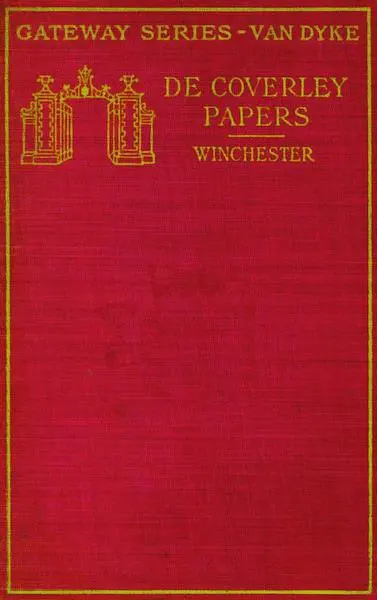
The Sir Roger de Coverley Papers
Joseph Addison & Eustace Budgell & Richard, Sir Steele
THE CLASSIC COLLECTION · 1713
"Cato: A Tragedy, in Five Acts" by Joseph Addison is a dramatic play written in the early 18th century, specifically around the early 1700s. This work belongs to the genre of tragedy and engages with themes of freedom, political integrity, and the moral struggles of its characters within the context of ancient Rome. The narrative focuses on the figure of Cato, a Roman statesman, who stands as a symbol of virtue and resistance against tyranny. The plot unfolds during a tumultuous time in Rome as Cato and his supporters grapple with the advancing power of Julius Caesar. Throughout the five acts, Cato embodies the struggle between liberty and oppression as he prepares to face Caesar’s forces in Utica. The story weaves together various subplots involving his children, Portius and Marcia, who navigate their own conflicts of love and allegiance against the backdrop of civil war, adding depth to the central theme of sacrifice for one’s country. Cato's unwavering commitment to his principles ultimately leads him to a tragic yet noble end, reflecting Addison's exploration of stoicism and virtue in the face of despair.
Introduction adapted from the source catalogue; source summaries may be automatically generated.
Free to read · English · 15,158 words · No account needed
MAKE TIME FOR A GOOD BOOK
On by default. Untick to stop anonymous reading totals. Each page counts after 10 seconds in view. How this works.
Anonymous counting is on unless you have switched it off.
Part of the Senate House.
Enter SEMPRONIUS, with LEADERS of the Mutiny.
Sem. At length the winds are raised, the storm blows high!
Be it your care, my friends, to keep it up
In all its fury, and direct it right,
Till it has spent itself on Cato's head.
Meanwhile, I'll herd among his friends, and seem
One of the number, that, whate'er arrive,
My friends and fellow soldiers may be safe. [Exit.
1 Lead. We are all safe; Sempronius is our friend.
Sempronius is as brave a man as Cato.
But, hark, he enters. Bear up boldly to him;
Be sure you beat him down, and bind him fast;
This day will end our toils.
Fear nothing, for Sempronius is our friend.
Enter SEMPRONIUS, with CATO, LUCIUS, PORTIUS, and MARCUS.
Cato. Where are those bold, intrepid sons of war,
That greatly turn their backs upon the foe,
And to their general send a brave defiance?
Sem. Curse on their dastard souls, they stand astonish'd! [Aside.
Cato. Perfidious men! And will you thus dishonour
Your past exploits, and sully all your wars?
Why could not Cato fall
Without your guilt! Behold, ungrateful men,
Behold my bosom naked to your swords,
And let the man that's injured strike the blow.
Which of you all suspects that he is wrong'd,
Or thinks he suffers greater ills than Cato?
Am I distinguished from you but by toils,
Superior toils, and heavier weight of cares?
Painful pre-eminence!
Sem. Confusion to the villains! all is lost! [Aside.
Cato. Have you forgotten Lybia's burning waste,
Its barren rocks, parch'd earth, and hills of sand,
Its tainted air, and all its broods of poison?
Who was the first to explore th' untrodden path,
When life was hazarded in ev'ry step?
Or, fainting in the long laborious march,
When, on the banks of an unlook'd-for stream,
You sunk the river with repeated draughts,
Who was the last of all your host who thirsted?
Sem. Did not his temples glow
In the same sultry winds and scorching heats?
Cato. Hence, worthless men! hence! and complain to Caesar, You could not undergo the toil of war, Nor bear the hardships that your leader bore.
Lucius. See, Cato, see the unhappy men: they weep!
Fear, and remorse, and sorrow for their crime,
Appear in ev'ry look, and plead for mercy.
Cato. Learn to be honest men; give up yon leaders,
And pardon shall descend on all the rest.
Your reading position is saved on this browser. Take it to another device with a library code. Reading pages adapt to text, rather than matching a printed edition.
Joseph Addison & Eustace Budgell & Richard, Sir Steele
BEHIND THE BOOK
This eBook is for the use of anyone anywhere in the United States and most other parts of the world at no cost and with almost no restrictions whatsoever. You may copy it, give it away or re-use it under the terms of the Project Gutenberg License included with this eBook or online at www.gutenberg.org. If you are not located in the United States, you will have to check the laws of the country where you are located before using this eBook. Read the source licence.
The original source file, including credits and licence, is retained by this library. Request an original-format copy at no charge. Please include the book title and Project Gutenberg identifier #31592.
KEEP YOUR CURIOSITY GOING
Maurice Baring
W. B. (William Butler) Yeats
Edward Martyn

John Brougham & Charlotte Brontë
Marguerite Merington
Leonid Andreyev