THE CLASSIC COLLECTION✦The Early Life of Mark Rutherford (W. Hale White)CLASSIC FREE BOOKS
The Early Life of Mark Rutherford (W. Hale White)
William Hale White
THE CLASSIC COLLECTION · 1893
"Catharine Furze" by William Hale White is a novel written during the late 19th century. Set in the market town of Eastthorpe in 1840, the story revolves around the Furze family, particularly their daughter Catharine, as they navigate the complexities of social aspirations, class distinctions, and family dynamics in a changing society. The opening of the novel paints a vivid picture of Eastthorpe, detailing its geography, inhabitants, and the social structures that define it. We are introduced to a series of characters gathered in the home of Mr. Furze, the local ironmonger, where discussions about life, death, and the social standing of the characters unfold. Catharine emerges as a central figure characterized by her spirited interactions and defiance of the constraints imposed by her family and society. Her relationships with her parents reveal tensions, particularly between her mother’s desire for social improvement and Catharine’s growing sense of individuality. The opening sets the stage for a deeper exploration of identity, familial love, and the struggle for personal freedom amidst societal expectations.
Introduction adapted from the source catalogue; source summaries may be automatically generated.
Free to read · English · 67,165 words · No account needed
MAKE TIME FOR A GOOD BOOK
On by default. Untick to stop anonymous reading totals. Each page counts after 10 seconds in view. How this works.
Anonymous counting is on unless you have switched it off.
Dr. Turnbull was the doctor who, it will be remembered, lived in the square near the church. There was another doctor in Eastthorpe, Mr. Butcher, of whom we have heard, but Dr. Turnbull's reputation as a doctor was far higher than Mr. Butcher's. What Eastthorpe thought of Dr. Turnbull as a man is another matter. Mr. Butcher was married, church- going, polite, smiling to everybody, and when he called he always said, "Well, and how are we?" in such a nice way, identifying himself with his patient. But even Eastthorpe had not much faith in him, and in very serious cases always preferred Dr. Turnbull. Eastthorpe had remarked that Mr. Butcher's medicines had a curious similarity. He believed in two classes of diseases--sthenic and asthenic. For the former he prescribed bleeding and purgatives; for the latter he "threw in" bark and iron, and ordered port wine. Eastthorpe thought him very fair for colds, measles, chicken-pox, and for rashes of all sorts, and so did all the country round. He generally attended everybody for such complaints, but as Mr. Gosford said after his recovery from a dangerous attack, "when it come to a stoppage, I thought I'd better have Turnbull," and Mr. Gosford sent for him promptly.
Dr. Turnbull was born three or four years before the outbreak of the French Revolution. He was consequently a little older than the great Dr. Elliotson, whose memory some of us still piously cherish, and Dr. Elliotson and he were devoted friends. Dr. Turnbull was tall, thin, upright, with undimmed grey eyes and dark hair, which had hardly yet begun to turn in colour, but was a little worn off his forehead. He had a curiously piercing look in his face, so that it was impossible if you told him an untruth not to feel that you were detected. He never joked or laughed in the sickroom or in his consulting-room, and his words were few. But what was most striking in him was his mute power of command, so that everybody in contact with him did his bidding without any effort on his part. He kept three servants--two women and a man. They were very good servants, but all three had been pronounced utterly intractable before they went to him. Master and mistress dared not speak to them; but with Dr. Turnbull they were suppressed as completely as if he had been Napoleon and they had been privates. He was kind to them, it is true, but at times very severe, and they could neither reply to him nor leave him. He did not affect the dress nor the manners of the doctors who preceded him. He wore a simple, black necktie, a shirt with no frill, and a black frock-coat. The poor worshipped him, as well they might, for his generosity to them was unexampled, and he took as much pains with them and was as kind to them as if they were the first people in Eastthorpe. He was perhaps even gentler with the poor than with the rich. He was very apt to be contemptuous, and to snarl when called to a rich man suffering from some trifling disorder who thought that his wealth justified a second opinion, but he watched the whole night through with the tenderness of a woman by the bedside of poor Phoebe Crowhurst when she had congestion of the lungs before she lived with Mrs. Furze. He saved that girl and would not take a sixpence, and when the mother, overcome with gratitude, actually fell on her knees before him and clung to him and sobbed and could not speak, he lifted her up with a "Nonsense, my good woman!" and quickly departed. He was a materialist, and described himself as one: he disbelieved in what he called the soap-bubble theory, that somewhere in us there is something like a bubble, which controls everything, and is everything, and escapes invisible and gaseous to some other place after death. Consequently he never went to church. He was not openly combative, but Eastthorpe knew his heresies, and was taught to shudder at them. His professionally religious neighbours of course put him in hell in the future, but the common people did not go so far as that, although they could not believe him saved. They somehow confounded his denial of immortality with his own mortality, and imagined he would be at an end when he was put into the grave. As time wore on the attitude, even of the clergy, towards the doctor was gradually changed. They hastened to recognise him on week- days as he walked in his rapid, stately manner through the streets, although if they saw him on Sundays they considered it more becoming to avoid him. He was, as we have seen, a materialist, but yet he was the most spiritual person in the whole district. He took the keenest interest in science; he was generous, and a believer in a spiritualism infinitely beyond that of most of his neighbours, for they had not a single spiritual interest. He was spiritual in his treatment of disease. He was before his age by half a century, and instead of "throwing in" drugs after the fashion of Butcher, he prescribed fresh air, rest, and change, and, above everything, administered his own powerful individuality. He did not follow his friend Elliotson into mesmerism, but he had a mesmerism of his own, subduing all terror and sanative like light. Mr. Gosford was not capable of great expression, but he was always as expressive as he could be when he told the story of that dreadful illness.
Your reading position is saved on this browser. Take it to another device with a library code. Reading pages adapt to text, rather than matching a printed edition.
William Hale White
William Hale White
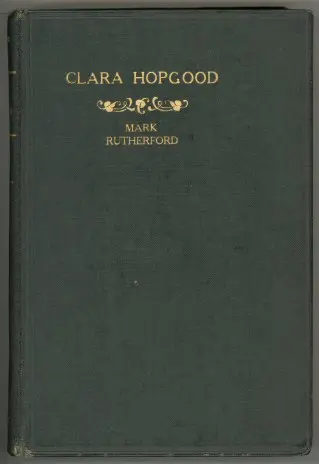
William Hale White
BEHIND THE BOOK
This eBook is for the use of anyone anywhere in the United States and most other parts of the world at no cost and with almost no restrictions whatsoever. You may copy it, give it away or re-use it under the terms of the Project Gutenberg License included with this eBook or online at www.gutenberg.org. If you are not located in the United States, you will have to check the laws of the country where you are located before using this eBook. Read the source licence.
The original source file, including credits and licence, is retained by this library. Request an original-format copy at no charge. Please include the book title and Project Gutenberg identifier #6023.
KEEP YOUR CURIOSITY GOING
Coulson Kernahan

Maurice Baring
Frances Wright
Cécile Tormay

Frederic Jesup Stimson

W. H. P. (William Henry Pope) Jarvis