
The lost dirigible
Ralph Henry Barbour
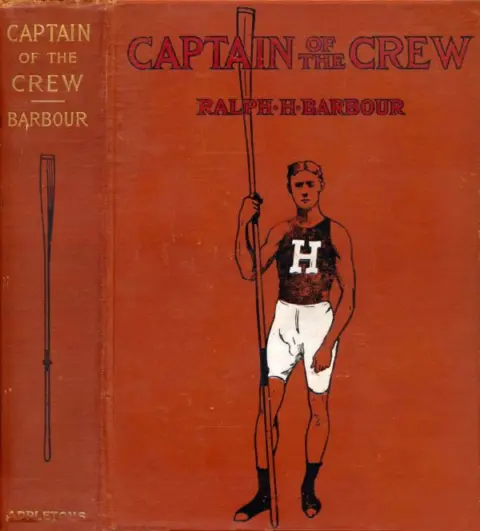
THE CLASSIC COLLECTION · 1901
"Captain of the Crew" by Ralph Henry Barbour is a sports novel written in the early 20th century. The narrative is set at Hillton Academy and centers around Richard Hope, the captain of the school's rowing crew, as he navigates the challenges of leadership, athletic competition, and personal growth. The text explores themes of camaraderie, school spirit, and the importance of integrity in sports. The opening of the story introduces a group of boys returning to Hillton Academy after Christmas vacation, and it sets a lively scene of excitement and youthful exuberance. Among them is Dick Hope, who emerges as a central character as he anticipates the demands of captaining the crew. The early chapters depict his interactions with new classmates, particularly Trevor Nesbitt, a boy with a tendency to show off. As the story unfolds, the dynamics between the characters hint at future conflicts and competitions, both in the context of rowing and personal relationships, setting the stage for a deeper exploration of teamwork and rivalry as the crew prepares for the annual boat race against their rival school.
Introduction adapted from the source catalogue; source summaries may be automatically generated.
Free to read · English · 68,425 words · No account needed
MAKE TIME FOR A GOOD BOOK
On by default. Untick to stop anonymous reading totals. Each page counts after 10 seconds in view. How this works.
Anonymous counting is on unless you have switched it off.
The Scene.--The boat-house landing and the river thereabouts.
The Time.--Four-thirty of the following Saturday afternoon.
Characters.--Dick, Trevor, Carl, Stewart, an ice-yacht,
chorus of boys on skates.
Chorus: “Heave-o! Now, all together! Heave!”
Carl: “Hang the thing, anyhow! What’s the matter with it?”
Dick: “Well, since you know all about the art of ice-sailing, it strikes me that you ought to be able to raise a little old pillow-sham of a sail like that!”
Trevor: “Let’s pull on this rope and see what happens.”
Chorus: “How’d you like to be the ice-yachtsmen?”
Carl: “That’s the rope! Take hold here, fellows!”
Chorus: “Everybody shove!”
Carl: “There she goes! Make a hitch there, Dick! Jump on, quick!
Whoa!”
Chorus: “A-ah!”
The boat catches the wind, starts suddenly up-stream, as suddenly changes its mind, veers about, rams the landing, backs off, charges a group of boys on skates, and then stands motionless with its head into the wind and laughs so that its sail flaps.
It is now discovered that there is room on the yacht for but three fellows at the most, and every one save Carl begs to be allowed to sacrifice his pleasure and remain at home. The choice falls to Stewart, and he joins the chorus with a countenance eloquent of relief. Carl, Dick, and Trevor huddle together on the cockpit, and a portion of the chorus shoves the yacht’s head about. The sail fills, and the yacht glides off up-stream in a strong breeze, to the jeers and biting sarcasms of the chorus, many of whom pretend to weep agonizedly into their handkerchiefs.
The Sleet had been delivered and paid for the preceding Wednesday. She was an old-style boat with a length of sixteen feet and a sail area altogether too small for her size. A new coat of brilliant--and as yet but partly dried--crimson paint hid a multitude of weak places. The cockpit, upholstered with a piece of faded red carpet, was barely large enough to allow the three boys to huddle onto it.
The boat-house and landing, Stewart, and the contemptuous chorus were soon left behind, and The Sleet gained momentum every second. Carl held the tiller, and Dick and Trevor held their breaths. The wind was straight abaft, but the cold made the boys huddle closely together to protect their faces. The academy buildings faded from sight in the gray afternoon haze, and the river stretched cold and bleak before them.
“How fast are we going?” asked Dick.
“I don’t know; pretty well, I guess,” answered Carl. “Fine, isn’t it?”
Your reading position is saved on this browser. Take it to another device with a library code. Reading pages adapt to text, rather than matching a printed edition.
Ralph Henry Barbour
Ralph Henry Barbour

Ralph Henry Barbour

Ralph Henry Barbour
BEHIND THE BOOK
This eBook is for the use of anyone anywhere in the United States and most other parts of the world at no cost and with almost no restrictions whatsoever. You may copy it, give it away or re-use it under the terms of the Project Gutenberg License included with this eBook or online at www.gutenberg.org. If you are not located in the United States, you will have to check the laws of the country where you are located before using this eBook. Read the source licence.
The original source file, including credits and licence, is retained by this library. Request an original-format copy at no charge. Please include the book title and Project Gutenberg identifier #48745.
KEEP YOUR CURIOSITY GOING
Coulson Kernahan

Maurice Baring
Frances Wright
Cécile Tormay

Frederic Jesup Stimson

W. H. P. (William Henry Pope) Jarvis