
The lost dirigible
Ralph Henry Barbour
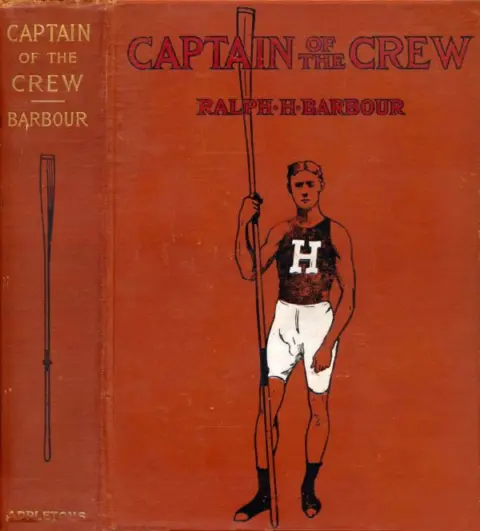
THE CLASSIC COLLECTION · 1901
"Captain of the Crew" by Ralph Henry Barbour is a sports novel written in the early 20th century. The narrative is set at Hillton Academy and centers around Richard Hope, the captain of the school's rowing crew, as he navigates the challenges of leadership, athletic competition, and personal growth. The text explores themes of camaraderie, school spirit, and the importance of integrity in sports. The opening of the story introduces a group of boys returning to Hillton Academy after Christmas vacation, and it sets a lively scene of excitement and youthful exuberance. Among them is Dick Hope, who emerges as a central character as he anticipates the demands of captaining the crew. The early chapters depict his interactions with new classmates, particularly Trevor Nesbitt, a boy with a tendency to show off. As the story unfolds, the dynamics between the characters hint at future conflicts and competitions, both in the context of rowing and personal relationships, setting the stage for a deeper exploration of teamwork and rivalry as the crew prepares for the annual boat race against their rival school.
Introduction adapted from the source catalogue; source summaries may be automatically generated.
Free to read · English · 68,425 words · No account needed
MAKE TIME FOR A GOOD BOOK
On by default. Untick to stop anonymous reading totals. Each page counts after 10 seconds in view. How this works.
Anonymous counting is on unless you have switched it off.
“Thanks,” said Dick. “I expect it was chilly. I was going to put another stick on the fire, and while I was thinking about it I suppose I fell asleep. It’s pretty late, isn’t it? Well, to-morrow’s Sunday.”
He arose and the two began to prepare for bed. There was something in Dick’s tone and manner quite friendly, and Trevor was puzzled.
“That was a great race you ran, Nesbitt,” said the former presently.
“The last one wasn’t so bad,” answered Trevor.
“Bad! It was fine!” replied Dick warmly. “It was the best bit of head-work I’ve seen on a track. And I was glad you beat Taylor, even if it did mean the loss of the race to the seniors. But I rather think I liked the first race better.”
“Well, of course you would,” said Trevor. “Earle’s a friend of yours; and he ran a good race. I--I didn’t much mind his beating; he seems like a jolly good sort of a chap.”
“He is a good chap; and I know it pleased him like anything to win that race, because his father and mother were there, you see.”
“Yes.”
“It would have been too bad if he’d lost it, wouldn’t it?” Dick was smiling rather queerly, Trevor thought.
“I suppose it would,” he answered.
“Yes; and so you gave it to him.”
“What--what do you mean?” stammered Trevor, very red and uncomfortable.
“Why,” laughed Dick, “just what I said. You’re not going to deny that you slowed down and let him win, are you?”
For a long moment Trevor was very busy with his nightshirt, which suddenly exhibited an unwonted dislike to going on. Then:
“I fancy there’s no use denying it,” he muttered from the folds of the
mutinous garment.
“Not a bit,” answered Dick smilingly.
“You see,” explained Trevor presently, “Earle had set his heart on winning, and it didn’t mean anything to me, you know; I hadn’t any relatives looking on; and then his mother was so--so jolly nice about it, and his father, and--and all, that I just thought he might as well win. Doesn’t it--don’t you think it was all right?”
“Well, it wasn’t exactly fair, you know; but I guess it was something even better,” answered Dick.
“Do you think Earle suspected anything?”
“I’m sure I don’t know; I didn’t see him. But Williams and Todd, who were sitting with me, thought it was a straight race, and so I guess Earle thought so too.”
Later, when the lights were out and the two were in bed, Dick broke the
silence.
Your reading position is saved on this browser. Take it to another device with a library code. Reading pages adapt to text, rather than matching a printed edition.
Ralph Henry Barbour
Ralph Henry Barbour

Ralph Henry Barbour

Ralph Henry Barbour
BEHIND THE BOOK
This eBook is for the use of anyone anywhere in the United States and most other parts of the world at no cost and with almost no restrictions whatsoever. You may copy it, give it away or re-use it under the terms of the Project Gutenberg License included with this eBook or online at www.gutenberg.org. If you are not located in the United States, you will have to check the laws of the country where you are located before using this eBook. Read the source licence.
The original source file, including credits and licence, is retained by this library. Request an original-format copy at no charge. Please include the book title and Project Gutenberg identifier #48745.
KEEP YOUR CURIOSITY GOING
Coulson Kernahan

Maurice Baring
Frances Wright
Cécile Tormay

Frederic Jesup Stimson

W. H. P. (William Henry Pope) Jarvis