
The lost dirigible
Ralph Henry Barbour
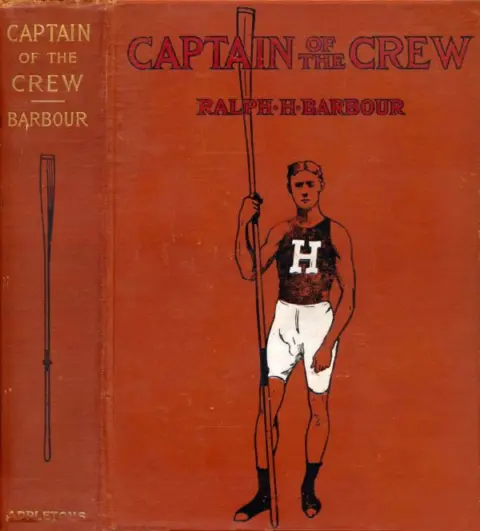
THE CLASSIC COLLECTION · 1901
"Captain of the Crew" by Ralph Henry Barbour is a sports novel written in the early 20th century. The narrative is set at Hillton Academy and centers around Richard Hope, the captain of the school's rowing crew, as he navigates the challenges of leadership, athletic competition, and personal growth. The text explores themes of camaraderie, school spirit, and the importance of integrity in sports. The opening of the story introduces a group of boys returning to Hillton Academy after Christmas vacation, and it sets a lively scene of excitement and youthful exuberance. Among them is Dick Hope, who emerges as a central character as he anticipates the demands of captaining the crew. The early chapters depict his interactions with new classmates, particularly Trevor Nesbitt, a boy with a tendency to show off. As the story unfolds, the dynamics between the characters hint at future conflicts and competitions, both in the context of rowing and personal relationships, setting the stage for a deeper exploration of teamwork and rivalry as the crew prepares for the annual boat race against their rival school.
Introduction adapted from the source catalogue; source summaries may be automatically generated.
Free to read · English · 68,425 words · No account needed
MAKE TIME FOR A GOOD BOOK
On by default. Untick to stop anonymous reading totals. Each page counts after 10 seconds in view. How this works.
Anonymous counting is on unless you have switched it off.
“‘It resembles a horse in its mane, its tail, and its voice; it is of the size of a big ox, and has an epidermis--otherwise, and in vulgar parlance, a skin--so remarkably thick that when dry it becomes very offensive.’” The monotonous voice paused; apparently the rendering of the latter portion of the narrative was not quite satisfactory. But the second occupant of the study was evidently lenient, for the deep voice said:
“Proceed, Nesbitt; that is correct.”
“He’s reading Herodotus,” said Dick to himself. “But who in thunder is
that with him?”
“‘The Nile,’” continued Trevor, “‘also produces otters, which Egyptians venerate, as they do also the fish named lepidotus--so called on account of its spots, which resemble those of a leopard--and the eel; these are sacred to the Nile, as among birds is one named chenalopex.’ What is that, professor?”
“The chenalopex,” responded the deep voice, “is a bird----”
But Dick’s curiosity got the better of him at this point, and he opened the door and entered. At the study table was Trevor, Dick’s volume of Herodotus open before him, and a Greek lexicon at his elbow. Dick stared about the room in surprise. Save for Trevor and himself it was empty.
“What in thunder----” he began.
“Hope,” said Trevor, pointing a paper-knife at him in the manner of Professor Garrison, and speaking sternly in deep tones, “take your seat, sir. The habit of tardiness appears to be growing upon you, sir. Pattern your conduct upon that of the excellently punctual Nesbitt.”
Dick seized Trevor’s head and rubbed his nose violently into Herodotus. “You silly chump, you! What do you think you’re doing?”
“Amusing myself, I fancy. What can a chap do when his roommate goes off and leaves him this way?” He struck the paper-knife against the green shade of the drop-light. “Beg pardon, professor, I believe the bell rang.” Then, in the professor’s voice, “The bell, Nesbitt? Ah, the time passes very quickly when deep in the beautiful utterances of Herodotus. We will begin to-morrow where we leave off this morning, at the seventy-first paragraph.” Trevor slammed the book shut, jumped up, and grinned at Dick.
“You’d better be learning your own lessons than mine,” laughed the latter. “And, now that Professor Garrison’s gone, I propose to go to bed.”
Long after the light was out Trevor sat up suddenly and asked:
“I say, Dick, did you thump Taylor?”
“No,” was the drowsy answer. Trevor snuggled back under the clothes,
grumbling.
“What do you expect to amount to when you grow up,” he asked
disgustedly, “if you continue to neglect your opportunities in this
way?”
Your reading position is saved on this browser. Take it to another device with a library code. Reading pages adapt to text, rather than matching a printed edition.
Ralph Henry Barbour
Ralph Henry Barbour

Ralph Henry Barbour

Ralph Henry Barbour
BEHIND THE BOOK
This eBook is for the use of anyone anywhere in the United States and most other parts of the world at no cost and with almost no restrictions whatsoever. You may copy it, give it away or re-use it under the terms of the Project Gutenberg License included with this eBook or online at www.gutenberg.org. If you are not located in the United States, you will have to check the laws of the country where you are located before using this eBook. Read the source licence.
The original source file, including credits and licence, is retained by this library. Request an original-format copy at no charge. Please include the book title and Project Gutenberg identifier #48745.
KEEP YOUR CURIOSITY GOING
Coulson Kernahan

Maurice Baring
Frances Wright
Cécile Tormay

Frederic Jesup Stimson

W. H. P. (William Henry Pope) Jarvis