THE CLASSIC COLLECTION✦A dead man’s diaryCLASSIC FREE BOOKS
A dead man’s diary
Coulson Kernahan
THE CLASSIC COLLECTION · 1902
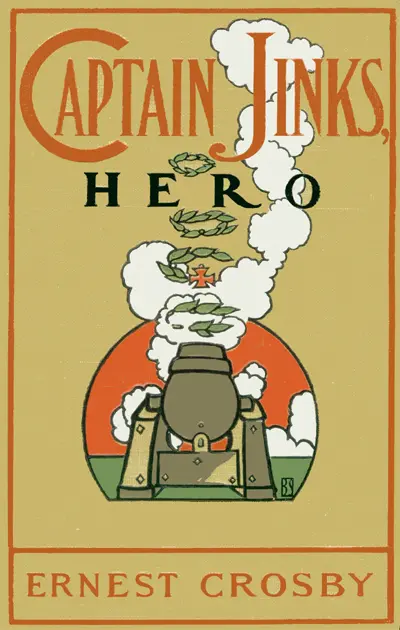
"Captain Jinks, Hero" by Ernest Crosby is a novel written in the early 20th century. The story revolves around Colonel Jinks, an amiable farmer with a military title, and his son Sam, who aspires to become a hero much like the toy soldiers gifted to him for his birthday. The narrative explores themes of military ambition and a young boy's journey into the world of soldiers, touching on Sam's profound admiration for authority and valor, all set against the backdrop of war and societal expectations. The opening portion introduces us to Colonel Jinks, who buys a box of toy soldiers for his son Sam, igniting the boy's imagination and dreams of grandeur. Sam's affection for his new toys quickly morphs into an intense aspiration to become a "hero," as he becomes enthralled with military life. Soon, the family relocates to a nearby town where Sam joins the local Boys' Brigade, fully embracing his military ambitions. As he grows older, he dreams of attending a military academy and eventually joining the army, which sets the stage for his evolving identity amidst the themes of war, heroism, and the societal constructs surrounding them.
Introduction adapted from the source catalogue; source summaries may be automatically generated.
Free to read · English · 67,739 words · No account needed
MAKE TIME FOR A GOOD BOOK
On by default. Untick to stop anonymous reading totals. Each page counts after 10 seconds in view. How this works.
Anonymous counting is on unless you have switched it off.
"Come, Sam," said Cleary, "I'm a civilian now, and I'm not going to have you crow over us. How about Captain Peters, who was the pet of Whoppington and cleaned out the Deer Harbor fund?"
Sam walked on in silence.
"See here," said Foster, "I'm tired of going on foot. Let's take a cab.
Here, you fellow!"
A two-wheeled wagon with an awning, drawn by a small, shaggy horse,
drew up before them.
"There's a gentleman in it," said Sam. "We must wait for another."
"Nonsense!" cried Foster in a loud voice. "You evidently are a new
arrival. It's only one of those monkeys. Here you, sir, get out of
that!"
The native expostulated a little, shrugged his shoulders, and did as he was told, and the three men got in.
"I'm afraid he didn't like it," said Sam.
"Didn't like it? What of it?" said Foster. "Whatever we do in uniform is official business, and we've got to impress these fellows with our power and make them respect us."
They drove now through some narrow streets, past various native cafes half open to the air, where the habitues were beginning to collect, through a picturesque gate in the old city wall, and out on the Boulevard, which was now filled with people driving and walking. It was a gay scene, and reminded Cleary of some of the cities of the Mediterranean which he had visited.
"They're not quite as much like Apaches as I expected," said Sam, and neither of his friends ventured to respond.
"We haven't got time to go out to where the ships are sunk," said Foster, "but if we drive up that hill and get out and walk up a little farther we can see them in the distance. I've got my glasses with me."
In a few minutes they were at this point of vantage in a sort of unfrequented public park, and the three men took turns in looking at the distant wrecks through the captain's field-glass.
"It was a great victory, wasn't it?" said Sam.
"Well, perhaps it was," answered Foster; "but the fact is, that those old boats could hardly float and their guns couldn't reach our ships. We just took our time and blew them up and set them on fire, and the crews were roasted or drowned, that was all there was of it. I don't think much of naval men anyway, to tell the truth. They don't compare with the army. They're always running their ships aground if there's any ground to run into."
"Anyhow, if it had been a strong fleet we'd have wiped it out just the same, wouldn't we?" said Sam.
Your reading position is saved on this browser. Take it to another device with a library code. Reading pages adapt to text, rather than matching a printed edition.
BEHIND THE BOOK
This eBook is for the use of anyone anywhere in the United States and most other parts of the world at no cost and with almost no restrictions whatsoever. You may copy it, give it away or re-use it under the terms of the Project Gutenberg License included with this eBook or online at www.gutenberg.org. If you are not located in the United States, you will have to check the laws of the country where you are located before using this eBook. Read the source licence.
The original source file, including credits and licence, is retained by this library. Request an original-format copy at no charge. Please include the book title and Project Gutenberg identifier #19353.
KEEP YOUR CURIOSITY GOING
Coulson Kernahan

Maurice Baring
Frances Wright
Cécile Tormay

Frederic Jesup Stimson

W. H. P. (William Henry Pope) Jarvis