THE CLASSIC COLLECTION✦A dead man’s diaryCLASSIC FREE BOOKS
A dead man’s diary
Coulson Kernahan
THE CLASSIC COLLECTION · 1902
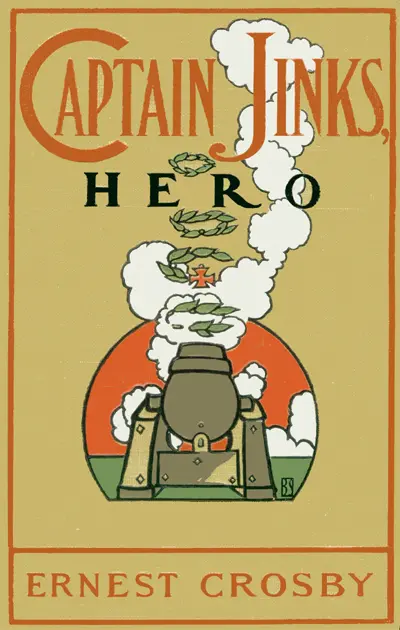
"Captain Jinks, Hero" by Ernest Crosby is a novel written in the early 20th century. The story revolves around Colonel Jinks, an amiable farmer with a military title, and his son Sam, who aspires to become a hero much like the toy soldiers gifted to him for his birthday. The narrative explores themes of military ambition and a young boy's journey into the world of soldiers, touching on Sam's profound admiration for authority and valor, all set against the backdrop of war and societal expectations. The opening portion introduces us to Colonel Jinks, who buys a box of toy soldiers for his son Sam, igniting the boy's imagination and dreams of grandeur. Sam's affection for his new toys quickly morphs into an intense aspiration to become a "hero," as he becomes enthralled with military life. Soon, the family relocates to a nearby town where Sam joins the local Boys' Brigade, fully embracing his military ambitions. As he grows older, he dreams of attending a military academy and eventually joining the army, which sets the stage for his evolving identity amidst the themes of war, heroism, and the societal constructs surrounding them.
Introduction adapted from the source catalogue; source summaries may be automatically generated.
Free to read · English · 67,739 words · No account needed
MAKE TIME FOR A GOOD BOOK
On by default. Untick to stop anonymous reading totals. Each page counts after 10 seconds in view. How this works.
Anonymous counting is on unless you have switched it off.
"A good many of the shop signs are in English already," remarked Sam. "That's a good beginning."
"Yes," said Cleary. "But they seem to be almost all saloons, that's
queer."
"So they are," said Sam.
"There are some pretty good ones, too," said Foster. "Just stop in here for a moment and take a drink."
They entered a drinking-place and found a bar planned on the familiar
lines of home.
"Look at this list of our drinks," said Foster proudly. "Count 'em;
there are eighty-two."
Sam examined the list, which was printed and framed and hanging on the wall, and they each took a glass of beer, standing. There were about a dozen men in the place, most of them soldiers.
"Do they do a big business in these places?" asked Sam.
"You'll think so when you see the drunken soldiers in the streets in the evening," answered Foster. "We're planting our institutions here, I tell you."
"Not only saloons," said Sam. "There's the post-office, for instance."
"They had a post-office before," said Cleary.
"But ours is surely better," rejoined Sam.
"It's better than it was," said Foster, "now that they've put the new postmaster in jail. They say he's bagged $75,000."
"It's a good example of the way we treat embezzlers," cried Sam. "It ought to be a lesson to these Cubapinos. He'll be sent home to be tried. They ought to do that with every one caught robbing the mails in any way."
"I'm afraid if they did the force would be pretty well crippled," said
Foster.
"Then there's the custom house," said Sam. "They must be delighted to get rid of those Castalian swindlers."
"A merchant here told me," said Foster, "that they have to pay just as often now, but that they have to pay bigger sums."
"Of course," cried Cleary, "you wouldn't expect our people to bother with the little bribes the Castalians were after. We live on a larger scale. It will do these natives good to open their eyes to a real nation. I'm sorry any of them steal, but if they do, let 'em take a lot and be done with it."
"We must remember that these people are only civilians," said Sam. "What can we expect of them?"
"Our commissary and quartermaster departments aren't much better, tho," said Foster. "Somebody's getting rich, to judge from the prices we pay and the stuff we get. The meat stinks, and the boots are made with glue instead of stitches and nails."
"Then they must have been appointed from civil life," cried Sam.
Your reading position is saved on this browser. Take it to another device with a library code. Reading pages adapt to text, rather than matching a printed edition.
BEHIND THE BOOK
This eBook is for the use of anyone anywhere in the United States and most other parts of the world at no cost and with almost no restrictions whatsoever. You may copy it, give it away or re-use it under the terms of the Project Gutenberg License included with this eBook or online at www.gutenberg.org. If you are not located in the United States, you will have to check the laws of the country where you are located before using this eBook. Read the source licence.
The original source file, including credits and licence, is retained by this library. Request an original-format copy at no charge. Please include the book title and Project Gutenberg identifier #19353.
KEEP YOUR CURIOSITY GOING
Coulson Kernahan

Maurice Baring
Frances Wright
Cécile Tormay

Frederic Jesup Stimson

W. H. P. (William Henry Pope) Jarvis