
Van Zorn
Edwin Arlington Robinson
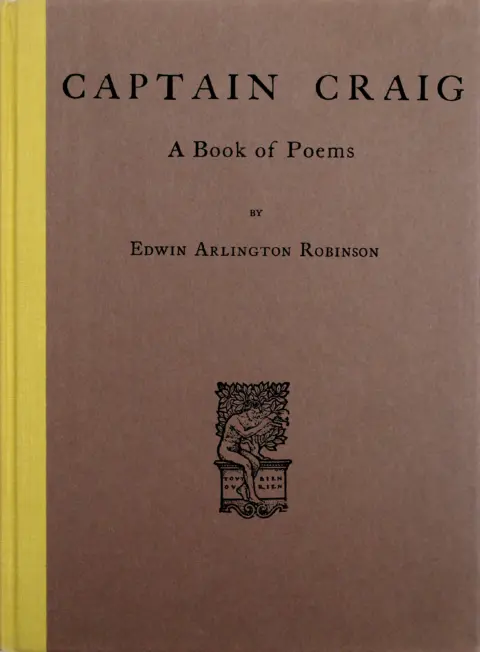
THE CLASSIC COLLECTION · 1902
"Captain Craig" by Edwin Arlington Robinson is a collection of poems written in the early 20th century. It is anchored by a long narrative in verse set in Tilbury Town, following an eccentric, destitute philosopher named Captain Craig as observed by a young narrator and his friends. Through talk, letters, and character sketches, it meditates on truth, art, faith, failure, and the stubborn spark of joy amid want. Readers drawn to character-driven, philosophical poetry with a dry New England wit may find it compelling.
The opening of the work introduces Tilbury Town and the shabby, hungry Captain, whom only a few men befriend; the narrator visits his attic and hears bold, ruminative talk on gratitude, sunlight, laughter with God, and sincerity. After the narrator departs, letters arrive in which the Captain celebrates spring, quotes Sophocles, names his three hens after the Fates, recounts odd dreams (including a carpenter’s counsel to “find Nazareth”), tells an anecdote of Count Pretzel, and playfully critiques a friend’s ballad. Returning, the narrator finds the Captain failing; the old man reads a grandly humorous “testament” that bequeaths “God’s universe” and urges courage, climbing, and truth, then drifts through fevered dreams and dies with a final whimsical word about “trombones.” The friends gather at their tavern before escorting his funeral with the Tilbury band. The section closes by turning to a new poem, where the speaker fondly recalls Isaac and Archibald and a country walk to check on oats.
Introduction adapted from the source catalogue; source summaries may be automatically generated.
Free to read · English · 29,828 words · No account needed
MAKE TIME FOR A GOOD BOOK
On by default. Untick to stop anonymous reading totals. Each page counts after 10 seconds in view. How this works.
Anonymous counting is on unless you have switched it off.
That evening, at “The Chrysalis,” I found
The faces of my comrades all suffused
With what I chose then to denominate
Superfluous good feeling. In return,
They loaded me with titles of odd form
And unexemplified significance,
Like “Bellows-mender to Prince Æolus,”
“Pipe-filler to the Hoboscholiast,”
“Bread-fruit for the Non-Doing,” with one more
That I remember, and a dozen more
That I forget. I may have been disturbed,
I do not say that I was not annoyed,
But something of the same serenity
That fortified me later made me feel
For their skin-pricking arrows not so much
Of pain as of a vigorous defect
In this world’s archery. I might have tried,
With a flat facetiousness, to demonstrate
What they had only snapped at and thereby
Made out of my best evidence no more
Than comfortable food for their conceit;
But patient wisdom frowned on argument,
With a side nod for silence, and I smoked
A series of incurable dry pipes
While Morgan fiddled, with obnoxious care,
Some things that I detested.--Killigrew,
Drowsed with a fond abstraction, like an ass,
Lay blinking at me while he grinned and made
Remarks. The learned Plunket made remarks.
It may have been for smoke that I cursed cats
That night, but I have rather to believe
As I lay turning, twisting, listening,
And wondering, between great sleepless yawns,
What possible satisfaction those dead leaves
Could find in sending shadows to my room
And swinging them like black rags on a line,
That I, with a forlorn clear-headedness
Was ekeing out probation. I had sinned
In fearing to believe what I believed,
And I was paying for it.--Whimsical,
You think,--factitious; but “there is no luck,
No fate, no fortune for us, but the old
Unswerving and inviolable price
Gets paid: God sells himself eternally,
But never gives a crust,” my friend had said;
And while I watched those leaves, and heard those cats,
And with half mad minuteness analyzed
The Captain’s attitude and then my own,
I felt at length as one who throws himself
Down restless on a couch when clouds are dark,
And shuts his eyes to find, when he wakes up
And opens them again, what seems at first
An unfamiliar sunlight in his room
And in his life--as if the child in him
Had laughed and let him see; and then I knew
Some prowling superfluity of child
In me had found the child in Captain Craig
And had the sunlight reach him. While I slept,
That thought reshaped itself to friendly dreams,
And in the morning it was with me still.
Through March and shifting April to the time
When winter first becomes a memory
My friend the Captain--to my other friend’s
Incredulous regret that such as he
Should ever get the talons of his talk
So fixed in my unfledged credulity--
Kept up the peroration of his life,
Not yielding at a threshold, nor, I think,
Too often on the stairs. He made me laugh
Sometimes, and then again he made me weep
Almost; for I had insufficiency
Enough in me to make me know the truth
Within the jest, and I could feel it there
As well as if it were the folded note
I felt between my fingers. I had said
Before that I should have to go away
And leave him for the season; and his eyes
Had shone with well-becoming interest
At that intelligence. There was no mist
In them that I remember; but I marked
An unmistakable self-questioning
And a reticence of unassumed regret.
The two together made anxiety--
Not selfishness, I ventured. I should see
No more of him for six or seven months,
And I was there to tell him as I might
What humorous provision we had made
For keeping him locked up in Tilbury Town.
That finished--with a few more commonplace
Prosaics on the certified event
Of my return to find him young again--
I left him neither vexed, I thought, with us,
Nor very much at odds with destiny.
At any rate, save always for a look
That I had seen too often to mistake
Or to forget, he gave no other sign.
Your reading position is saved on this browser. Take it to another device with a library code. Reading pages adapt to text, rather than matching a printed edition.
Edwin Arlington Robinson
Edwin Arlington Robinson
Edwin Arlington Robinson
BEHIND THE BOOK
This eBook is for the use of anyone anywhere in the United States and most other parts of the world at no cost and with almost no restrictions whatsoever. You may copy it, give it away or re-use it under the terms of the Project Gutenberg License included with this eBook or online at www.gutenberg.org. If you are not located in the United States, you will have to check the laws of the country where you are located before using this eBook. Read the source licence.
The original source file, including credits and licence, is retained by this library. Request an original-format copy at no charge. Please include the book title and Project Gutenberg identifier #77544.
KEEP YOUR CURIOSITY GOING
Eric Mackay
Edmund Gosse
Sophia Margaretta Hensley
Gilbert Parker
George MacDonald

Elizabeth Bibesco