THE CLASSIC COLLECTION✦Familiar Letters The Writings of Henry David Thoreau, Volume 06 (of 20)CLASSIC FREE BOOKS
Familiar Letters The Writings of Henry David Thoreau, Volume 06 (of 20)
Henry David Thoreau
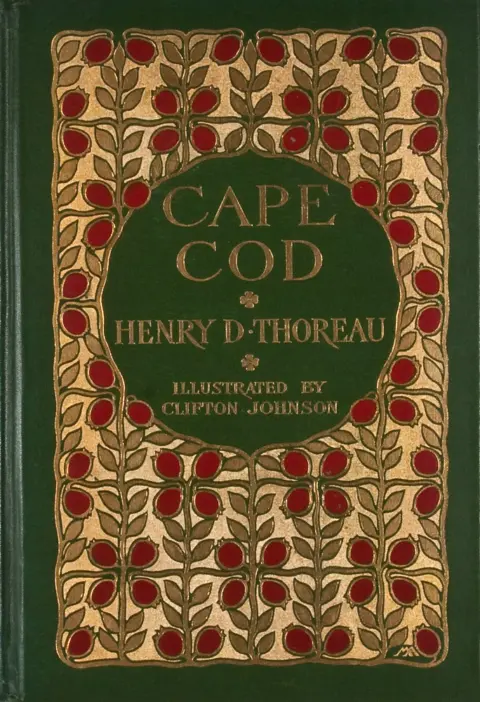
THE CLASSIC COLLECTION · 1908
"Cape Cod" by Henry David Thoreau is a detailed travelogue and nature reflection written in the mid-19th century. The book chronicles the author’s journeys through Cape Cod, exploring its landscapes, inhabitants, and the philosophical underpinnings of life on the coast. Thoreau, known for his deep appreciation of nature and individualism, captures the essence of the Cape's natural beauty and the lives of those who call it home. The opening of "Cape Cod" introduces Thoreau's desire to explore and understand the ocean and its surroundings more intimately, prompting his visits in various seasons. He recounts his experiences following the shipwreck of the brig "St. John" off the Cohasset shore, describing the somber aftermath as locals engage in grim recovery efforts, dealing with both the physical remains of the tragedy and their emotional impact. Thoreau reflects on life, death, and the sea's indifference, drawing philosophical conclusions from the environment he encounters, indicating a deeper exploration of existence and the human condition amidst the trials of nature.
Introduction adapted from the source catalogue; source summaries may be automatically generated.
Free to read · English · 78,660 words · No account needed
MAKE TIME FOR A GOOD BOOK
On by default. Untick to stop anonymous reading totals. Each page counts after 10 seconds in view. How this works.
Anonymous counting is on unless you have switched it off.
Though for some time I have not spoken of the roaring of the breakers, and the ceaseless flux and reflux of the waves, yet they did not for a moment cease to dash and roar, with such a tumult that if you had been there, you could scarcely have heard my voice the while; and they are dashing and roaring this very moment, though it may be with less din and violence, for there the sea never rests. We were wholly absorbed by this spectacle and tumult, and like Chryses, though in a different mood from him, we walked silent along the shore of the resounding sea,
Βῆ δ’ ἀκέων παρὰ θῖνα πολυφλοίσβοιο θαλάσσης.[1]
I put in a little Greek now and then, partly because it sounds so much like the ocean,—though I doubt if Homer’s Mediterranean Sea ever sounded so loud as this.
The attention of those who frequent the camp-meetings at Eastham is said to be divided between the preaching of the Methodists and the preaching of the billows on the back-side of the Cape, for they all stream over here in the course of their stay. I trust that in this case the loudest voice carries it. With what effect may we suppose the ocean to say, “My hearers!” to the multitude on the bank! On that side some John N. Maffit; on this, the Reverend Poluphloisboios Thalassa.
There was but little weed cast up here, and that kelp chiefly, there being scarcely a rock for rockweed to adhere to. Who has not had a vision from some vessel’s deck, when he had still his land-legs on, of this great brown apron, drifting half upright, and quite submerged through the green water, clasping a stone or a deep-sea mussel in its unearthly fingers? I have seen it carrying a stone half as large as my head. We sometimes watched a mass of this cable-like weed, as it was tossed up on the crest of a breaker, waiting with interest to see it come in, as if there were some treasure buoyed up by it; but we were always surprised and disappointed at the insignificance of the mass which had attracted us. As we looked out over the water, the smallest objects floating on it appeared indefinitely large, we were so impressed by the vastness of the ocean, and each one bore so large a proportion to the whole ocean, which we saw. We were so often disappointed in the size of such things as came ashore, the ridiculous bits of wood or weed, with which the ocean labored, that we began to doubt whether the Atlantic itself would bear a still closer inspection, and wold not turn out to be a but small pond, if it should come ashore to us. This kelp, oar-weed, tangle, devils-apron, sole-leather, or ribbon-weed,—as various species are called,—appeared to us a singularly marine and fabulous product, a lit invention for Neptune to adorn his car with, or a freak of Proteus. All that is told of the sea has a fabulous sound to an inhabitant of the land, and all its products have a certain fabulous quality, as if they belonged to another planet, from sea-weed to a sailor’s yarn, or a fish-story. In this element the animal and vegetable kingdoms meet and are strangely mingled. One species of kelp, according to Bory St. Vincent, has a stem fifteen hundred feet long, and hence is the longest vegetable known, and a brig’s crew spent two days to no purpose collecting the trunks of another kind cast ashore on the Falkland Islands, mistaking it for drift-wood. (See Harvey on Algæ) This species looked almost edible; at least, I thought that if I were starving I would try it. One sailor told me that the cows ate it. It cut like cheese: for I took the earliest opportunity to sit down and deliberately whittle up a fathom or two of it, that I might become more intimately acquainted with it, see how it cut, and if it were hollow all the way through. The blade looked like a broad belt, whose edges had been quilled, or as if stretched by hammering, and it was also twisted spirally. The extremity was generally worn and ragged from the lashing of the waves. A piece of the stem which I carried home shrunk to one quarter of its size a week afterward, and was completely covered with crystals of salt like frost. The reader will excuse my greenness,—though it is not sea-greenness, like his, perchance,—for I live by a river-shore, where this weed does not wash up. When we consider in what meadows it grew. and how it was raked, and in what kind of hay weather got in or out, we may well be curious about it. One who is weatherwise has given the following account of the matter.
Your reading position is saved on this browser. Take it to another device with a library code. Reading pages adapt to text, rather than matching a printed edition.
Henry David Thoreau
Henry David Thoreau
Henry David Thoreau
Henry David Thoreau
BEHIND THE BOOK
This eBook is for the use of anyone anywhere in the United States and most other parts of the world at no cost and with almost no restrictions whatsoever. You may copy it, give it away or re-use it under the terms of the Project Gutenberg License included with this eBook or online at www.gutenberg.org. If you are not located in the United States, you will have to check the laws of the country where you are located before using this eBook. Read the source licence.
The original source file, including credits and licence, is retained by this library. Request an original-format copy at no charge. Please include the book title and Project Gutenberg identifier #34392.
KEEP YOUR CURIOSITY GOING
Wilfrid Scawen Blunt
Wilfrid Scawen Blunt
E. W. (Edgar Watson) Howe

David Patterson (Spirit) Hatch
Coulson Kernahan

Ralph Waldo Emerson