THE CLASSIC COLLECTION✦Familiar Letters The Writings of Henry David Thoreau, Volume 06 (of 20)CLASSIC FREE BOOKS
Familiar Letters The Writings of Henry David Thoreau, Volume 06 (of 20)
Henry David Thoreau
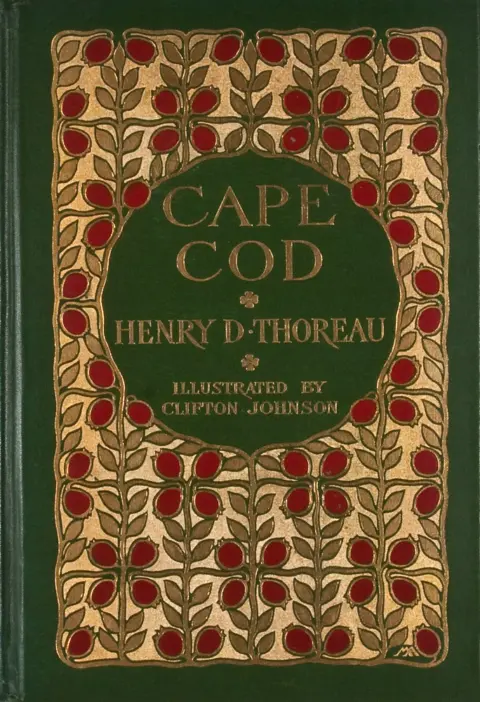
THE CLASSIC COLLECTION · 1908
"Cape Cod" by Henry David Thoreau is a detailed travelogue and nature reflection written in the mid-19th century. The book chronicles the author’s journeys through Cape Cod, exploring its landscapes, inhabitants, and the philosophical underpinnings of life on the coast. Thoreau, known for his deep appreciation of nature and individualism, captures the essence of the Cape's natural beauty and the lives of those who call it home. The opening of "Cape Cod" introduces Thoreau's desire to explore and understand the ocean and its surroundings more intimately, prompting his visits in various seasons. He recounts his experiences following the shipwreck of the brig "St. John" off the Cohasset shore, describing the somber aftermath as locals engage in grim recovery efforts, dealing with both the physical remains of the tragedy and their emotional impact. Thoreau reflects on life, death, and the sea's indifference, drawing philosophical conclusions from the environment he encounters, indicating a deeper exploration of existence and the human condition amidst the trials of nature.
Introduction adapted from the source catalogue; source summaries may be automatically generated.
Free to read · English · 78,660 words · No account needed
MAKE TIME FOR A GOOD BOOK
On by default. Untick to stop anonymous reading totals. Each page counts after 10 seconds in view. How this works.
Anonymous counting is on unless you have switched it off.
The ecclesiastical history of this town interested us somewhat. It appears that “they very early built a small meeting-house, twenty feet square, with a thatched roof through which they might fire their muskets,”—of course, at the Devil. “In 1662, the town agreed that a part of every whale cast on shore be appropriated for the support of the ministry.” No doubt there seemed to be some propriety in thus leaving the support of the ministers to Providence, whose servants they are, and who alone rules the storms; for, when few whales were cast up, they might suspect that their worship was not acceptable. The ministers must have sat upon the cliffs in every storm, and watched the shore with anxiety. And, for my part, if I were a minister I would rather trust to the bowels of the billows, on the back-side of Cape Cod, to cast up a whale for me, than to the generosity of many a country parish that I know. You cannot say of a country minister’s salary, commonly, that it is “very like a whale.” Nevertheless, the minister who depended on whales cast up must have had a trying time of it. I would rather have gone to the Falkland Isles with a harpoon, and done with it. Think of a whale having the breath of life beaten out of him by a storm, and dragging in over the bars and guzzles, for the support of the ministry! What a consolation it must have been to him! I have heard of a minister, who had been a fisherman, being settled in Bridgewater for as long a time as he could tell a cod from a haddock. Generous as it seems, this condition would empty most country pulpits forthwith, for it is long since the fishers of men were fishermen. Also, a duty was put on mackerel here to support a free-school; in other words, the mackerel-school was taxed in order that the children’s school might be free. “In 1665 the Court passed a law to inflict corporal punishment on all persons, who resided in the towns of this government, who denied the Scriptures.” Think of a man being whipped on a spring morning till he was constrained to confess that the Scriptures were true! “It was also voted by the town that all persons who should stand out of the meeting-house during the time of divine service should be set in the stocks.” It behooved such a town to see that sitting in the meeting-house was nothing akin to sitting in the stocks, lest the penalty of obedience to the law might be greater than that of disobedience. This was the Eastham famous of late years for its camp-meetings, held in a grove near by, to which thousands flock from all parts of the Bay. We conjectured that the reason for the perhaps unusual, if not unhealthful, development of the religious sentiment here was the fact that a large portion of the population are women whose husbands and sons are either abroad on the sea, or else drowned, and there is nobody but they and the ministers left behind. The old account says that “hysteric fits are very common in Orleans, Eastham, and the towns below, particularly on Sunday, in the times of divine service. When one woman is affected, five or six others generally sympathize with her; and the congregation is thrown into the utmost confusion. Several old men suppose, unphilosophically and uncharitably, perhaps, that the will is partly concerned, and that ridicule and threats would have a tendency to prevent the evil.” How this is now we did not learn. We saw one singularly masculine woman, however, in a house on this very plain, who did not look as if she was ever troubled with hysterics, or sympathized with those that were; or, perchance, life itself was to her a hysteric fit,—a Nauset woman, of a hardness and coarseness such as no man ever possesses or suggests. It was enough to see the vertebrae and sinews of her neck, and her set jaws of iron, which would have bitten a board-nail in two in their ordinary action,—braced against the world, talking like a man-of-war’s-man in petticoats, or as if shouting to you through a breaker; who looked as if it made her head ache to live; hard enough for any enormity. I looked upon her as one who had committed infanticide; who never had a brother, unless it were some wee thing that died in infancy,—for what need of him?—and whose father must have died before she was born. This woman told us that the camp-meetings were not held the previous summer for fear of introducing the cholera, and that they would have been held earlier this summer, but the rye was so backward that straw would not have been ready for them; for they lie in straw. There are sometimes one hundred and fifty ministers (!) and five thousand hearers assembled. The ground, which is called Millennium Grove, is owned by a company in Boston, and is the most suitable, or rather unsuitable, for this purpose of any that I saw on the Cape. It is fenced, and the frames of the tents are at all times to be seen interspersed among the oaks. They have an oven and a pump, and keep all their kitchen utensils and tent coverings and furniture in a permanent building on the spot. They select a time for their meetings when the moon is full. A man is appointed to clear out the pump a week beforehand, while the ministers are clearing their throats; but, probably, the latter do not always deliver as pure a stream as the former. I saw the heaps of clam-shells left under the tables, where they had feasted in previous summers, and supposed, of course, that that was the work of the unconverted, or the backsliders and scoffers. It looked as if a camp-meeting must be a singular combination of a prayer-meeting and a picnic.
Your reading position is saved on this browser. Take it to another device with a library code. Reading pages adapt to text, rather than matching a printed edition.
Henry David Thoreau
Henry David Thoreau

Henry David Thoreau
Henry David Thoreau
BEHIND THE BOOK
This eBook is for the use of anyone anywhere in the United States and most other parts of the world at no cost and with almost no restrictions whatsoever. You may copy it, give it away or re-use it under the terms of the Project Gutenberg License included with this eBook or online at www.gutenberg.org. If you are not located in the United States, you will have to check the laws of the country where you are located before using this eBook. Read the source licence.
The original source file, including credits and licence, is retained by this library. Request an original-format copy at no charge. Please include the book title and Project Gutenberg identifier #34392.
KEEP YOUR CURIOSITY GOING
Wilfrid Scawen Blunt
Wilfrid Scawen Blunt

E. W. (Edgar Watson) Howe

David Patterson (Spirit) Hatch
Coulson Kernahan

Ralph Waldo Emerson