READ · DISCOVER · ENJOYClassic literature · Always free
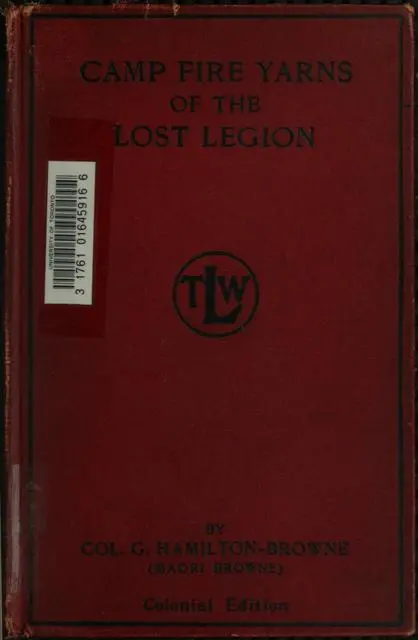
Camp Fire Yarns of the Lost Legion — digital edition cover

THE CLASSIC COLLECTION · 1910

Camp Fire Yarns of the Lost Legion

"Camp Fire Yarns of the Lost Legion" by Colonel G. Hamilton-Browne is a collection of personal narratives and historical accounts written in the late 19th century. The stories reflect on the author's experiences during his military service with the Lost Legion, particularly focusing on his encounters with the Maori people in New Zealand and the tumultuous conflicts of that era. The book aims to capture the essence of camaraderie, culture, and the hardships faced by soldiers and their indigenous counterparts during this significant period. The opening of the narrative introduces the author's nostalgic reflections as he recalls his time spent in New Zealand, longing for the days of adventure and the spirit of companionship that marked his military career. He discusses the Maori's complex character as both courageous warriors and hospitable individuals, sharing insights into their culture and conflicts, particularly during the wars that raged from the 1860s to the 1870s. With a blend of personal anecdotes and broader historical context, Browne sets the stage for a series of yarns that celebrate bravery, explore cultural exchanges, and delve into the rich tapestry of life on the frontier during a gripping time in history.

Introduction adapted from the source catalogue; source summaries may be automatically generated.

Start reading ↓

Free to read · English · 85,399 words · No account needed

MAKE TIME FOR A GOOD BOOK

Camp Fire Yarns of the Lost Legion

On by default. Untick to stop anonymous reading totals. Each page counts after 10 seconds in view. How this works.

Anonymous counting is on unless you have switched it off.

Camp Fire Yarns of the Lost Legion

I, however, had started telling you about my personal experiences with Mad Conway. Well, after I met him at dinner, I saw a good deal of him, and one day he asked me to come for a drive with two of his friends, who owned a very smart turn-out, to a well-known drift across the Vaal River, where there was an hotel. We were to start on a Saturday afternoon, stay there the night, and return the next day. He promised me a lively time, as two of the team of four horses were unbroken, and the other two, although splendid animals, possessed all the vices that gee-gees can be either born with or acquire. The distance was about twenty-five miles, the road was good, across a dead-level flat, which, like most of those in Grigualand West, was thickly sprinkled with ant-heaps, from about a foot to two and a half feet high. Well, perhaps the characters of the horses and that of the two other men who were to accompany us, both roaring blades, to say nothing about the well-known recklessness of our Jehu, might have made a nervous old gentleman give pause and refuse the invite; but then you see at that time I was not a nervous old party, and although I have no wish to claim an inordinate amount of pluck or recklessness still as I was blue mouldy for the want of a bit of divarsion, and knew Conway to be one of the best whips in Africa, I gladly accepted. The start was a trifle exciting, our two companions turning up just about half-seas over, while the horses promised to act up to their evil reputations. However, the trap was a brand-new Cape cart, and the harness of the very best, so that after some little circus play Conway managed to get the nags to move off, and we started. The drive through the diggings was accomplished, thanks to Conway's masterly management, in safety, for although we scattered like chaff many groups of niggers, we only upset two Parsee pedlars and one Chinaman, the balance of the damage done being the demolishment of a coolie's habitation, which was constructed out of material that at one time had been paraffin and sardine tins. This accident caused the pious Hindoo who owned the shattered tin-heap to swear horribly and spit just like an angry cat; but I don't think we killed anybody. When we reached the veld and were on the broad, open waggon road, the horses, thanks to the splendid handling of our charioteer, settled down to a swinging pace. There was but little chance of our meeting anyone, the scores of high-heaped produce and wood waggons trekking into Kimberley being, at that time of day, all drawn off the road and outspanned, as were also the empty waggons homeward bound, and I firmly believe we should have reached our destination in safety had it not been for the conduct of the other two passengers. The drive was most exhilarating as we rushed through the glorious air, and there was plenty of excitement in it too for a man who was not a glutton; for although the road was a first-class one, and quite flat, yet frequently, when we passed a group of outspanned waggons, the Dutchmen's dogs would rush out and bark at us, a proceeding that drove our unbroken and vicious horses nearly mad. Yet I thoroughly enjoyed the drive, and no doubt should have done so to the end, as the change from the slogging hard work of the mine, with its dust and dirt, was delightful, while the slashing pace we were going and the wild, fresh, veld wind roused my animal spirits till I felt as exhilarated as a penniless small boy does when he is presented with an unexpected half-crown. But, alas! we had other spirits on board, and our two companions, who occupied the back seat in the cart, partook of them freely, nor did they partake of them in the orthodox manner, as the motion of the swinging cart made the use of a glass and a mixing of aqua fortis with aqua fontis a somewhat difficult matter; so they dispensed with the usual accessories and swigged the whisky neat out of the bottle. Now this was a very dangerous proceeding, especially as they had imbibed a fair skinful previous to starting, and what with the natural high spirits engendered by the drive, and the other spirits they loaded up in the aforementioned manner, they became very tight indeed, and decidedly uproarious. First of all they began to sing a song. That was a failure. Then they began to chaff old Conway, which was dangerous; and then they began to rattle and stamp their feet on the floor of the cart, so as to make the horses more restive, which was both unnecessary and foolish. Conway, the muscles of whose arms were swollen to nigh breaking-point, took no notice of their crazy antics, except to order them to stop monkeying, as it was all he could do to hold and guide the half-maddened animals, but they paid no heed to his admonitions. Then he cursed them with unction, but that succeeded no better, till at last, thoroughly angry, he shouted out: "Oh, you want a smash, do you? Well! by gad, you shall have one." And without another word he bundled up the reins, which he threw on to the leaders' backs, at the same time letting go a letter "S" cut with his whip which impartially stung up every horse in the team, and then sitting back he let go one of his well-known wild bursts of laughter. At the moment this happened we were about five miles from the drift. The road was perfect, but some two miles or more farther on there was a sharp bend in it, and the problem to me was, would the maddened horses keep to the road or take to the veld when they came to it. I had not to wait long for the solution. The horses, the moment they felt the whip, and found their heads loose, at once broke into a tearing gallop. Reaching the bend in next door to no time, they took to the veld and tore wildly across it, making straight for the long line of willows that marked the river's bank. Here we were bound to come a most unholy smash, provided we ever reached it, but I knew there were far too many ant-heaps on the way, and to run against any one of these, which we were sure to do, would be quite enough to upset our apple-cart. From the moment Conway threw away the ribbons I knew I must come an awful mucker, and had philosophically prepared myself for the inevitable smash. He simply leant back in his seat, giving vent to his peculiar bursts of laughter, while the other two, sobered up by the danger, howled curses, entreaties and pious ejaculations in a duet that would have been highly diverting under other circumstances. Now events that are inevitable usually happen--at least, that is my experience--and we had not travelled far across the veld when the off-side wheel of the cart struck an ant-heap, some two feet high, bang in the middle, when I immediately and involuntarily vacated my seat. Yes; I left it in the same manner as a war rocket should leave its trough, and I described the same sort of a flight as one of those infernal machines very often used to do, for when I had described a parabola through the air, and had reached the full height of the trajectory, I turned a complete somersault. Then my specific gravity bringing me back to mother earth, I landed on my feet, ran a few yards so as to ease off the momentum of my flight, and came to a halt, devil a cent the worse. This was luck, and I turned round to see what had become of my companions, one or more of whom I feared must be badly hurt. Conway was all right, that was evident, as he was sitting on an ant-heap taking a pull at a bottle of whisky that had somehow escaped the debacle. Looking round, I saw the horses still galloping, dragging the remains of the cart, smashed to flinders, behind them. They disappeared among the willows, and I could conjecture the awful mess there must be at the foot of the river's bank. I longed to go to their assistance, for I dearly love a horse, but I first turned to our two mates, for although they were, in my opinion, far the worse brutes, still they were human brutes, and fashion makes us serve them first. Going to them as they lay amidst a debris of lamps, cushions, karosses, etc., I saw one of them was not only knocked silly but had broken his left arm and, by the way he breathed and looked, I diagnosed concussion of the brain. The other had broken his left leg, had acquired a beautiful gravel rash all over his face and was swearing at old Conway with much volubility. I was rendering the poor devils first aid, and begging Conway to walk on to the hotel to get more help, when we were hailed from the road by a well-known Kimberley sawbones, who, having providentially viewed the smash-up from a cross-road, had borne down to our assistance. A mob of Dutchmen and waggon boys were also on their way from the hotel, so I was able to go and look after the horses, borrowing a Boer's rifle en route. On reaching the poor beasts I found them lying in a tangled heap at the bottom of a steep bank. The cart was smashed to matchwood, and I had to shoot two of the nags, while the others we extricated with great trouble, both of them being badly hurt.

Your reading position is saved on this browser. Take it to another device with a library code. Reading pages adapt to text, rather than matching a printed edition.

BEHIND THE WORDS

About G. Hamilton-Browne

G. Hamilton-Browne (1844–1916). Explore Camp Fire Yarns of the Lost Legion in this collection. These books span adventure, history.

Explore this author’s books →

THE READERS’ VERDICT

How did this story stay with you?

Not rated yet
Your rating for Camp Fire Yarns of the Lost Legion

Be the first to share your verdict.

One rating per browser, which you can change or remove. A necessary browser identifier remembers your vote. How ratings work

A GOOD STORY DESERVES COMPANY

Pass this book along.

A great read is even better when it’s shared.

SEND A LITTLE INSPIRATION

Share this book

BEHIND THE BOOK

Edition & source details.

Title
Camp Fire Yarns of the Lost Legion
Author
G. Hamilton-Browne
First publication (Open Library catalogue match)
1910
Digital edition publisher
Project Gutenberg
Gutenberg release date
2013-02-28
Language
English
Source edition imprint
Not stated in source catalogue
Source identifier
Project Gutenberg #42228
Contributors
No additional named contributors in source metadata

Public-domain source & licence

This eBook is for the use of anyone anywhere in the United States and most other parts of the world at no cost and with almost no restrictions whatsoever. You may copy it, give it away or re-use it under the terms of the Project Gutenberg License included with this eBook or online at www.gutenberg.org. If you are not located in the United States, you will have to check the laws of the country where you are located before using this eBook. Read the source licence.

Full source licence and obtaining an original copy

The original source file, including credits and licence, is retained by this library. Request an original-format copy at no charge. Please include the book title and Project Gutenberg identifier #42228.

the full Project Gutenberg License must appear
prominently whenever any copy of a Project Gutenberg work (any work
on which the phrase “Project Gutenberg” appears, or with which the
phrase “Project Gutenberg” is associated) is accessed, displayed,
performed, viewed, copied or distributed:

This eBook is for the use of anyone anywhere in the United States and most
other parts of the world at no cost and with almost no restrictions
whatsoever. You may copy it, give it away or re-use it under the terms
of the Project Gutenberg™ License included with this eBook or online
at www.gutenberg.org. If you
are not located in the United States, you will have to check the laws
of the country where you are located before using this eBook.

1.E.2. If an individual Project Gutenberg electronic work is
derived from texts not protected by U.S. copyright law (does not
contain a notice indicating that it is posted with permission of the
copyright holder), the work can be copied and distributed to anyone in
the United States without paying any fees or charges. If you are
redistributing or providing access to a work with the phrase “Project
Gutenberg” associated with or appearing on the work, you must comply
either with the requirements of paragraphs 1.E.1 through 1.E.7 or
obtain permission for the use of the work and the Project Gutenberg
trademark as set forth in paragraphs 1.E.8 or 1.E.9.

1.E.3. If an individual Project Gutenberg electronic work is posted
with the permission of the copyright holder, your use and distribution
must comply with both paragraphs 1.E.1 through 1.E.7 and any
additional terms imposed by the copyright holder. Additional terms
will be linked to the Project Gutenberg License for all works
posted with the permission of the copyright holder found at the
beginning of this work.

1.E.4. Do not unlink or detach or remove the full Project Gutenberg
License terms from this work, or any files containing a part of this
work or any other work associated with Project Gutenberg.

1.E.5. Do not copy, display, perform, distribute or redistribute this
electronic work, or any part of this electronic work, without
prominently displaying the sentence set forth in paragraph 1.E.1 with
active links or immediate access to the full terms of the Project
Gutenberg License.

1.E.6. You may convert to and distribute this work in any binary,
compressed, marked up, nonproprietary or proprietary form, including
any word processing or hypertext form. However, if you provide access
to or distribute copies of a Project Gutenberg work in a format
other than “Plain Vanilla ASCII” or other format used in the official
version posted on the official Project Gutenberg website
(www.gutenberg.org), you must, at no additional cost, fee or expense
to the user, provide a copy, a means of exporting a copy, or a means
of obtaining a copy upon request, of the work in its original “Plain
Vanilla ASCII” or other form. Any alternate format must include the
full Project Gutenberg License as specified in paragraph 1.E.1.

1.E.7. Do not charge a fee for access to, viewing, displaying,
performing, copying or distributing any Project Gutenberg works
unless you comply with paragraph 1.E.8 or 1.E.9.

1.E.8. You may charge a reasonable fee for copies of or providing
access to or distributing Project Gutenberg electronic works
provided that:

• You pay a royalty fee of 20% of the gross profits you derive from
the use of Project Gutenberg works calculated using the method
you already use to calculate your applicable taxes. The fee is owed
to the owner of the Project Gutenberg trademark, but he has
agreed to donate royalties under this paragraph to the Project
Gutenberg Literary Archive Foundation. Royalty payments must be paid
within 60 days following each date on which you prepare (or are
legally required to prepare) your periodic tax returns. Royalty
payments should be clearly marked as such and sent to the Project
Gutenberg Literary Archive Foundation at the address specified in
Section 4, “Information about donations to the Project Gutenberg
Literary Archive Foundation.”

• You provide a full refund of any money paid by a user who notifies
you in writing (or by e-mail) within 30 days of receipt that s/he
does not agree to the terms of the full Project Gutenberg™
License. You must require such a user to return or destroy all
copies of the works possessed in a physical medium and discontinue
all use of and all access to other copies of Project Gutenberg™
works.

• You provide, in accordance with paragraph 1.F.3, a full refund of
any money paid for a work or a replacement copy, if a defect in the
electronic work is discovered and reported to you within 90 days of
receipt of the work.

• You comply with all other terms of this agreement for free
distribution of Project Gutenberg™ works.


1.E.9. If you wish to charge a fee or distribute a Project
Gutenberg™ electronic work or group of works on different terms than
are set forth in this agreement, you must obtain permission in writing
from the Project Gutenberg Literary Archive Foundation, the manager of
the Project Gutenberg™ trademark. Contact the Foundation as set
forth in Section 3 below.

1.F.

1.F.1. Project Gutenberg volunteers and employees expend considerable
effort to identify, do copyright research on, transcribe and proofread
works not protected by U.S. copyright law in creating the Project
Gutenberg™ collection. Despite these efforts, Project Gutenberg™
electronic works, and the medium on which they may be stored, may
contain “Defects,” such as, but not limited to, incomplete, inaccurate
or corrupt data, transcription errors, a copyright or other
intellectual property infringement, a defective or damaged disk or
other medium, a computer virus, or computer codes that damage or
cannot be read by your equipment.

1.F.2. LIMITED WARRANTY, DISCLAIMER OF DAMAGES - Except for the “Right
of Replacement or Refund” described in paragraph 1.F.3, the Project
Gutenberg Literary Archive Foundation, the owner of the Project
Gutenberg™ trademark, and any other party distributing a Project
Gutenberg™ electronic work under this agreement, disclaim all
liability to you for damages, costs and expenses, including legal
fees. YOU AGREE THAT YOU HAVE NO REMEDIES FOR NEGLIGENCE, STRICT
LIABILITY, BREACH OF WARRANTY OR BREACH OF CONTRACT EXCEPT THOSE
PROVIDED IN PARAGRAPH 1.F.3. YOU AGREE THAT THE FOUNDATION, THE
TRADEMARK OWNER, AND ANY DISTRIBUTOR UNDER THIS AGREEMENT WILL NOT BE
LIABLE TO YOU FOR ACTUAL, DIRECT, INDIRECT, CONSEQUENTIAL, PUNITIVE OR
INCIDENTAL DAMAGES EVEN IF YOU GIVE NOTICE OF THE POSSIBILITY OF SUCH
DAMAGE.

1.F.3. LIMITED RIGHT OF REPLACEMENT OR REFUND - If you discover a
defect in this electronic work within 90 days of receiving it, you can
receive a refund of the money (if any) you paid for it by sending a
written explanation to the person you received the work from. If you
received the work on a physical medium, you must return the medium
with your written explanation. The person or entity that provided you
with the defective work may elect to provide a replacement copy in
lieu of a refund. If you received the work electronically, the person
or entity providing it to you may choose to give you a second
opportunity to receive the work electronically in lieu of a refund. If
the second copy is also defective, you may demand a refund in writing
without further opportunities to fix the problem.

1.F.4. Except for the limited right of replacement or refund set forth
in paragraph 1.F.3, this work is provided to you ‘AS-IS’, WITH NO
OTHER WARRANTIES OF ANY KIND, EXPRESS OR IMPLIED, INCLUDING BUT NOT
LIMITED TO WARRANTIES OF MERCHANTABILITY OR FITNESS FOR ANY PURPOSE.

1.F.5. Some states do not allow disclaimers of certain implied
warranties or the exclusion or limitation of certain types of
damages. If any disclaimer or limitation set forth in this agreement
violates the law of the state applicable to this agreement, the
agreement shall be interpreted to make the maximum disclaimer or
limitation permitted by the applicable state law. The invalidity or
unenforceability of any provision of this agreement shall not void the
remaining provisions.

1.F.6. INDEMNITY - You agree to indemnify and hold the Foundation, the
trademark owner, any agent or employee of the Foundation, anyone
providing copies of Project Gutenberg™ electronic works in
accordance with this agreement, and any volunteers associated with the
production, promotion and distribution of Project Gutenberg™
electronic works, harmless from all liability, costs and expenses,
including legal fees, that arise directly or indirectly from any of
the following which you do or cause to occur: (a) distribution of this
or any Project Gutenberg work, (b) alteration, modification, or
additions or deletions to any Project Gutenberg work, and (c) any
Defect you cause.

Section 2. Information about the Mission of Project Gutenberg

Project Gutenberg is synonymous with the free distribution of
electronic works in formats readable by the widest variety of
computers including obsolete, old, middle-aged and new computers. It
exists because of the efforts of hundreds of volunteers and donations
from people in all walks of life.

Volunteers and financial support to provide volunteers with the
assistance they need are critical to reaching Project Gutenberg’s
goals and ensuring that the Project Gutenberg collection will
remain freely available for generations to come. In 2001, the Project
Gutenberg Literary Archive Foundation was created to provide a secure
and permanent future for Project Gutenberg and future
generations. To learn more about the Project Gutenberg Literary
Archive Foundation and how your efforts and donations can help, see
Sections 3 and 4 and the Foundation information page at www.gutenberg.org.

Section 3. Information about the Project Gutenberg Literary Archive Foundation

The Project Gutenberg Literary Archive Foundation is a non-profit
501(c)(3) educational corporation organized under the laws of the
state of Mississippi and granted tax exempt status by the Internal
Revenue Service. The Foundation’s EIN or federal tax identification
number is 64-6221541. Contributions to the Project Gutenberg Literary
Archive Foundation are tax deductible to the full extent permitted by
U.S. federal laws and your state’s laws.

The Foundation’s business office is located at 41 Watchung Plaza #516,
Montclair NJ 07042, USA, +1 (862) 621-9288. Email contact links and up
to date contact information can be found at the Foundation’s website
and official page at www.gutenberg.org/contact

Section 4. Information about Donations to the Project Gutenberg
Literary Archive Foundation

Project Gutenberg™ depends upon and cannot survive without widespread
public support and donations to carry out its mission of
increasing the number of public domain and licensed works that can be
freely distributed in machine-readable form accessible by the widest
array of equipment including outdated equipment. Many small donations
($1 to $5,000) are particularly important to maintaining tax exempt
status with the IRS.

The Foundation is committed to complying with the laws regulating
charities and charitable donations in all 50 states of the United
States. Compliance requirements are not uniform and it takes a
considerable effort, much paperwork and many fees to meet and keep up
with these requirements. We do not solicit donations in locations
where we have not received written confirmation of compliance. To SEND
DONATIONS or determine the status of compliance for any particular state
visit www.gutenberg.org/donate.

While we cannot and do not solicit contributions from states where we
have not met the solicitation requirements, we know of no prohibition
against accepting unsolicited donations from donors in such states who
approach us with offers to donate.

International donations are gratefully accepted, but we cannot make
any statements concerning tax treatment of donations received from
outside the United States. U.S. laws alone swamp our small staff.

Please check the Project Gutenberg web pages for current donation
methods and addresses. Donations are accepted in a number of other
ways including checks, online payments and credit card donations. To
donate, please visit: www.gutenberg.org/donate.

Section 5. General Information About Project Gutenberg electronic works

Professor Michael S. Hart was the originator of the Project
Gutenberg concept of a library of electronic works that could be
freely shared with anyone. For forty years, he produced and
distributed Project Gutenberg eBooks with only a loose network of
volunteer support.

Project Gutenberg eBooks are often created from several printed
editions, all of which are confirmed as not protected by copyright in
the U.S. unless a copyright notice is included. Thus, we do not
necessarily keep eBooks in compliance with any particular paper
edition.

Most people start at our website which has the main PG search
facility: www.gutenberg.org.

This website includes information about Project Gutenberg,
including how to make donations to the Project Gutenberg Literary
Archive Foundation, how to help produce our new eBooks, and how to
subscribe to our email newsletter to hear about new eBooks.


KEEP YOUR CURIOSITY GOING

Your next chapter awaits.

Your privacy choices

Reading is always free. You can change these settings at any time.

Book banners link to our books on simonward.net. They do not use advertising cookies or tracking.

Privacy & cookie policy · Reading data and privacy controls