THE CLASSIC COLLECTION✦An outlaw’s diary: the CommuneCLASSIC FREE BOOKS
An outlaw’s diary: the Commune
Cécile Tormay
THE CLASSIC COLLECTION · 1910
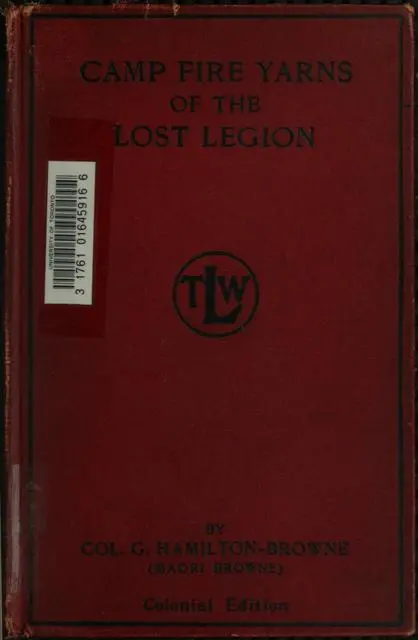
"Camp Fire Yarns of the Lost Legion" by Colonel G. Hamilton-Browne is a collection of personal narratives and historical accounts written in the late 19th century. The stories reflect on the author's experiences during his military service with the Lost Legion, particularly focusing on his encounters with the Maori people in New Zealand and the tumultuous conflicts of that era. The book aims to capture the essence of camaraderie, culture, and the hardships faced by soldiers and their indigenous counterparts during this significant period. The opening of the narrative introduces the author's nostalgic reflections as he recalls his time spent in New Zealand, longing for the days of adventure and the spirit of companionship that marked his military career. He discusses the Maori's complex character as both courageous warriors and hospitable individuals, sharing insights into their culture and conflicts, particularly during the wars that raged from the 1860s to the 1870s. With a blend of personal anecdotes and broader historical context, Browne sets the stage for a series of yarns that celebrate bravery, explore cultural exchanges, and delve into the rich tapestry of life on the frontier during a gripping time in history.
Introduction adapted from the source catalogue; source summaries may be automatically generated.
Free to read · English · 85,399 words · No account needed
MAKE TIME FOR A GOOD BOOK
On by default. Untick to stop anonymous reading totals. Each page counts after 10 seconds in view. How this works.
Anonymous counting is on unless you have switched it off.
Well, our two adventurers were in clover, and so well did they employ their opportunity that old Swan, who had been bragging to all his usual bar frequenters about having secured the General's custom, and chuckling to himself over the huge bill that, in the future, he would present, which would be duly paid in bright English gold instead of in worthless Transvaalian greenbacks, was fairly wild with greed and pride. There was, however, one small cloud on the horizon: the Colonel had stated that he rarely touched anything stronger than tea, and the tea-drinker is not nearly so profitable a customer to an up-country innkeeper as one who imbibes expensive drinks at short intervals during the day. This gloomy conjecture he confided to his circle of cronies, who condoned with him, but the cloud, however, was to be quickly blown away, for after he had summoned his guests to their lunch he rushed back into the bar and exclaimed: "Tea-drinker, does he call himself? Tea-drinker, ma certes! Why, they have finished the sherry; they've finished the pontac; they've finished the brandy and more than half finished the whisky, and the Colonel has ordered two big bottles of champagne for their tiffin. Yes, and I'm blest if they've turned a single hair. Tea-drinker indeed! My word, if the General and the remainder of the staff drink tea like the Colonel, and are half as drouthy, they will drink the dorp dry in less than a week." And the old fellow rubbed his hands as he booked the amount for the liquor consumed and chortled over the anticipated profits.
Well, to cut a long story short, our two penniless heroes lived for over a week on the very fat of the land, their Gargantuan repasts and the amount of liquor they consumed causing wonder and astonishment in the quiet dorp. But the end of their bean-feast was at hand. Sir Garnet, they knew, was in the vicinity. Prudence warned them to absquatulate, and they determined to cut their lucky, before the inevitable dénouement. One evening, therefore, they informed old Swan that the expected great man would arrive the next day, that they were riding out in the morning to meet him, and they conjured him to have things ready for his reception. Next morning, with their wallets filled with the best cigars, and their flasks full of the best cognac, they rode gaily away on their quest, and, bedad! it was high time for them to do so, as they had not proceeded two miles out of the dorp before they met the real Simon Pure, with all his staff, escort and mule waggons en route to the village they had just quitted. Well, they were all right: the paymaster had arrived, all arrears would be paid up, the war would start again, they had had a high old time of it, and they lapsed into roars of laughter when they thought of old Swan and the fury he would be in when he found out he had been hoaxed. Yes, old Swan's consternation and rage were beyond description when the General's cavalcade, instead of pulling up at his highly decorated house, proceeded to that of his hated rival, from whence, after a short interview between Sir Garnet and the landrost, it continued its way to parts unknown. Truly the old fellow's provocation was great. Not only had he been put to much expense by the alterations to his house, but the bill run up by the two marauders was a very big one, and then the chaff that he would have to submit to, because he, who fancied himself to be more than cute, had allowed himself to be taken in and done down by a well-known bad hat like Mad Conway. No; it was not to be tolerated, so he called for his horse and his two-shot scatter gun, for the purpose of going in pursuit, but on second thoughts that was far too risky a job, so he got drunk, and goaded at last to desperation by his wife's clacking tongue tried to beat her, but she, being a strong-armed suffragette, took the contract out of his hands and gave him the devil's own thumping. So the poor old fellow subsided and submitted to having his leg pulled with the best grace he could muster. There was, however, a little balm in store for him, as after the two freebooters had had some financial dealings with the paymaster they sent him a good round sum of money; for they were both men who did not object to paying their debts when they had the coin, and remembered to do so. This remittance, although it brought relief to his avarice, still did nothing to assuage his injured self-respect. He had been taken in and hoaxed. The yarn spread all over the country, and he was unmercifully chaffed to the day of his death about the way he had entertained Mad Conway and the counterfeit Colonel. It was, however, to be the last escapade of the latter, as the poor fellow was shortly afterwards killed while gallantly leading a desperate rush at Sekukuni's Mountains.
Your reading position is saved on this browser. Take it to another device with a library code. Reading pages adapt to text, rather than matching a printed edition.
BEHIND THE BOOK
This eBook is for the use of anyone anywhere in the United States and most other parts of the world at no cost and with almost no restrictions whatsoever. You may copy it, give it away or re-use it under the terms of the Project Gutenberg License included with this eBook or online at www.gutenberg.org. If you are not located in the United States, you will have to check the laws of the country where you are located before using this eBook. Read the source licence.
The original source file, including credits and licence, is retained by this library. Request an original-format copy at no charge. Please include the book title and Project Gutenberg identifier #42228.
KEEP YOUR CURIOSITY GOING
Cécile Tormay

Moritz Busch
John L. Ransom
Frances Wright
Cécile Tormay

Mabel Potter Daggett