THE CLASSIC COLLECTION✦An outlaw’s diary: the CommuneCLASSIC FREE BOOKS
An outlaw’s diary: the Commune
Cécile Tormay
THE CLASSIC COLLECTION · 1909
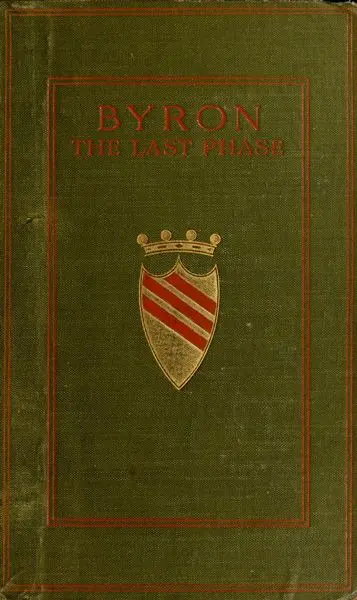
"Byron: The Last Phase" by Richard Edgcumbe is a historical account written in the early 20th century. The work delves into the latter years of the life of Lord Byron, revealing how his experiences and personal transformations, especially during his time in Italy and Greece, diverged from the notorious public persona he had acquired earlier in his life. The narrative particularly focuses on unexplored elements of Byron's character and relationships, particularly involving his friends and lovers. The opening of this biography sets the scene in Pisa around 1821, where Byron has recently arrived with an entourage that includes not just servants but also various pets. Edgcumbe introduces the reader to a contrasting view of Byron—he is described as being visibly changed from the man he once was, showing a disposition more sociable and compassionate. The text meticulously details Byron's physical appearance through the eyes of those who met him, while also hinting at the tumultuous nature of his personal life, including references to his estranged relationships and the lingering impact of his separation from his wife. The introduction builds intrigue around Byron's psychological state and contributions to the Greek War of Independence, setting the stage for a detailed exploration of his character during this pivotal period.
Introduction adapted from the source catalogue; source summaries may be automatically generated.
Free to read · English · 129,526 words · No account needed
MAKE TIME FOR A GOOD BOOK
On by default. Untick to stop anonymous reading totals. Each page counts after 10 seconds in view. How this works.
Anonymous counting is on unless you have switched it off.
Trelawny, Edward John:
arrives at Pisa, 4;
describes Byron and his peculiarities, 5, 17, 18;
on Leigh Hunt and Byron, 28;
effect of Shelley's death, 32;
lays up The Bolivar, 32;
travels with Byron to Greece, 47, 48;
and Byron's seizure, 62;
mistaken views of Byron's motives, 64, 65;
unhealthiness of Missolonghi, 87;
his opinion of Byron, 178 et seq.;
and Mavrocordato, 179;
on Byron's deformity, 191, 192
Tricoupi, Spiridion, pronounces funeral oration over Byron, 185
Vaga, Dr. Lucca, Greek physician, attends Byron in his last illness,
169, 408
Vathi, Byron at, 58
Villiers, Hon. Mrs., and Mrs. Leigh, 357, 362, 367; Lady Byron confides the secret to, 381, 394
Vivian, Charles, his death, 30
Volpiotti, Constantine, spy under Byron's roof, 162
Watson's Philip II., 102
Webster, Lady Frances Wedderburn, and Byron, 240, 241, 259
Wentworth, Lord, Byron inherits his property, 10
West, William Edward, American painter, his portrait of Byron, 9
Wildman, Colonel Thomas, 44
Wildman, Mrs., owner of Byron's boot-trees and the bootmaker's statement as to Byron's deformity, 7, 8
Williams, Edward, and Leigh Hunt, 29;
on Byron's treatment of Mrs. Hunt, 29;
his death, 30
Wilmot, Robert John, signs Lady Byron's statement, 355, 357, 359
Wilson, John, 60
Wilson, General Sir Robert, known as 'Jaffa Wilson,' 110
Wordsworth, William, 60;
Byron reviews his poems, 101 n.
York, Duke of, and Sir Walter Scott, 53
Young, Charles, actor, Byron's opinion of, 61
Zante, Byron at, 83, 198
[1] Medwin, in his book 'The Angler in Wales,' vol. ii., p. 211, says: 'The right foot, as everyone knows, being twisted inwards, so as to amount to what is generally known as a club-foot.'
[2] Letter to Mr. Gisborne, January 12, 1822. Professor Dowden's 'Life of Shelley,' vol. ii., p. 447.
[3] 'Lord Byron.'
[4] 'Letters and Journals of Lord Byron,' edited by Rowland Prothero, vol.
vi., appendix iii.
[5] 'Life of Shelley,' vol. ii., p. 494.
[6] Henry Dunn kept a British shop at Leghorn.
[7] For Byron's opinion of Shelley's poetry, see appendix to 'The Two Foscari': 'I highly admire the poetry of "Queen Mab" and Shelley's other publications.'
[8] 'The Angler in Wales,' by Thomas Medwin, vol. ii., pp. 144-146.
[9] Lady Noel left by her will to the trustees a portrait of Byron, with directions that it was not to be shown to his daughter Ada till she attained the age of twenty-one; but that if her mother were still living, it was not to be so delivered without Lady Byron's consent.
[10] It was at this time that Byron endeavoured to suppress the fact that he had written 'The Age of Bronze.'
[11] Dr. Bruno.
[12] Byron's sobriquet for Walter Scott.
[13] 'Letters and Journals of Lord Byron,' edited by Rowland Prothero,
vol. vi., p. 259.
[14] 'Memoir of Rev. F. Hodgson,' vol. ii., p. 150.
[15] 'Diary,' vol. iii., pp. 435, 436.
[16] Parry, p. 170.
Your reading position is saved on this browser. Take it to another device with a library code. Reading pages adapt to text, rather than matching a printed edition.
BEHIND THE BOOK
This eBook is for the use of anyone anywhere in the United States and most other parts of the world at no cost and with almost no restrictions whatsoever. You may copy it, give it away or re-use it under the terms of the Project Gutenberg License included with this eBook or online at www.gutenberg.org. If you are not located in the United States, you will have to check the laws of the country where you are located before using this eBook. Read the source licence.
The original source file, including credits and licence, is retained by this library. Request an original-format copy at no charge. Please include the book title and Project Gutenberg identifier #41809.
KEEP YOUR CURIOSITY GOING
Cécile Tormay

Moritz Busch
John L. Ransom
Frances Wright
Cécile Tormay

Mabel Potter Daggett